By Calistack Team · Editorial standards: Calistack editorial team
You can do incline push-ups but not a floor push-up: what to check
If incline push-ups feel manageable but floor reps stop early, check hand height, range, body position and fatigue before adding more reps. Try a slightly lower, stable incline while keeping the rest of the setup similar. Compare what changes across sessions instead of treating one rep count as proof you are ready for the floor.
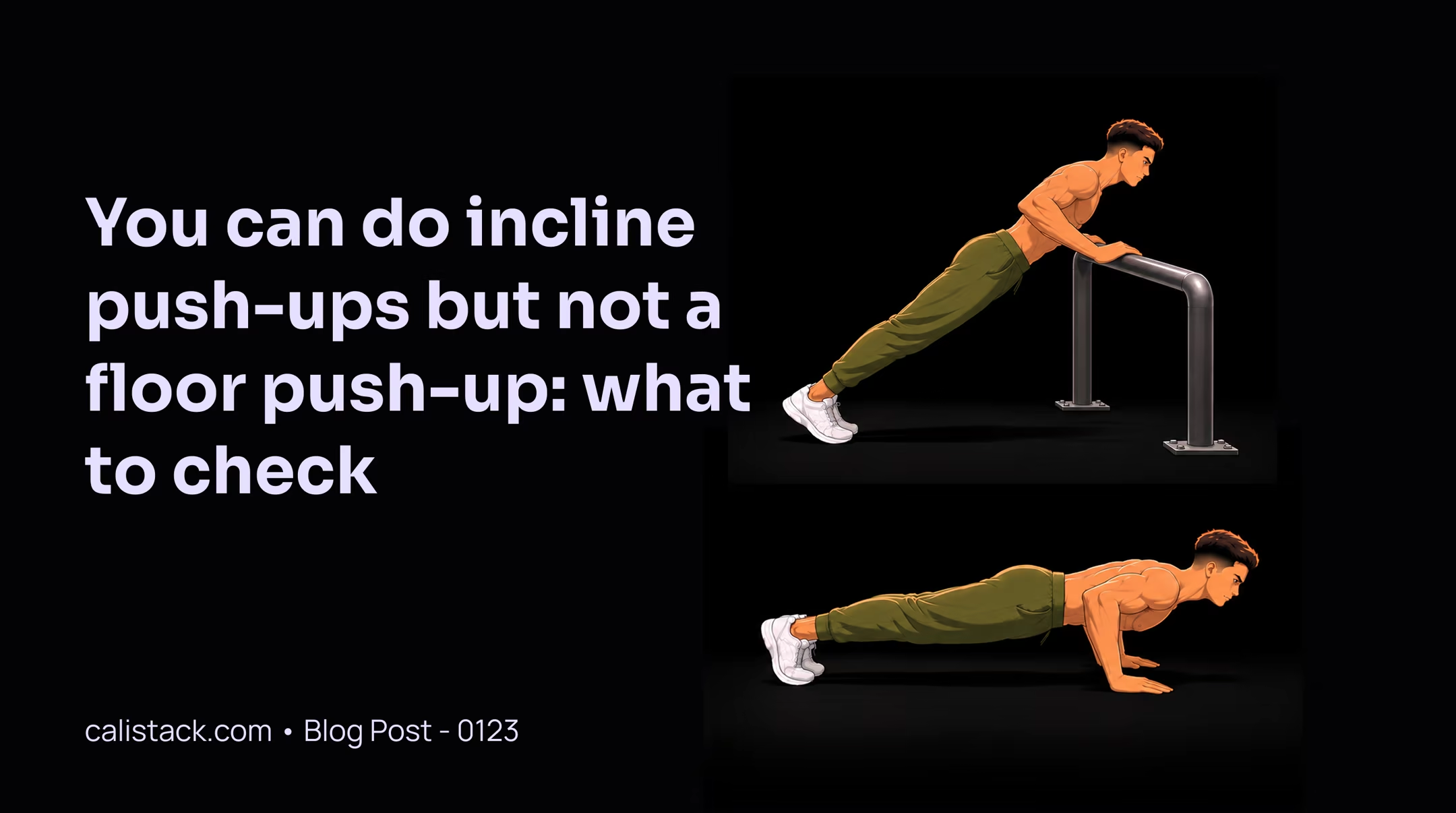
Being able to do incline push-ups but not a floor push-up does not mean your practice has failed. The hand height changes the task, and a floor repetition asks you to press through a different position and range. Before you lower the support, check that you are comparing the same incline setup, same range, and same standard for a counted rep. Then identify whether the floor attempt is limited by the press, the bottom position, body control, or fatigue.
Check that your incline repetitions are consistent
An incline push-up is only a useful comparison when the support and movement stay reasonably consistent. Use a fixed rail, built-in counter, or other surface that cannot slide or tip under your bodyweight. Record its height or mark the exact level if it is adjustable. Keep your feet in the same place and use a similar hand position. A chair, light table, or rolling stool can move unexpectedly and should not be treated as a training support.
Choose a range you can repeat without bouncing or reaching your chin toward the support. Lower your chest toward the same point, then press away while your torso and hips move together. The surface height, foot position, hand width, and bottom range all affect what your rep count means. If you have changed several at once, establish a new baseline instead of trying to interpret the difference as progress or regression.
| What happens on the floor | What to check | A practical next choice |
|---|---|---|
| You cannot lower without losing position. | Whether the range is much deeper than your incline range. | Return to the incline or use a shorter comfortable floor range with coaching guidance. |
| You reach the bottom but cannot press away. | Whether the floor position is beyond your current pressing capacity. | Use a higher fixed incline and practice the full press through a controlled range. |
| Your hips sag or rise before the arms finish. | Whether the trunk position changes before the sticking point. | End the rep, raise the hands, or reduce the range until the body moves as a unit. |
| Your first rep works but later reps do not. | How much fatigue and rest changed between attempts. | Stop testing repeated failures; rest and use the controlled practice version. |
| Your wrists or shoulders feel painful. | Whether the position is comfortable at all. | Stop that version and seek appropriate individual advice rather than pushing through it. |
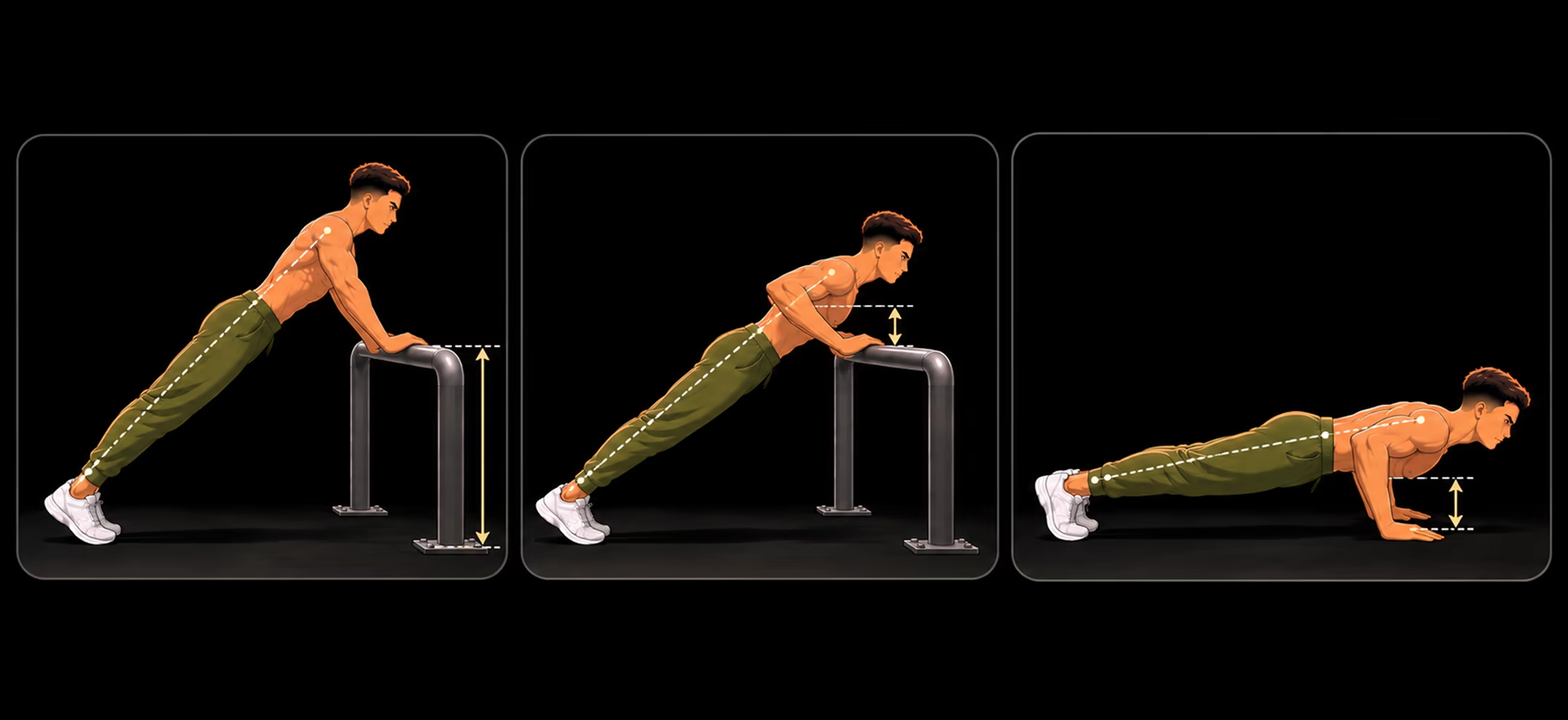
Separate pressing difficulty from body position
A floor repetition can stop for different reasons. You may not be able to press away from the bottom. You may be shortening the descent because the lower position feels unfamiliar. Or the arms may still be working while the trunk changes first. These observations help you choose a next version, but they do not diagnose a specific muscle problem. If you are unsure what you are seeing, a qualified trainer can review the movement in person.
Try one fresh floor repetition only if you can get into and out of the start position safely. Do not repeat maximum attempts until you are exhausted. Notice the first change: did the chest stop moving while the hips rose, did the elbows stop bending, did the range become shorter, or did you lose the body line? Return to the incline after the observation. The attempt is information, not a workout quota.
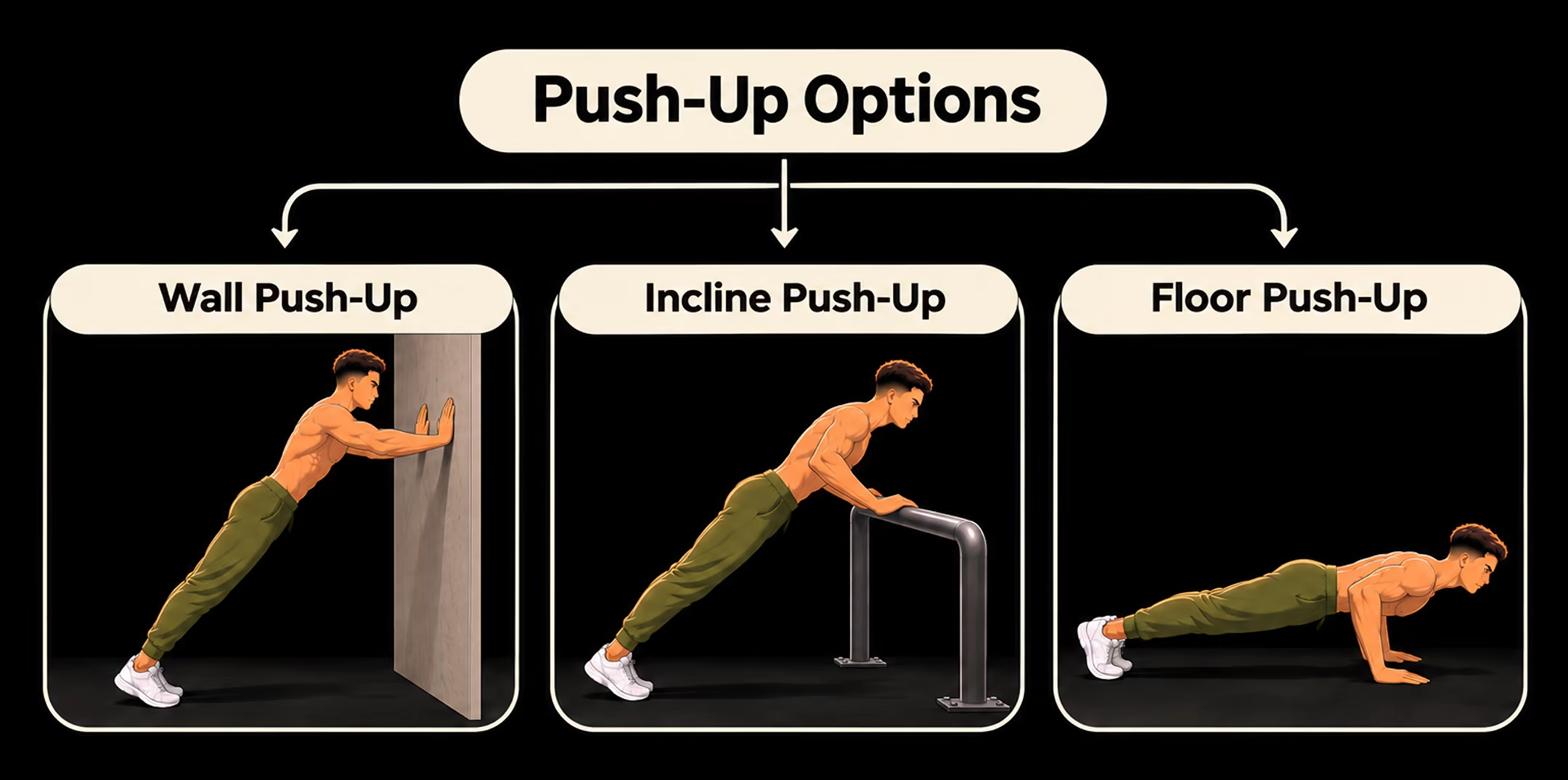
If you can control an incline but the floor feels too demanding, raising the hands is a clear way to change the leverage. A Wall Push-Up is another option in the exercise library. Move closer to the wall or choose a higher fixed surface to make the press easier. If the current incline still causes the same breakdown, raise the support further rather than forcing more repetitions at that level.
Use the related push-up movements carefully
The exercise list links Wall Push-Up to no additional movement; Incline Push-Up to Wall Push-Up; Assisted Push-Up to Wall Push-Up and Incline Push-Up; Push-Up to Wall Push-Up, Incline Push-Up, and Assisted Push-Up; and Push-Up Hold to Incline Push-Up, Assisted Push-Up, and Push-Up. These are related entries, not an assigned exercise order. You do not have to use every version, and no repetition target unlocks the next.
Wall and incline push-ups have identifiable setups. The name Assisted Push-Up alone does not identify the aid, so check the current CaliStack demonstration before choosing it. Do not assume it means a knee push-up, a band, or partner assistance. Until the method is clear and safe to set up, use the wall or fixed-incline version.
Push-Up Hold also needs a precise demonstration before you describe it as a particular drill. A hold could be specified by position and duration, but the exercise name alone does not tell us where to pause, how much range to use, or how the app defines a completed hold. If the clip clearly shows a static position, record that exact position and duration; do not invent a bottom hold or treat it as equivalent to a repetition.
Make a small, measurable adjustment
- Record the current incline height, foot position, hand placement, range, sets, reps, and rest.
- Choose one point to observe during a fresh floor attempt, then stop instead of repeating failed reps.
- Return to the incline version you can control and keep the range and setup consistent.
- After comparable sessions, consider one small adjustment, such as a slightly lower stable support or a modestly different range.
- If control changes sharply or discomfort appears, restore the easier option and ask for qualified guidance when needed.
One coaching example is to repeat the same incline across a couple of comparable sessions before making a small change. You might lower the hands a little while keeping the foot position and range similar. This is a way to organize practice, not a research-validated readiness test. There is no universal number of incline push-ups that certifies you can do a floor repetition.
If a lower support makes you shorten the range, twist, or lose control, return to the previous height. You can stay there and practice cleaner repetitions or ask a trainer to identify a smaller change. Adding more sets is not always the right adjustment, especially if your reps already become rushed or your next session starts before you feel recovered.
A short troubleshooting example
Imagine your incline record says: fixed rail at its middle setting, feet on the same floor mark, chest reaches the same point, two sets of six, last repetition controlled. On a fresh floor attempt, you lower partway, then your hips start to sag before you can press back up. The useful next choice is not to repeat that failed attempt. Return to the rail and keep practicing the full range there, or use a higher setting if the rail version also loses control. This is a fictional troubleshooting example, not a report from a trainee.
If instead your floor repetition reaches the same bottom point but you cannot press away, record that as the point where the movement stopped. Keep the incline as your main practice and avoid bouncing out of the bottom. If the first repetition is controlled and later ones deteriorate, rest longer or finish the set earlier. Each case gives you a different observation, but none creates a fixed deadline for getting the floor version.
Incline-to-floor push-up FAQs
Why can I do incline push-ups but not floor push-ups?
The hand height changes the leverage and the amount of pressing demand. The floor version may also ask for a range or body position you have not practiced yet. Check the setup and where the movement changes before choosing what to adjust.
How many incline reps should I reach before trying the floor?
There is no universal repetition count that proves readiness. Compare the same incline and range across sessions, and test a floor rep only when you can do so safely and while fresh.
Is the app's Assisted Push-Up a knee push-up?
The name alone does not specify the assistance method. Check the current app demonstration rather than assuming a particular version. Wall and fixed-incline push-ups are clearly described alternatives.
What does Push-Up Hold mean in the app?
Its exact start position and hold standard need to be checked against the current demonstration. If you use it, follow the demonstrated position and record the hold time; do not infer the definition from the name alone.
Should I keep trying floor push-ups during every workout?
No. One fresh observation can help you identify what changes. Return to a controlled practice version instead of repeating failed attempts while tired.
Use the record to choose your next step
At the next session, repeat the incline setup you can control and write down the support height, range, and movement quality. If you try the floor, do it fresh and stop when the position changes. Use a Wall Push-Up or a higher incline when you need a clearly defined easier option. Confirm any ambiguous demonstration before treating it as a specific technique. Find the push-up movement that matches your current ability in CaliStack.
Sources and evidence limits
Source check: . Research context is separate from an individual technique assessment. Sample programs are editorial examples, not validated unlock tests.
Ebben and colleagues measured lower peak vertical force with elevated hands than with standard floor push-ups in the tested setups. [5]
Force measurements do not establish a universal incline height or repetition threshold for a first floor push-up.
- [5] Ebben WP and colleagues. Kinetic analysis of several variations of push-ups (2011-10-01).
Abstract retrieved through Europe PMC; not a full-text assessment.
Want a clear plan for your next skill?
We built Calistack to show you the exact steps from where you are right now to your first handstand, muscle-up, or lever.