By Calistack Team · Editorial standards: Calistack editorial team
What to record in a calisthenics training log
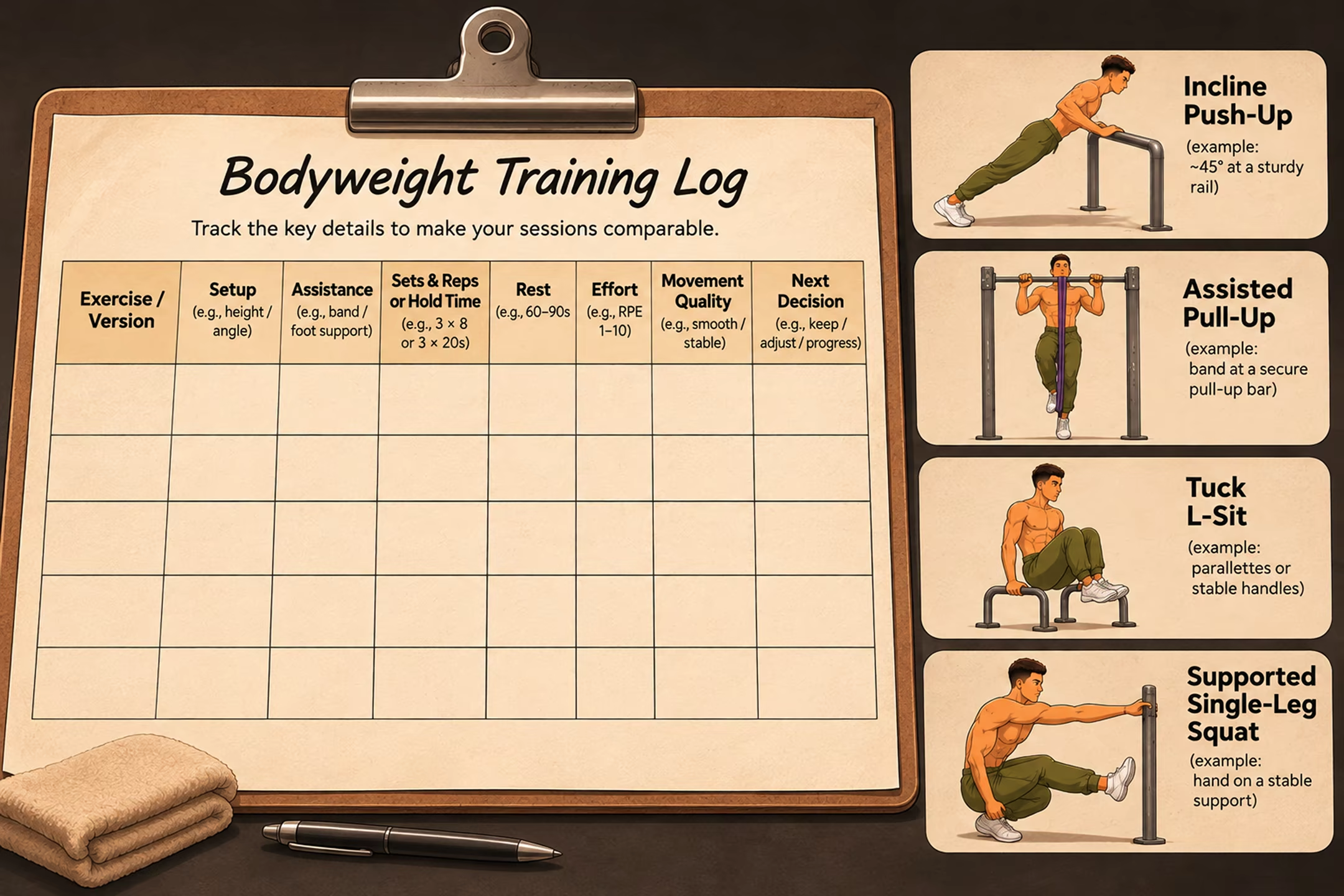
A useful calisthenics log records what you did and what made it harder or easier. Note the exercise version, support height or assistance, reps or hold time, rest and one detail about movement quality. Keep those details consistent when you compare sessions so a change in setup does not look like a change in strength.
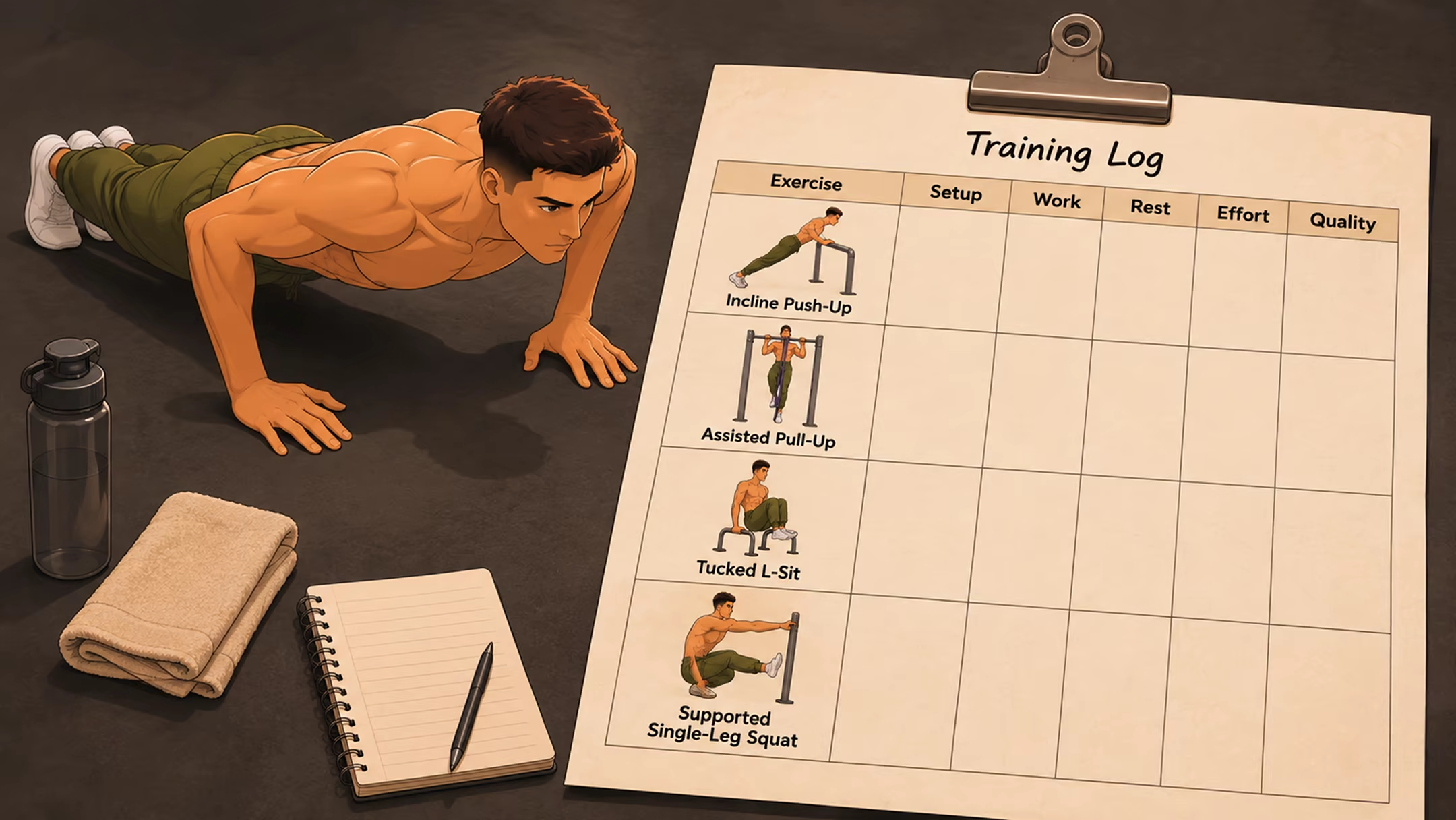
A useful calisthenics log records enough detail to tell what you actually practiced. A rep count alone may hide a lower incline, a different band, a shorter hold, or a changed range. Record the exercise and version, the setup that affects difficulty, the work completed, and one note about control or effort. Then compare sessions only when the important details are similar.
Record what changes the task
Start with the exercise name, then record its version. “Push-up” is not enough if one session uses a wall, another uses a fixed incline, and a third uses the floor. For bodyweight movements, setup and body position often stand in for the external load you might write down in a weight-training log. Note anything that changes the leverage, amount of help, or range.
| Field | What to write down | Example of useful detail |
|---|---|---|
| Exercise and version | The named movement plus the specific variation. | Incline Push-Up; assisted pull-up; tuck L-sit hold. |
| Setup | Surface, height, body angle, grip, side, or support. | Fixed rail at recorded height; bar grip; left or right leg. |
| Assistance | Aid, setting, contact point, and amount of help you can describe. | Band model and anchor; machine setting; foot on a stable step. |
| Work | Sets and repetitions, hold time, or a defined range. | Two sets of six controlled reps; two short holds. |
| Rest and effort | Approximate rest and a plain-language effort note. | About two minutes; challenging but controlled. |
| Quality and comfort | Range, control, and any discomfort in neutral terms. | Same bottom point; no swing; stopped when control changed. |
| Next decision | Repeat, reduce, or change one variable. | Repeat same height; do not change the band yet. |
You do not need laboratory precision. Choose a repeatable description. For an incline push-up, a marked rail level or measured support height is more informative than “counter.” For a row, note bar height and body angle. For a hold, write the position and the time you actually maintained it. For one-sided work, log each side separately if performance differs.
Rest can be approximate. A note such as “about ninety seconds” is usually more useful than leaving out a big change in rest between sessions. Effort can be a plain phrase: easy, challenging but controlled, or stopped because position changed. If you already use repetitions in reserve, record that estimate only if you understand the scale; no one needs a technical rating system to begin keeping a useful log.
- Name the exercise and version before you begin.
- Record the support, setup, assistance, grip, or range that changes the task.
- Write down the completed repetitions or hold time and approximate rest.
- Add one neutral note about movement quality or comfort, then choose whether to repeat or adjust one variable next time.
Work through four calisthenics examples
Incline Push-Up and Wall Push-Up
For an Incline Push-Up, record the fixed support and its height or level, where your feet stood, the range you used, sets and repetitions, and whether the body stayed controlled. If you change the support height, that is a new version to compare on its own. Wall Push-Up is listed as a related movement. Log your distance from the wall and the range you used rather than writing only “easier push-up.”
Assisted Pull-Up and related pulling options
For an Assisted Pull-Up, record how the assistance works: band identity and setup, machine setting, foot support, or another confirmed method. Note grip, range, reps, and whether the aid stayed consistent. If you switch to an Inverted Row, record the secure bar or handle setup, height, and body angle. A Dead Hang and Active Hang are different hold or position choices; note which one you used and the grip. A Negative Pull-Up emphasizes the lowering phase, so record how you reached the top and whether the descent stayed controlled. These are related options, not steps you must complete in one session.
L-sit and its related exercises
For an L-sit, record the version and support: a Tuck L-Sit Hold keeps the knees bent; One Leg L-Sit extends one leg while the other stays tucked; Seated L-Sit Leg Raise is a seated leg-lifting drill rather than automatically a full L-sit; Hanging Knee Raise uses a secure overhead bar and is a different task. Note the position, whether you used hands or feet for support, hold time or repetitions, and the side if the variation is one-sided. Do not compare a seated leg lift with a supported hold as if they were the same exercise.
Assisted Pistol Squat and related leg work
For an Assisted Pistol Squat, record the aid and how you used it, the working leg, the comfortable depth, and whether you returned to standing under control. Squat Hold (Bottom Position) records a held squat position, not a full pistol repetition. A Cossack Squat shifts the body side to side through a wide stance; Wall Sit and Wall Sit (Single-Leg) are static wall-supported options with different leg demands. These names describe related practice choices, not a requirement to perform every one.
| Main movement | Exact related movements | What the log should distinguish |
|---|---|---|
| Incline Push-Up | Wall Push-Up | Support height, foot mark, range, and controlled repetitions. |
| Assisted Pull-Up | Inverted Row; Dead Hang; Active Hang; Negative Pull-Up | Horizontal row versus hang versus assisted full movement versus lowering phase. |
| L-sit | Tuck L-Sit Hold; Seated L-Sit Leg Raise; One Leg L-Sit; Hanging Knee Raise | Support, leg position, side, hold or rep count, and floor versus bar setup. |
| Assisted Pistol Squat | Squat Hold (Bottom Position); Cossack Squat; Wall Sit (Single-Leg); Wall Sit | Assistance, working leg, squat depth, hold versus repetition, and balance support. |
These related-movement links are not a prescription to combine every exercise in one workout or a required progression. If a movement is unfamiliar, check its current demonstration and ask a qualified trainer to review its position. The log should describe what you performed, not what you think a recommendation implies.
A blank-to-completed record example
Begin with a short template. Incline Push-Up: support and measured height; foot mark; range; sets and reps; rest; effort; movement note. Assisted Pull-Up: assistance method; aid identity or setting; grip; range; sets and reps; rest; effort; movement note. Fill in what you can observe. If you do not know how much help a band provides, do not invent a force value; record the band and setup instead.
| Movement | Completed-format example | What the fields clarify |
|---|---|---|
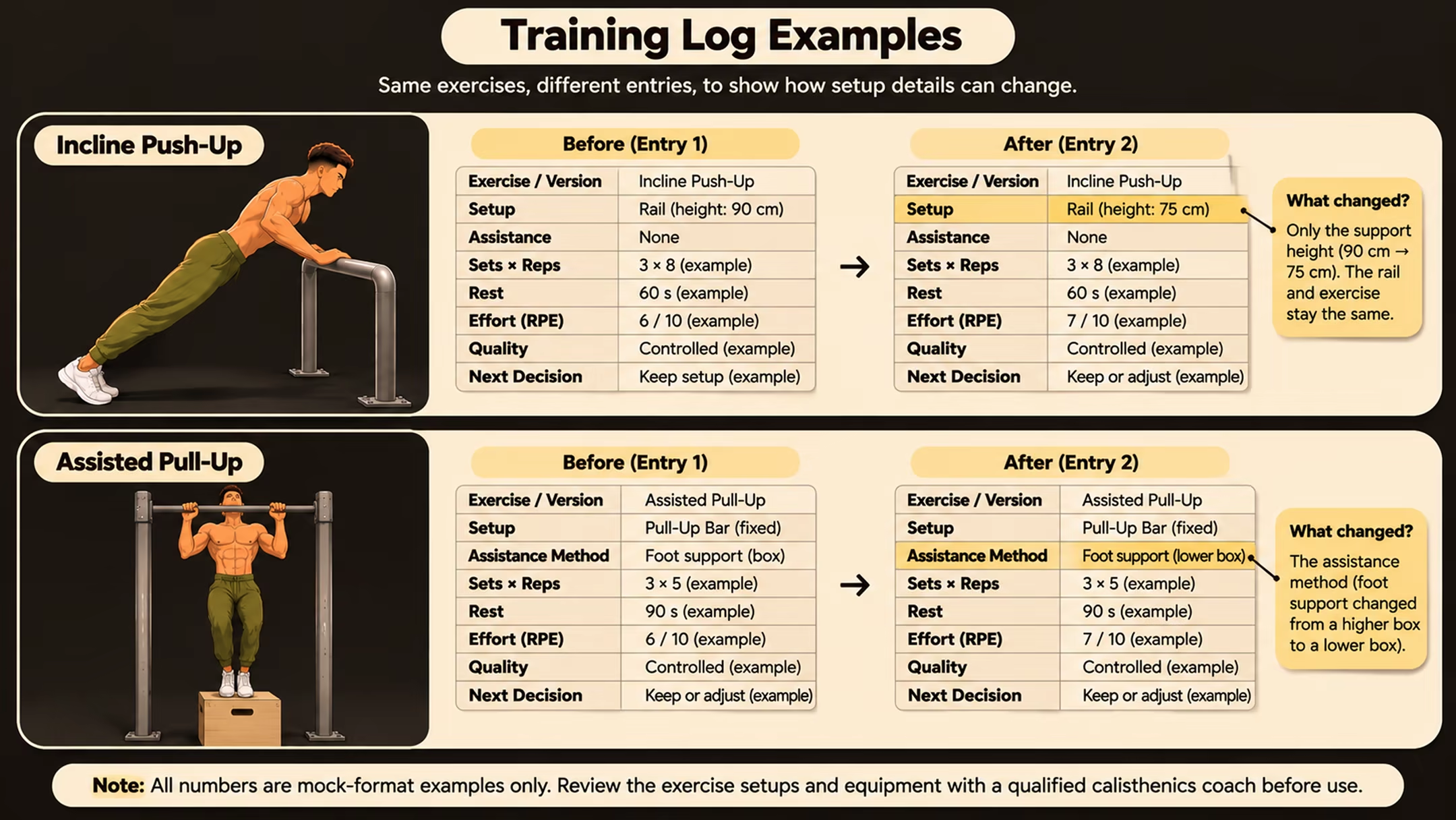
| Incline Push-Up | Fixed rail; recorded height 84 cm; feet on tape mark A; 2 sets of 6; same chest target; about 90 seconds rest; last rep slower but controlled. | The hand support and foot position let a later session reproduce the same incline. |
| Assisted Pull-Up | Foot-assisted on secure low bar; same step and foot contact; overhand grip; 2 sets of 4; descent stayed controlled; help described as moderate. | The note identifies the aid and contact instead of pretending that assistance is an exact load. |
| Next-session decision | Repeat both setups before changing rail height or foot assistance. | Only one variable should change when you want to compare the result. |
The measurements and repetitions in that table are invented solely to demonstrate a format. They are not observed user results, recommended targets, or a Calistack prescription. Use the actual height and assistance method you choose, and label an unfamiliar band or machine by its own setting. A different band color or rail height creates a different record, not a like-for-like comparison.
Use the log to choose what happens next
Look at a few comparable entries rather than treating one session as a verdict. If the same setup produces smoother repetitions or a more consistent hold, record that change even if the rep total stays the same. If the setup changed, label it clearly. A slight drop in repetitions after reducing assistance can simply mean the task got harder. If movement quality worsens, return to the previous setup or seek coaching rather than chasing the old number.
One practical decision rule is to repeat a controlled version over multiple comparable sessions before making one small change. That is a practical planning example, not a scientifically validated readiness count. Choose the next change based on your goal and recovery: a slightly lower incline, a small reduction in assistance, a different L-sit lever, or no change at all. You do not need to progress every exercise during every review.
A brief note about comfort can help you remember why you stopped a set or chose an easier variation. Keep it descriptive: “wrist felt uncomfortable, stopped,” rather than diagnosing a condition. If a movement causes pain, stop that movement. A log can preserve what happened; it cannot tell you why it happened or whether an exercise is medically appropriate.
Check what your digital log can store
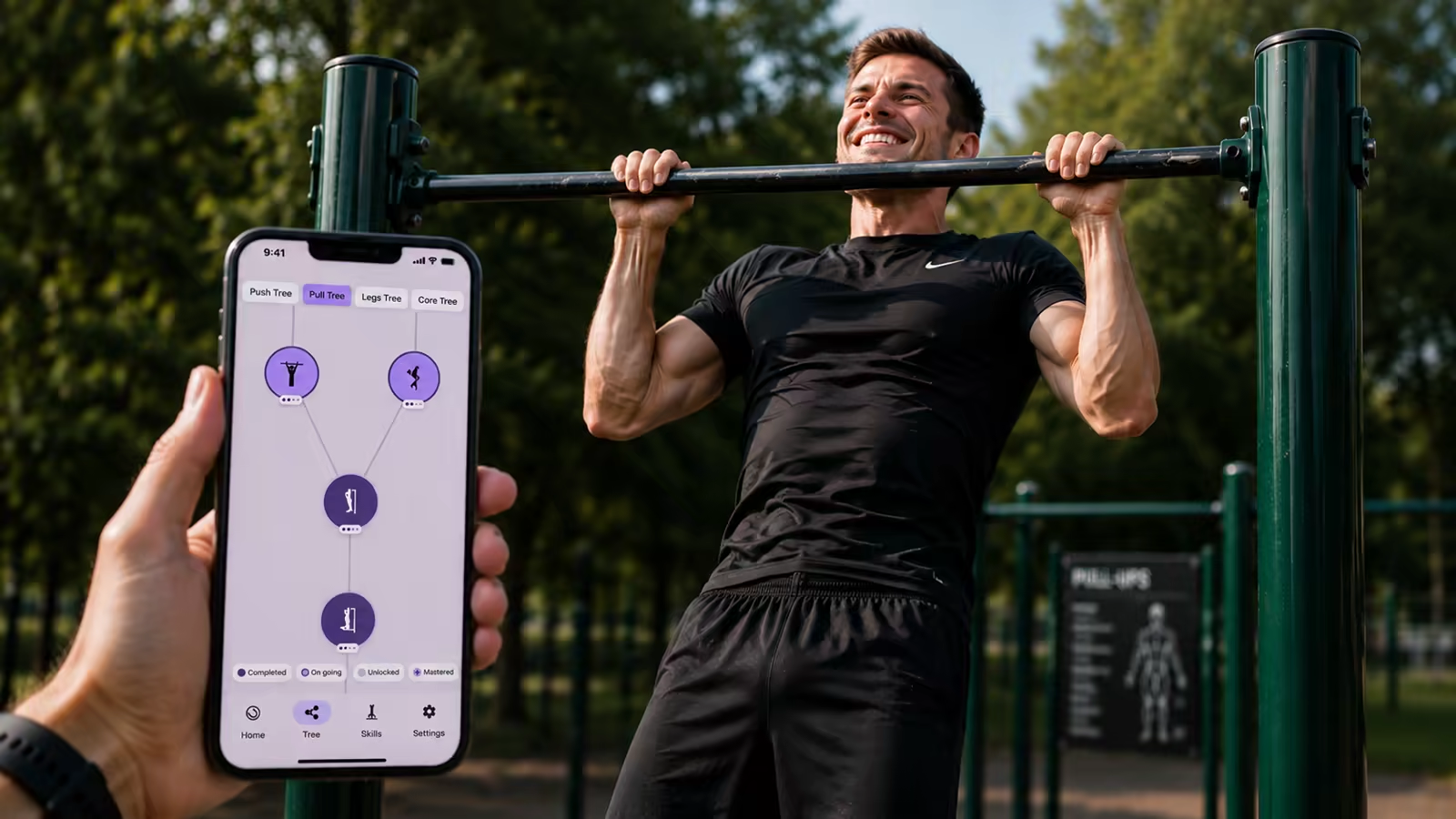
CaliStack’s public site advertises set-and-hold logging, but your current app screen may not include separate fields for incline height, assistance method, rest, effort, or movement quality. Check which details your version stores before relying on it for those records. If fields are missing, keep them in a notebook or phone note alongside any set or hold entry.
A digital log only helps if it preserves the detail you need. You can keep one short note per movement instead of documenting every sensation. If tracking begins to take longer than the session itself, simplify it to the version, setup, work completed, and one quality observation. Review that record when you choose your next practice, then get back to training.
Calisthenics logging FAQs
Do I need to record every repetition?
No. Record the variation, setup, completed sets or holds, and a short note about control. Add detail only when it helps you compare sessions or explain a change.
Should I log effort and rest?
A brief effort description and approximate rest can make two sessions easier to compare, especially if either changed. You do not need a technical rating scale if a plain note works for you.
How do I compare band-assisted pull-ups?
Use the same band and setup when possible. Record the band's identity, anchor, body contact, grip, range, and reps. Band colors are not a universal measure across brands.
Does CaliStack record every field in this guide?
Its public website advertises logging sets and holds, but that does not verify every field. Check the current app screen and use a separate note for setup, assistance, rest, effort, or quality details it does not capture.
Should I do all of the recommended exercises?
No. These links identify related movement options, not a mandatory workout list. Choose only the movements that suit your goal and equipment.
Write down one useful next decision
For your next session, record one exercise version, the setup that changes its difficulty, the reps or hold you completed, and one note about movement quality. Repeat that setup before you make a small change. Keep any unverified fields in a separate note until you confirm the current app supports them. Use CaliStack's advertised set-and-hold logging if it fits your workflow.
Want a clear plan for your next skill?
We built Calistack to show you the exact steps from where you are right now to your first handstand, muscle-up, or lever.