By Calistack Team · Editorial standards: Calistack editorial team
Tuck Planche: technique, recommended exercises and practice options
The tuck planche is an advanced straight-arm balance with the knees drawn in and the feet off the floor. Related pressing drills and supported balances can help you practise parts of the skill, but they are not a required sequence. Ask a qualified coach to assess your setup and choose a manageable starting point.
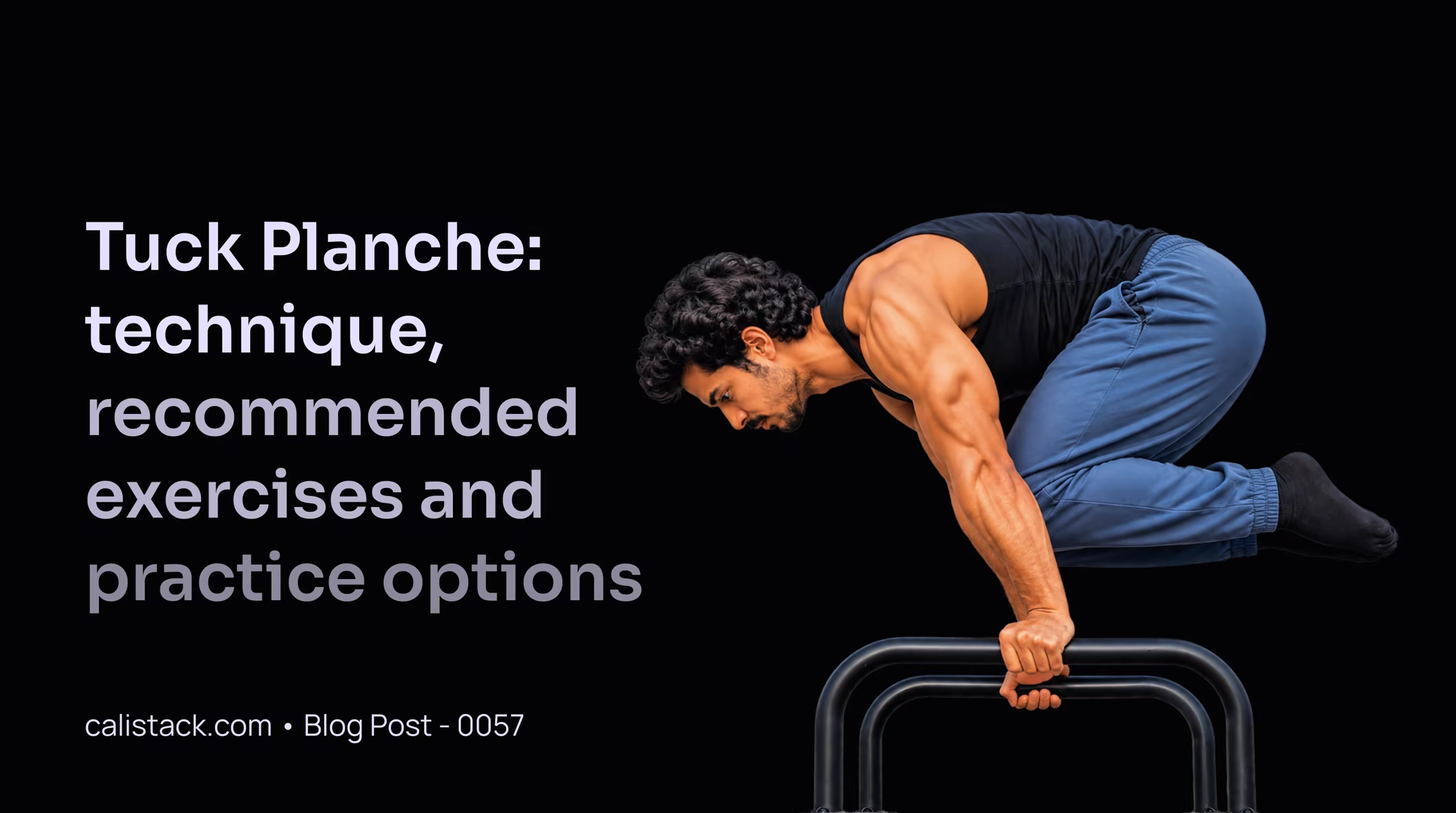
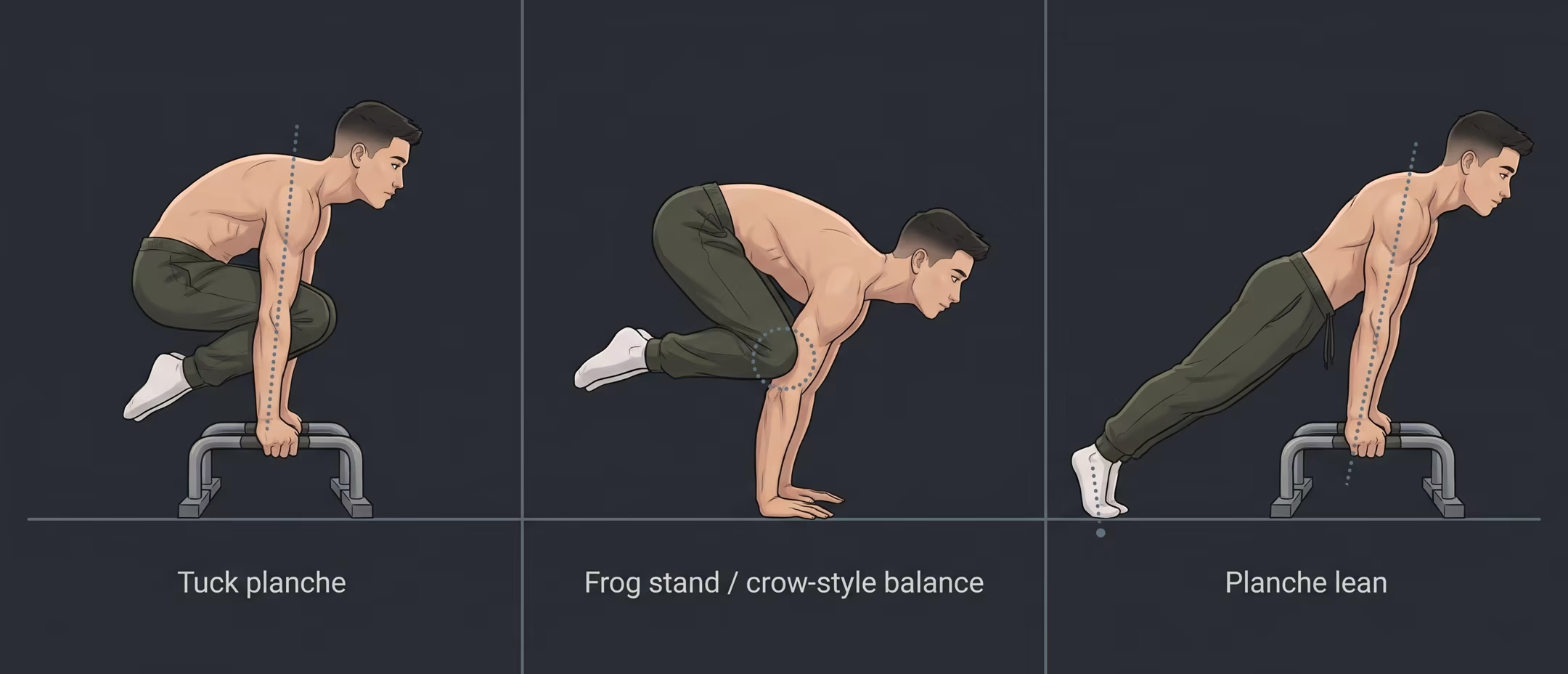
The tuck planche is an advanced bodyweight support skill. In a common coaching definition, the athlete supports the body through the hands with the elbows straight, feet lifted, knees tucked, and no knee support on the arms. It is not the same as a frog stand, crow pose or a push-up. Those movements can look related, but their arm positions and balance demands differ. The CaliStack demonstration may use a different shape or apparatus, so treat this as a working description rather than assuming every app version uses the same position. Have a qualified planche coach confirm the variation before anyone attempts it.
What the tuck changes, and what it does not
The tuck brings the legs closer to the trunk and shortens the body lever compared with a straight-body planche. That can reduce the leverage challenge, but the athlete still has to support the body through the arms in a demanding position. A tucked shape is not a casual balance and should not be treated as safe just because the knees are bent. Available coaching demonstrations describe a straight-arm planche position, while coaching pages differ in their cues for shoulders, hips, hand position and how to enter. A specialist should choose the exact definition and assess whether it fits the athlete.
Floor and parallettes are not identical. Parallettes can let the wrists sit in a different position, but they introduce their own grip, stability and fall considerations. Do not assume one apparatus is automatically safe or easier for you. A coach should inspect that the handles are solid, level and nonslip, with enough room to exit. No one should be asked to descend from a planche into a headstand, handstand or other advanced shape just because a demonstration includes it. The way into and out of the skill is part of the coaching decision.
Use the recommendation list as options, not a ladder
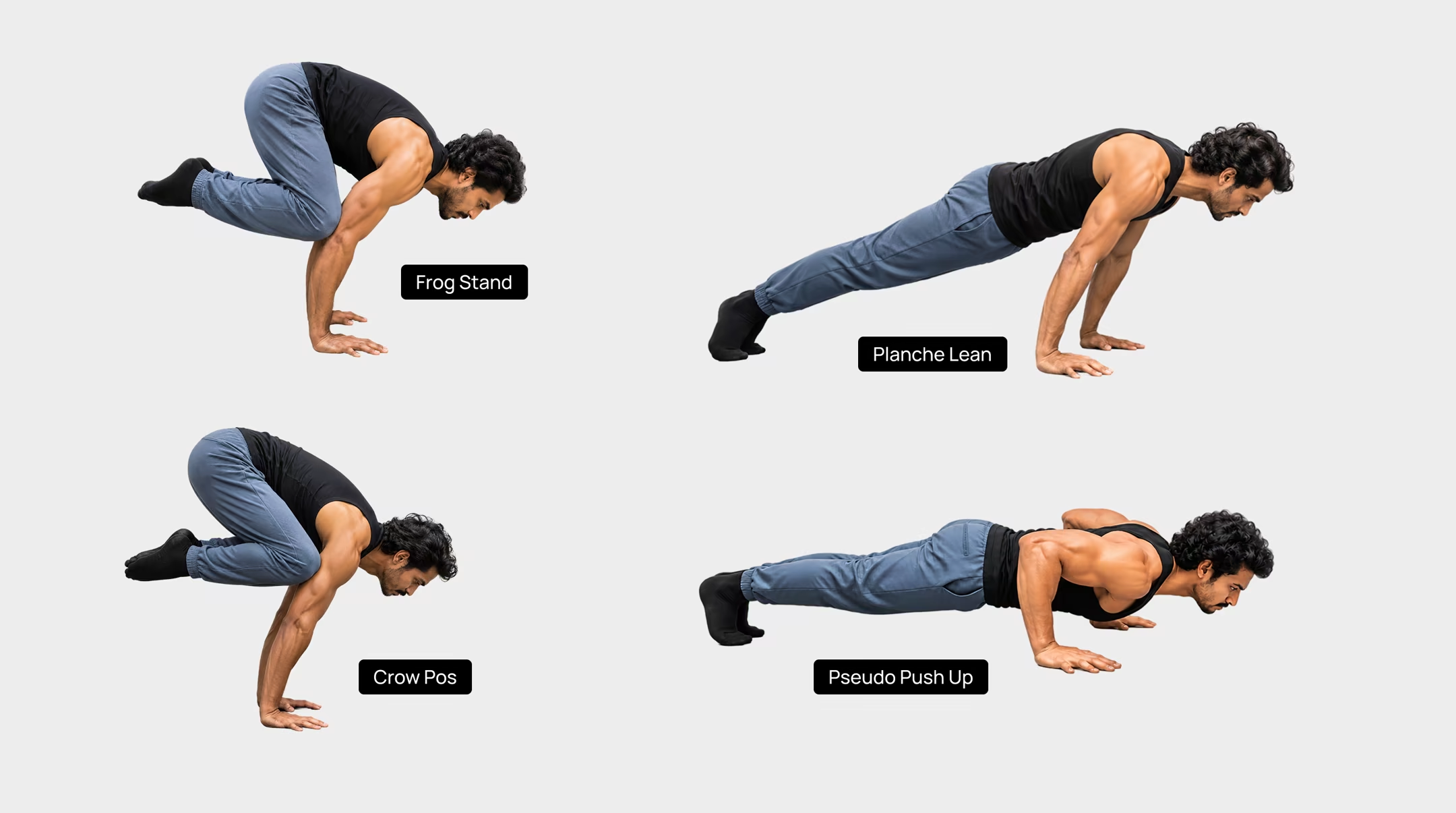
The planche recommendation links connect movements that can share hand support or a forward balance problem, but the labels do not establish a universal order. Frog Stand and Crow Pose are often used for bent-arm balances with the knees supported by the arms, although naming and exact shape can overlap. Neither is the same as a straight-arm tuck planche where the knees do not rest on the arms. Check the app's demonstration before treating either label as a specific version. A bent-arm balance may be relevant to some athletes and inappropriate for others; it is not a required entry method.
Planche Lean usually refers to a feet-down support where the body shifts forward relative to the hands. It can expose the wrists and shoulders to a more demanding angle even though the feet remain on the floor. The app's target range, hand position and hold requirement are unknown here, so do not chase a maximum lean from a screenshot. Pseudo Push-Up is also not a single universal label: in many calisthenics settings it means a bent-arm push-up with the shoulders shifted forward, but the app variation must be checked. It is a dynamic press, not a static straight-arm planche hold.
| Recommended exercise | Common distinction | Review needed before practice |
|---|---|---|
| Frog Stand | Commonly a bent-arm arm balance with the knees resting on the arms; exact hand and knee placement varies. | Confirm the app's shape, entry and exit. Do not call it a straight-arm tuck planche. |
| Crow Pose | A yoga arm balance often taught with bent elbows and knees supported near the upper arms; it may overlap in name with frog stand. | Check the exact demonstration and do not assume the two names mean identical app movements. |
| Planche Lean | A feet-down forward-leaning support, usually distinct from a tuck planche because the feet remain on the floor. | Have a specialist select hand position and lean range; the name does not define a safe individual load. |
| Pseudo Push-Up | A dynamic bent-arm press often performed with the shoulders forward of the hands; formats vary. | Confirm the app's exact hand, elbow and range standard. It is not a static planche hold. |
Choose only a movement that matches a specific reason to practise it. A feet-down lean might be a coach-selected way to discuss the forward support position. A pseudo push-up may fit a dynamic pressing goal. A frog or crow variation may be a separate balance task. None has been shown by the supplied recommendation graph to be a mandatory prerequisite for the Tuck Planche. Do not combine them into one session automatically; the total wrist, elbow and shoulder loading matters, especially when the athlete also trains handstands or pressing elsewhere. A coach should look at the full week rather than judging the skill in isolation.
What research can and cannot tell us
Direct planche research is sparse compared with research on general resistance training. A 2023 paper used a nine-segment biomechanical model to simulate planche performance across modeled body types; it was not a trial of a beginner teaching method. A 2025 electromyography study compared the ring support-scale planche with five preconditioning exercises in seven experienced ring specialists. The exercises produced different muscle-activation patterns from the target skill. These studies can help explain why a related drill is not automatically identical to the planche, but neither establishes a safe floor-based tuck-planche program, a universal hold time or an injury-prevention rule.
The model paper also makes claims about anthropometry that should not be turned into a ranking of individuals or populations. It is a simulation, not a measured training outcome for every athlete. The small 2025 sample involved highly experienced ring specialists and a ring support scale; it does not map directly onto a recreational athlete doing a floor tuck planche. For this reason, exact progression stages, effort limits and weekly frequency in online coaching pages should be treated as choices for an individual coach to assess for the person and apparatus. The evidence does not support a fixed deadline or a guarantee that a given drill will produce a tuck planche.
A practice discussion to take to a qualified coach
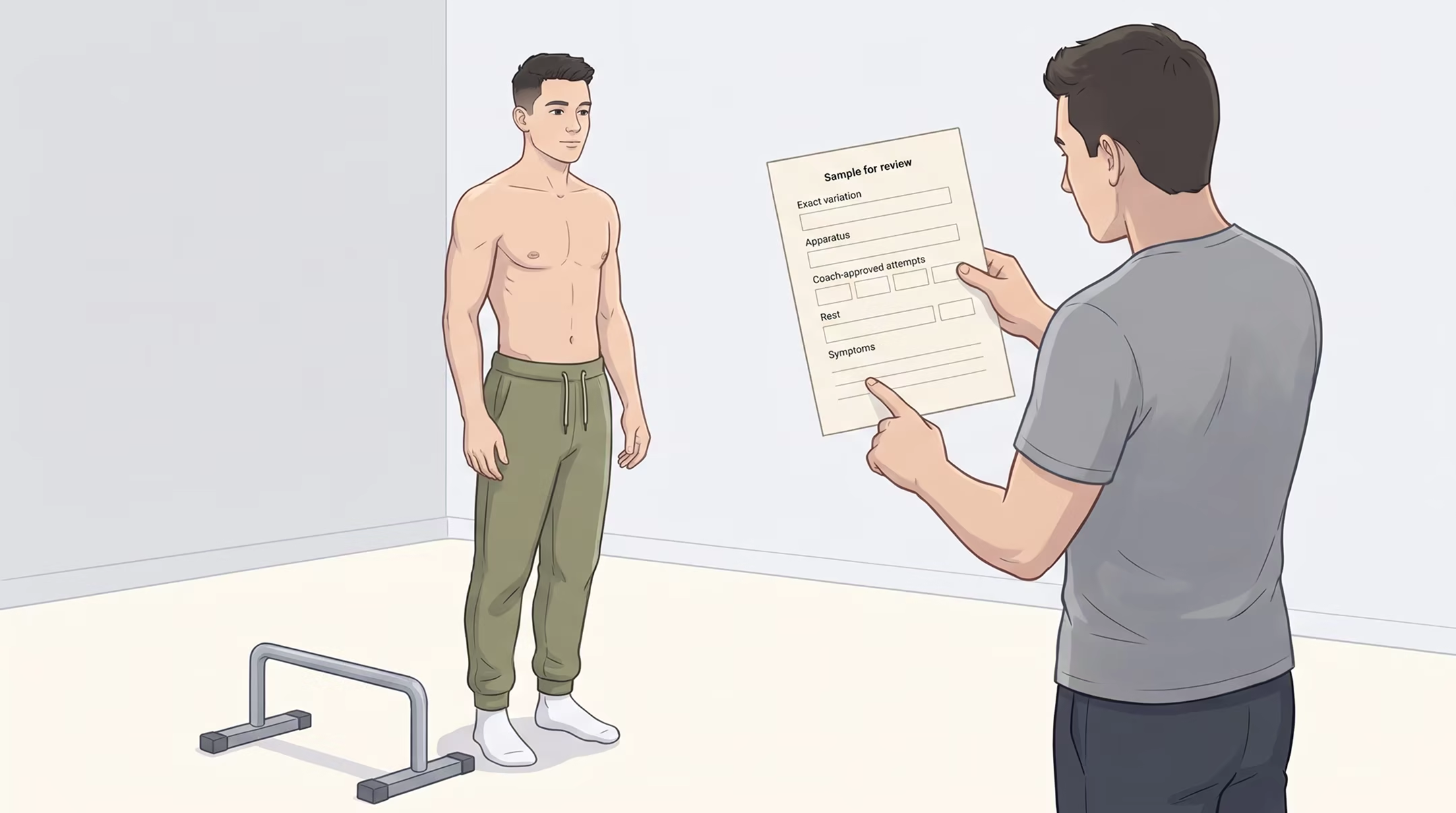
Because this is an advanced straight-arm skill, there is no responsible do-it-yourself plan to copy from a text article. A discussion template for an in-person specialist review is to identify the exact app variation and apparatus, select one appropriate preparation or support task, choose a small amount of work that leaves several clean efforts in reserve, rest fully, and end the set before the shape changes. If the coach approves a very brief hold, they might consider a few low-effort attempts of only a few seconds; that is an illustrative example for the coach to adapt, not a recommendation to attempt the tuck planche without review.
The coach should also account for other training that loads the wrists and shoulders. Handstands, push-ups, dips, leans and planche variations can overlap in the same joints even when they look like separate goals. A rest day on a calendar does not automatically mean the tissues are ready for another high-load skill session. Keep a record of apparatus, exact drill, range, clean attempts, rest and any symptoms. If the coach does not know your other training, tell them before adding a planche-specific block. The goal is a sustainable decision, not the highest total of holds in one workout.
- Show the specialist the exact CaliStack video and ask them to define the movement standard.
- Confirm the surface, floor or parallettes, space, entry and exit before loading the hands.
- Choose one coach-approved practice option rather than performing every recommended movement.
- Stop each attempt when the agreed position changes, not after a forced extra second.
- Record symptoms and total wrist/shoulder work from the rest of the training week.
Common errors are reasons to scale back
If your elbows bend during a supposed tuck planche, do not strain to straighten them under load; end the attempt and ask the specialist to reassess the version. If your knees rest on your arms, you may be doing a frog or crow-style balance rather than the straight-arm skill described here. If your feet remain down, the movement may be a lean, not a tuck planche. Those can all be useful exercises in the right context, but the name matters when you are logging progress. A coach can tell you whether the movement standard has changed.
If the wrists feel uncomfortable, stop rather than trying to stretch further into the position. A coach may choose another exercise or apparatus, but parallettes are not a guaranteed fix and should not be switched in without checking stability. If you lose balance, do not improvise a forward roll, headstand or handstand exit. Return to only the way out you have practised with the coach. If the shoulders cannot maintain the approved position, reduce the demand or leave the skill out of the session. No warm-up makes pain safe.
Frequently asked questions
Frequently Asked Questions
Is a frog stand the same as a tuck planche?
No. Common frog-stand versions use bent arms and knee support on the arms. A common tuck-planche definition uses straight arms and no knee support. Confirm the exact app demonstration because names can vary.
Do I need to master Crow Pose first?
No universal prerequisite is established. Crow Pose is a related arm balance, often with bent elbows and knee support, but it does not prove readiness for straight-arm planche loading.
Are planche leans safe for everyone?
No exercise is automatically appropriate for everyone. A lean can still load the wrists and shoulders. A qualified specialist should choose the range and determine whether it fits your circumstances.
How many seconds should I hold a tuck planche?
No research-validated universal hold time was found for this floor-based variation. Any short-hold example in this guide is for a specialist to review and adapt, not a self-prescription.
Can I train it on the floor or parallettes?
The apparatus changes the hand and support conditions. Use only the setup confirmed by the exact demonstration and a qualified coach; do not assume one is automatically easier or safer.
Confirm the movement before choosing a next step
The next decision is not which number of seconds to chase. Ask a planche specialist to verify the actual Tuck Planche demonstration, apparatus, shape and way out. Then choose one related option only if it has a clear purpose in your wider program. Frog Stand, Crow Pose, Planche Lean and Pseudo Push-Up are different tasks, not a required four-step ladder. If you use CaliStack, view the current demonstrations for the listed movements and ask a planche specialist to clarify any version before practicing.
Sources and evidence limits
Source check: . Research context is separate from an individual technique assessment. Sample programs are editorial examples, not validated unlock tests.
Wang and Shan simulated planche mechanics with a nine-segment model. [11]
This was a simulation, not a trial of beginner floor tuck-planche instruction or safety.
Rosaci and colleagues measured different activation patterns between the ring support scale and preparatory exercises in seven ring specialists. [12]
This acute study did not test the floor tuck planche or establish hold times, learning rates or injury risk.
- [11] Xiuping Wang and Gongbing Shan. Insights from a Nine-Segment Biomechanical Model and Its Simulation for Anthropometrical Influence on Individualized Planche Learning and Training in Gymnastics (2023-06-25).
Abstract and methods checked in PubMed Central.
- [12] Giuseppe Rosaci and colleagues. Electromyographic Analysis of the Support Scale in Gymnastics and Its Related Preconditioning Strengthening Exercises (2025).
Abstract and methods checked in PubMed Central.
Want a clear plan for your next skill?
We built Calistack to show you the exact steps from where you are right now to your first handstand, muscle-up, or lever.