By Calistack Team · Editorial standards: Calistack editorial team
Assisted Dip: technique, recommended exercises and practice options
An assisted dip uses external support to make the dip more manageable. Choose enough assistance to control both directions through a comfortable range, and record what support you used. A wall or incline push-up is a separate pressing option; a bench dip changes the setup and is not automatically an easier substitute.
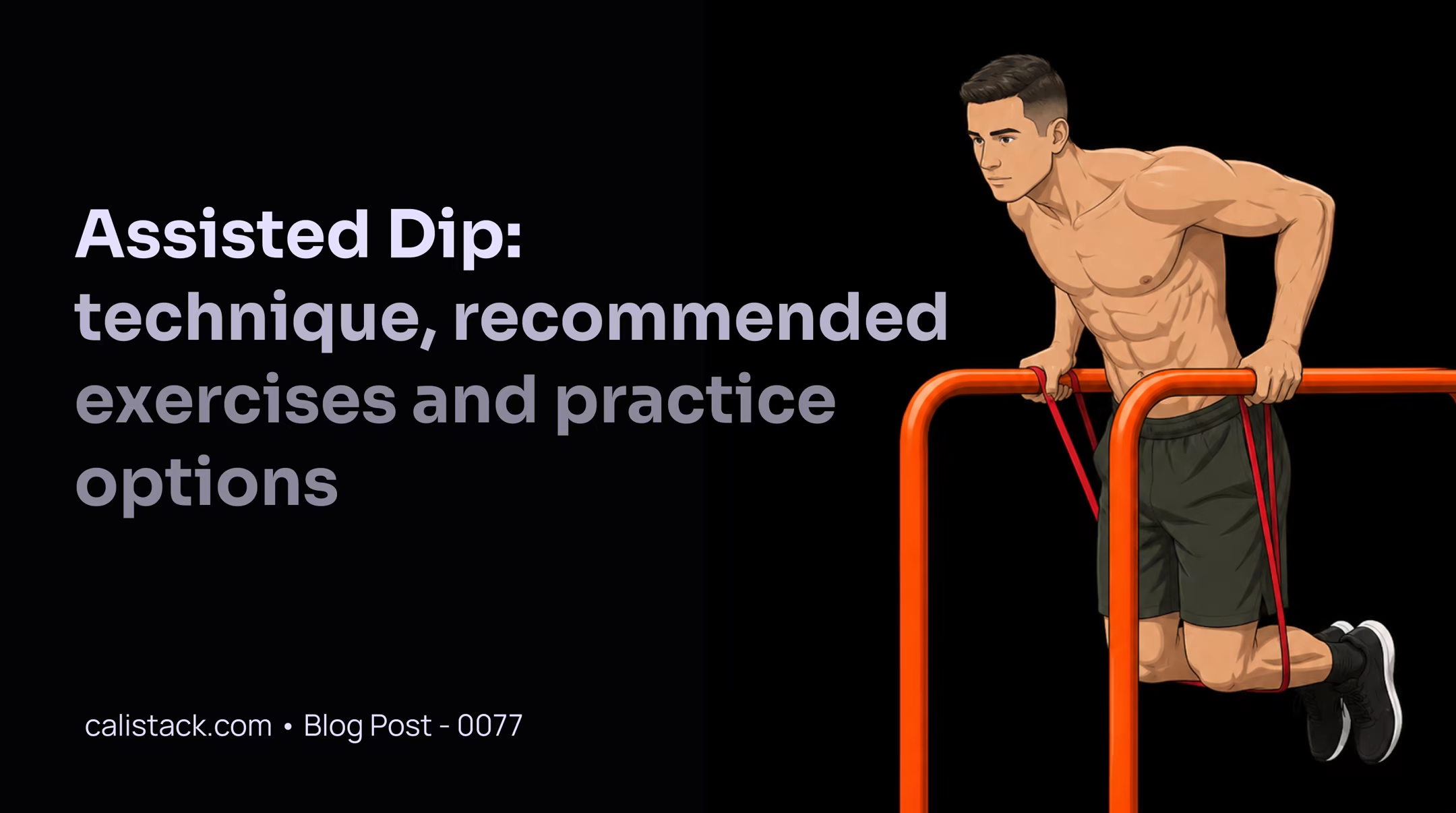
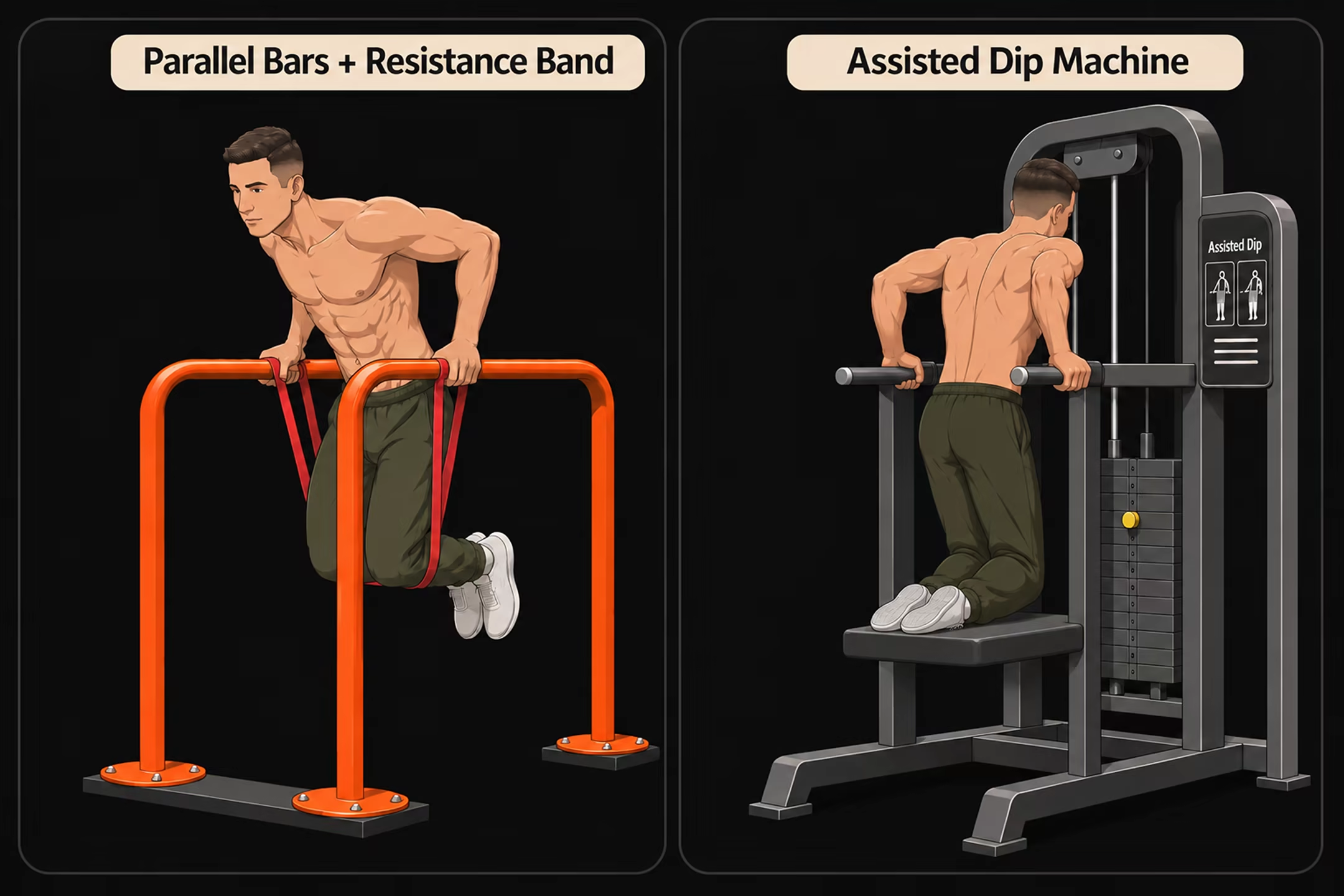
An assisted dip reduces some of the bodyweight you have to move while you practice a dip-like pressing action. The term is not specific enough to identify the setup by itself: assistance might come from a band, a machine, or your feet on a stable support. CaliStack's exact Assisted Dip demonstration has not been confirmed, so the instructions below describe common options, not a claim about the app's version. Check the clip and equipment before using this guide as a match.
What “assisted dip” can mean
In a common parallel-bar dip, the hands support the body on fixed bars, the elbows bend as the body lowers, and the arms press to raise it again. An assistance system reduces the effective load. With a band, the band stretches under the athlete and helps through part of the range. On a counterweight machine, a platform or pad provides assistance according to the machine's design. With foot support, the legs share some of the load. These are distinct arrangements, and the amount of help is not measured in the same way.
Before training, identify the bars or handles, the assistance source, and whether the exercise starts from straight-arm support or another position. If the demonstration shows a bench dip, ring dip, or a different device, do not substitute the parallel-bar instructions here. The database name alone does not confirm the apparatus or how much help it provides. If you are matching this guide to CaliStack, compare its demonstration with these options and ask a qualified trainer which version is shown.
Choose a stable assistance setup
For a band-assisted version, use fixed dip bars and a band intended for exercise assistance. Inspect the band for damage and follow its manufacturer’s instructions. Set it only as shown by a qualified instructor or the equipment guide; a twisted or badly placed band can move unexpectedly. Get into and out of the band with the bars or a stable platform supporting you, not by jumping onto the handles. Keep other people outside the band’s path.
For a machine-assisted version, check the manufacturer's setup instructions and confirm how its assistance setting works. On many counterweight designs, a larger counterweight provides more help, but machine mechanisms differ. Record the model and setting rather than comparing the number with another gym. For a foot-supported version, use a fixed, nonslip platform that lets you return both feet to support. The amount of help from your legs is adjustable but not a precise load reading.
Perform a controlled assisted dip
The following cues apply only if the approved demonstration shows a fixed-bar dip with assistance. Start from the support position your trainer has taught. Hold both bars securely and check that you can remain steady before bending your elbows. Keep your shoulders comfortable and your torso controlled; do not force a particular chest angle or pull the shoulders into an extreme position.
- Set up on fixed parallel bars with the selected assistance installed and checked. Make sure the assistance can support you throughout the range you intend to use.
- Begin in a stable supported position. Keep the bars and wrists steady, and breathe normally. If you cannot establish this position without pain or slipping, stop and ask for another option.
- Bend the elbows and lower only through a range you can control comfortably. Your shoulders do not need to descend past a preset depth for this guide.
- Press through both hands to return to the starting support without bouncing, kicking, or twisting. Keep the assistance available until both feet or the machine platform are safely supporting you again.
A consistent range matters more than reaching a dramatic bottom position. In a small 2022 study, 13 experienced men performed bench, bar and ring dips; the researchers found different shoulder and elbow positions and different muscle-activation profiles across the variations. The bench dip used greater shoulder-extension range in that sample. The study did not test assisted dips or track injuries, so it cannot identify a universally safe depth. It does show why one dip variation should not be treated as mechanically identical to another.
How the recommended exercises compare
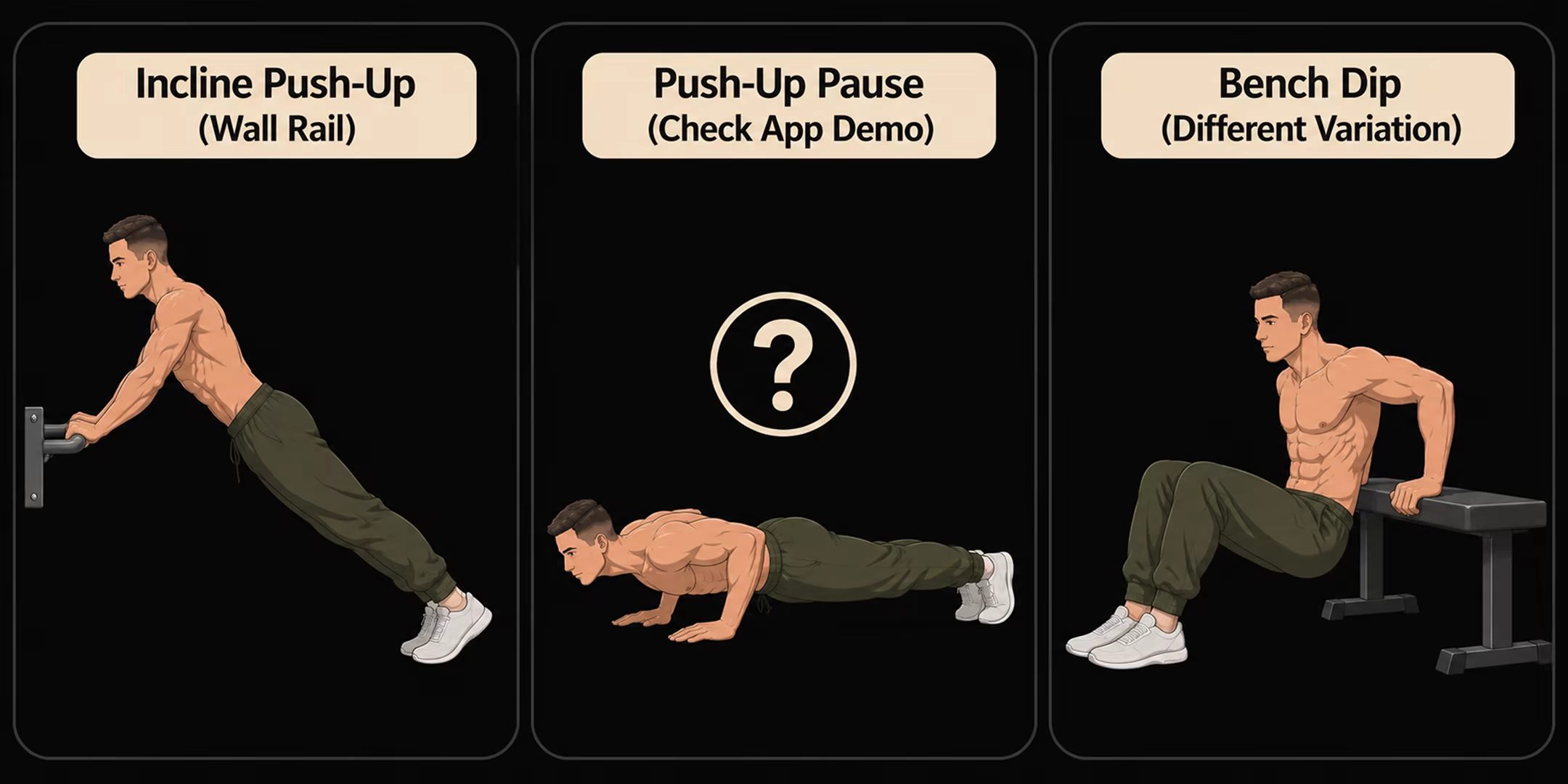
The database links Push-Up, Push-Up Hold, and Bench Dip to Assisted Dip. It does not identify them as prerequisites or explain whether the hold occurs at the top, middle, or another point. Treat them as separate choices and confirm each app demonstration before prescribing a variation.
| Recommended movement | How it differs | A reasonable way to use the link |
|---|---|---|
| Push-Up | A horizontal pressing exercise performed with the hands against the floor or an incline, not a supported dip between bars. | A separate pressing option. NASM lists wall and incline versions for reducing the load; choose a stable surface and record its height. |
| Push-Up Hold | The database name does not specify the hold position or duration. | Check the app demo. If the position is unclear, do not assume it is a dip support hold or prescribe an invented duration. |
| Bench Dip | A dip variation with hands behind the body on a bench and feet on the floor or another support; it differs from parallel-bar support. | Discuss it only as a distinct exercise. A 2022 study found greater shoulder-extension range in bench dips than bar or ring dips in its sample; that is a reason to avoid calling it automatically safer or easier for every shoulder. |
A push-up can be a verified alternative when the dip setup is unavailable or not yet comfortable, but it does not rehearse the same supported vertical press. Use a wall or fixed incline only if the surface is secure. The Push-Up Hold label needs a video check before its position can be described. The research on bench dips is about kinematics and surface electromyography in a small experienced-male sample, not a clinical injury trial. Keep those limits in view when comparing options.
A sample practice block
After a trainer confirms the equipment and the version you are using, a conservative editorial example is one or two sets of four to six assisted repetitions, resting until you can repeat the same controlled range. Choose enough assistance that you are not forced to kick, bounce, or drop through the bottom. These numbers are a starting example for discussion, not a research-derived dose, an app unlock benchmark, or a personalized prescription. Reduce the range or increase assistance if your position changes.
If dips are not appropriate for you or the setup is unavailable, use a comfortable push-up variation as a different pressing exercise. A wall or stable incline can reduce the load; begin with a range that stays controlled. Do not treat push-ups as proof that you are ready for dips, and do not do bench dips merely because the word dip appears in both names.
- Record the exact apparatus and the assistance setting or arrangement.
- Note your comfortable range, sets, repetitions and rest, and whether both sides moved evenly.
- Write down whether you needed to shorten the range, add support, or stop the set.
- Compare only sessions with the same equipment, setup and movement standard.
Progress without forcing the bottom position
You can make practice more demanding in several ways: slightly less assistance, a small increase in controlled repetitions, or a modest increase in the range approved by your trainer. Change one feature at a time. If a thinner band makes you kick or lose control, use the previous assistance again. If the machine setting changes but the equipment is unfamiliar, ask staff to verify the direction of the scale.
Do not use a band color as a universal progression chart. Bands vary by brand, age and setup, and the help changes as the band stretches. A bodyweight dip also increases the load substantially compared with an assisted rep; reaching an arbitrary repetition count does not automatically make that change appropriate. A trainer can review technique and equipment, but individual medical questions belong with a qualified healthcare professional.
Troubleshoot the part that changes
If you feel a pinch or pain at the bottom, stop the repetition and use a smaller range only after a trainer has checked the position. Do not try to fix discomfort by forcing your shoulders farther down or changing your torso angle at random. If the band shifts, end the set and reset it safely. If you are relying on a sudden leg kick, increase the assistance or choose a different exercise.
If your reps change from session to session, check whether you changed the machine, band, platform height or depth. The same number of repetitions can describe a different task when the setup changes. If you are not recovering well, reduce the amount of dip work rather than adding more sets to chase a target. There is no need to test an unassisted dip every session.
Assisted Dip questions
Does Assisted Dip mean band-assisted dip in CaliStack?
That exact app definition has not been confirmed. It may use a band, machine, foot support, or another setup. Verify the exercise video before applying these cues.
Are push-ups a prerequisite for dips?
The database link does not establish a prerequisite. Push-ups are a different horizontal press and can be a separate option when a dip setup is unsuitable.
Are bench dips the easiest assisted dip?
Not as a universal rule. Bench dips use a different body position, and a small study found greater shoulder-extension range in bench dips than bar or ring dips among experienced participants. Choose only a comfortable, coach-reviewed variation.
How do I know when to reduce assistance?
There is no universal rep count in the supplied database. Review consistent, controlled repetitions and comfortable recovery with a qualified trainer before making one small change.
How much rest should I take?
Take enough rest to repeat the same controlled movement. Any sample interval or set range in this article is an editorial example, not a validated prescription.
Your next step
First confirm what the Assisted Dip demonstration shows and whether the equipment matches. Then choose a supported version or a different pressing option that you can control. CaliStack's muscle-up guide discusses straight-bar dips as part of a separate skill; that does not make every assisted dip a required muscle-up step. Explore Assisted Dip in CaliStack and use its demonstration to identify the equipment and assistance method before choosing an option.
Sources and evidence limits
Source check: . Research context is separate from an individual technique assessment. Sample programs are editorial examples, not validated unlock tests.
McKenzie and colleagues found greater shoulder-extension range in bench dips than in bar or ring dips in their sample. [8]
The study did not test assisted dips or establish the safest depth.
- [8] Alec McKenzie and colleagues. Bench, Bar, and Ring Dips: Do Kinematics and Muscle Activity Differ? (2022-10-14).
Full article retrieved from PubMed Central on 2026-11-10; the sample was thirteen experienced males, not a beginner safety trial.
Want a clear plan for your next skill?
We built Calistack to show you the exact steps from where you are right now to your first handstand, muscle-up, or lever.