By Calistack Team · Editorial standards: Calistack editorial team
How to learn a bar muscle-up: pulling, transition and support practice
A bar muscle-up combines a pull, a transition around the bar and a press into support. Work on the phase you can control rather than using a fixed pull-up count as a readiness test. Track whether your reps are strict or momentum-assisted so you can compare like with like.
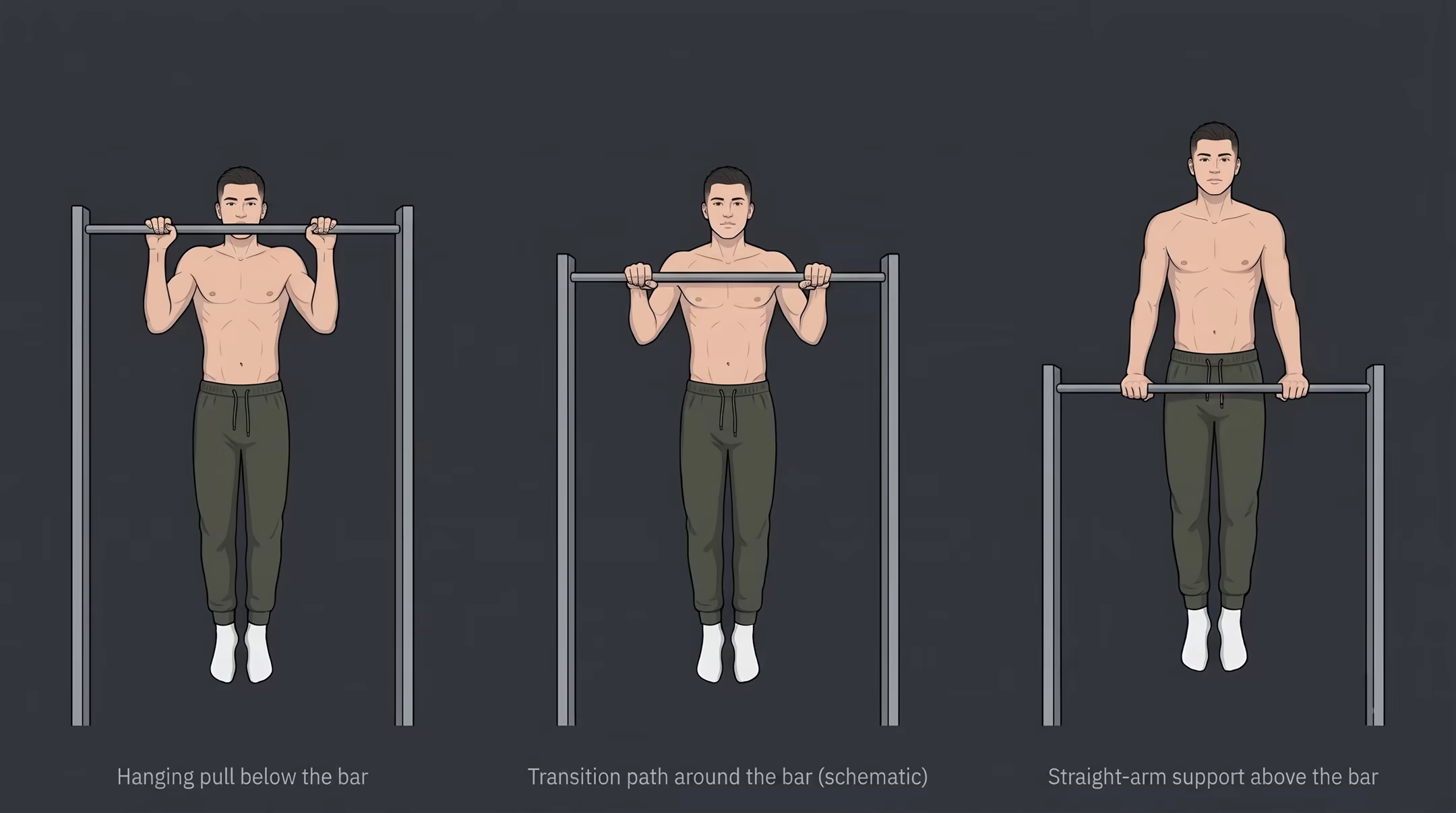
A bar muscle-up is not just a high pull-up followed by a dip. You have to move from hanging below a fixed bar to supporting yourself above it, and the transition between those positions is its own skill. Pulling strength, transition practice and top support matter, but none of them gives every athlete a universal pass mark for trying the full movement.
This guide uses a bar muscle-up as the target, not a ring muscle-up. It separates a strict version, performed without a deliberate kip, from a momentum-assisted version that uses a controlled swing or hip drive. Before copying any drill, check which version you want and whether the bar, assistance and demonstration match it.
What counts as a bar muscle-up?
For this guide, the reference movement begins hanging below a fixed bar, passes through a pull and a transition over the bar, then finishes in a supported position with the elbows extended. The bar cannot move out of your path, so you must move your body around it. A strict attempt avoids deliberate leg swing or knee drive; a momentum-assisted attempt uses a defined kip. Those are different tasks. Record which one you train instead of comparing them as if they were interchangeable repetitions.
- Strict bar muscle-up: aim to produce the pull and transition without a deliberate kip; the required pulling height and transition control are demanding.
- Momentum-assisted bar muscle-up: use a planned swing or hip-and-knee action. The amount and timing of momentum change the movement, so use a coach's demonstration rather than guessing from a name.
- Ring muscle-up: the rings move independently and allow a different path. Skill cues and grip demands do not transfer exactly to a fixed bar.
Separate the pull, transition and support
Pull high enough to create room
A chin-over-bar pull-up finishes below the bar. A muscle-up needs a pull that brings the torso high enough to begin moving over it. That does not mean there is one universal chest-height target for every body, grip, bar or style. A strict athlete and a kipping athlete solve the pull differently. Practice a version that lets you move deliberately, and ask a coach to check the path rather than repeatedly throwing yourself at the top of the bar.
Treat the transition as a separate skill
The transition is where the athlete moves from pulling below the bar to pressing from above it. The bar is fixed, so timing, torso position and the way both sides move matter. If a low bar is used for a foot-assisted drill, keep the feet supported and let a qualified coach select the path. Do not improvise a high-bar turnover from a drawing, twist one elbow over first, or use a loose chair as a step. A low-bar drill is not automatically the same as a full hanging repetition.
Finish in a support you can control
The top position is a straight-arm support above the bar. If you cannot support yourself there comfortably, pressing harder during a rushed transition is unlikely to solve the gap. A coach can decide whether support holds, a limited-range straight-bar dip or another option is appropriate. Keep the shoulder position comfortable and stop before your elbows or shoulders lose control.
Choose a starting point you can manage
Start by checking the setup, not by testing a maximum. Use a bar installed or designed for bodyweight training, with enough clear space to enter and leave the exercise. Check the equipment and floor, and make sure your hands are dry. If you do not have a secure bar or cannot get into and out of the chosen position reliably, do not attempt a full muscle-up there. A warm-up does not make a painful grip or shoulder position safe.
Next, identify the part that is currently manageable. Can you hang comfortably? Can you practice a controlled pull on a suitable assistance setup? Can you support yourself above the bar without discomfort? These are observations for planning, not a pass/fail test. No exact number of pull-ups, dips or seconds in a hold proves that someone is ready for a muscle-up.
| Part | What to notice | Useful next decision |
|---|---|---|
| Pull | Height, grip, swing and whether the descent stays controlled | Keep the pull assisted or reduce its difficulty if the movement turns into a kick or drop. |
| Transition | Whether both sides move together and the bar path is coach-approved | Return to a supported low-bar drill if the turnover is rushed or asymmetric. |
| Support | Whether the top position feels stable and pain-free | Use a coach-selected support option instead of pressing through a failing position. |
How to use the related exercises
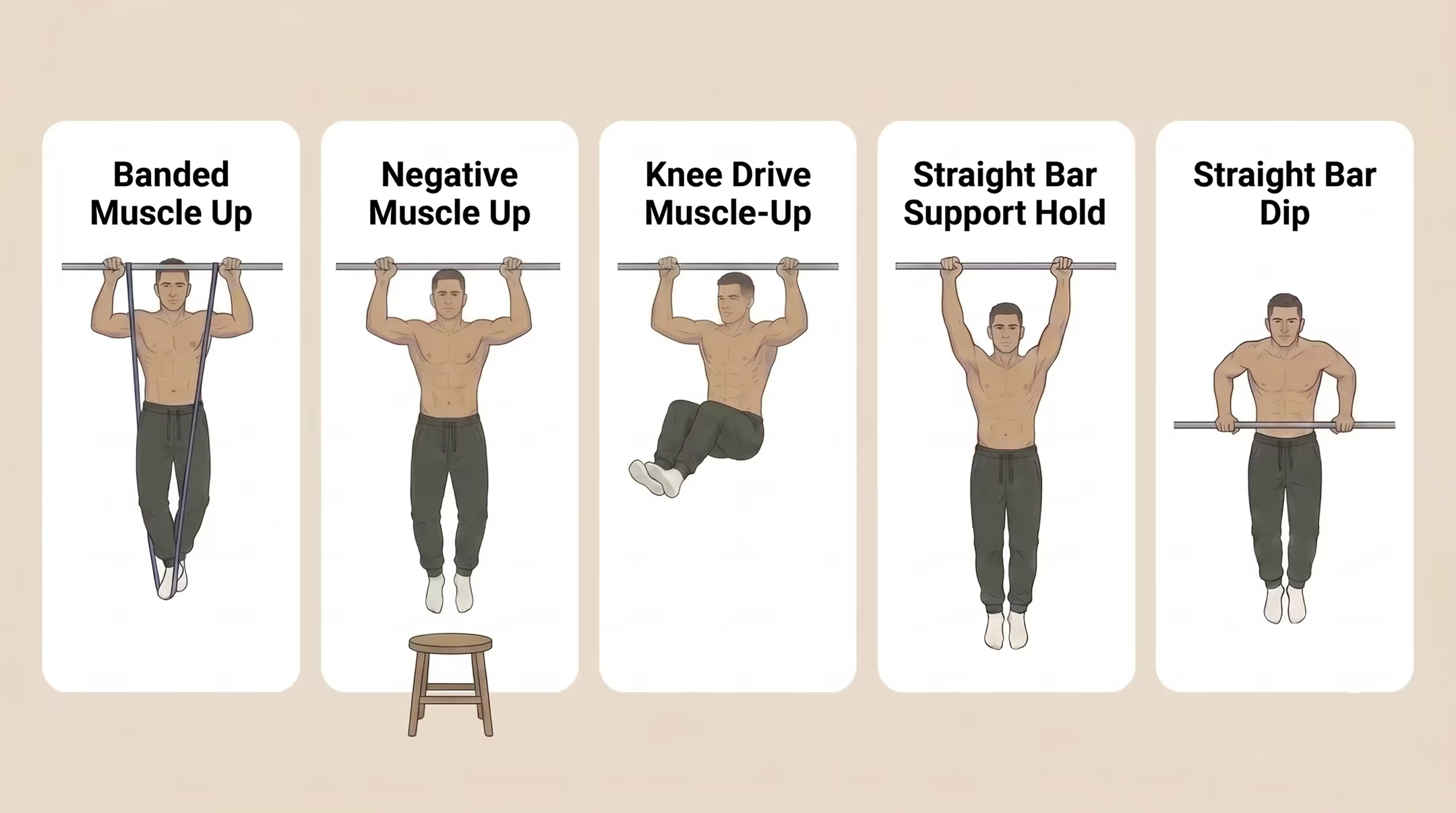
CaliStack lists five related movements for Muscle-Up. They are options to understand, not a mandatory ladder, and they should not all be crammed into one session. The names alone do not confirm the app videos, exact assistance method or difficulty. The notes below describe what each name may refer to and what needs coaching confirmation.
Banded Muscle Up: a resistance band can provide assistance through part of a muscle-up, but assistance changes across the movement and may alter timing. The exact anchor and body position matter. Use a band only after a coach checks its rating, setup and entry or exit; do not assume a band makes the full skill low-risk. Confirm the app's demonstration before treating this name as a particular technique.
Negative Muscle Up: the name commonly suggests practicing a descent from top support through the transition toward a hang. If that is the version shown, it is a demanding lowering task, not a beginner shortcut. Do not jump to the top or drop through the transition. A coach should decide whether you can control the starting support and the full descent; the app movement definition is unconfirmed.
Knee Drive Muscle-Up: the name suggests a version that uses knee drive, but it does not specify the amount, timing or whether the movement is kipping. If the video confirms a deliberate knee-driven kip, treat it as momentum-assisted practice, not strict-muscle-up training. Ask a coach to review the entry, swing and exit, and do not use a single successful repetition as proof of repeatable control.
Straight Bar Support Hold: this appears to address the position above a bar. A stable hold may help you become familiar with supporting yourself, but it does not rehearse the pull or transition. Use a bar that is designed for the task and a hold duration you can end safely. No universal hold-time target is needed.
Straight Bar Dip: this appears to practice pressing from support on a fixed bar. It relates to the finishing portion, but it cannot create the pull or turnover by itself. Choose a range that keeps your shoulders comfortable and stop when control changes. Confirm the app's setup, because different bars and support positions can change the exercise.
A small practice block to review with a coach
The database does not provide sets, repetitions, rest periods or readiness rules. The following is an editorial example for a generally healthy adult, not a tested muscle-up program or an app prescription. Have a qualified coach review it before use, especially if you are new to overhead hanging or transition drills.
- Use a few minutes of comfortable general movement and easy, supported bar practice. Stop if the grip or shoulder position hurts.
- Choose one coached pull or low-bar transition drill. Try one or two easy sets of a few controlled repetitions, with enough rest to repeat the same path. Do not combine every listed recommendation in one workout.
- If the coach has cleared it, add either a straight-bar support hold or a small-range straight-bar dip. Keep this part separate from the transition drill and end before the position deteriorates.
- Record the exact variation, assistance, bar and grip, repetitions or hold time, control and any discomfort. Repeat the same setup before changing one feature.
If the drill is no longer challenging, make one small change with the coach: slightly less assistance, a little more controlled range, or a different pull emphasis. Do not simultaneously add speed, volume and a harder transition. The point of a sample is to make a practice decision visible, not to promise a result by a certain date.
Troubleshoot the part that breaks down
If you pull but stall below the bar, do not keep repeating maximal attempts. Return to a controlled pull variation and have a coach assess whether height, timing or the chosen style is the limiting part. If one elbow moves over first, stop that drill and seek an in-person technique check; do not practice an asymmetric turnover because it happened to clear the bar once.
If you get above the bar but cannot press to support, use an easier coach-selected support or dip variation rather than forcing the lockout. If a band changes your path unpredictably, reduce the assistance or choose a different setup. If a negative becomes a fall, the current version is too difficult for unsupervised practice.
For a plateau, compare like with like. Note whether the bar, grip, band, kip, range and fatigue were the same. A cleaner transition at the same setup is useful progress even if the number of repetitions has not changed. Change one variable only after several comparable practices, and take more recovery if your next session begins with worse control.
Bar muscle-up questions
Do I need a set number of pull-ups before trying a muscle-up?
No universal pull-up count establishes readiness. The strict and momentum-assisted versions also place different demands on the pull and transition. Ask a coach to assess your chosen style, setup and control rather than relying on a number.
Are strict and kipping muscle-ups the same skill?
They share the move from hanging below a bar to support above it, but deliberate momentum changes the task. Decide which version you are practicing and label your training log accordingly.
Are banded or negative muscle-ups beginner exercises?
Not automatically. A band can change assistance through the range, and a negative can demand substantial control while lowering. Have a coach confirm the exact version and whether it suits you.
Should I train every recommended movement in one session?
No. The recommendations are related options, not instructions for one circuit or a compulsory progression. Choose one or two parts that match the coach's assessment and allow recovery.
Your next practice decision
Write down whether your goal is a strict or momentum-assisted bar muscle-up. Then choose the part you can practice safely with the equipment and coaching available: pull, transition or support. Explore Muscle-Up in CaliStack and its listed related movements. Check their demonstrations and ask a coach how they fit the version you want to practice.
Sources and evidence limits
Source check: . Research context is separate from an individual technique assessment. Sample programs are editorial examples, not validated unlock tests.
Walker and colleagues compared muscle activity during bar and ring muscle-ups in ten active men. [13]
Participants could use momentum. The comparison does not establish a strict muscle-up progression, a prerequisite repetition count or a beginner training rule.
- [13] Cody W Walker and colleagues. Comparison of Muscle Activity During a Ring Muscle Up and a Bar Muscle Up (2023-12-01).
Abstract and methods checked in PubMed Central.
Want a clear plan for your next skill?
We built Calistack to show you the exact steps from where you are right now to your first handstand, muscle-up, or lever.