By Calistack Team · Editorial standards: Calistack editorial team
Pike Push-Up: technique, recommended exercises and practice options
A pike push-up is a controlled press with your hips raised and hands supporting your weight. Choose a manageable range, keep pressure off your head and neck, and record your hand position, target height and repetitions. Holds, negatives and shoulder taps are related options, not substitutes for handstand balance practice.
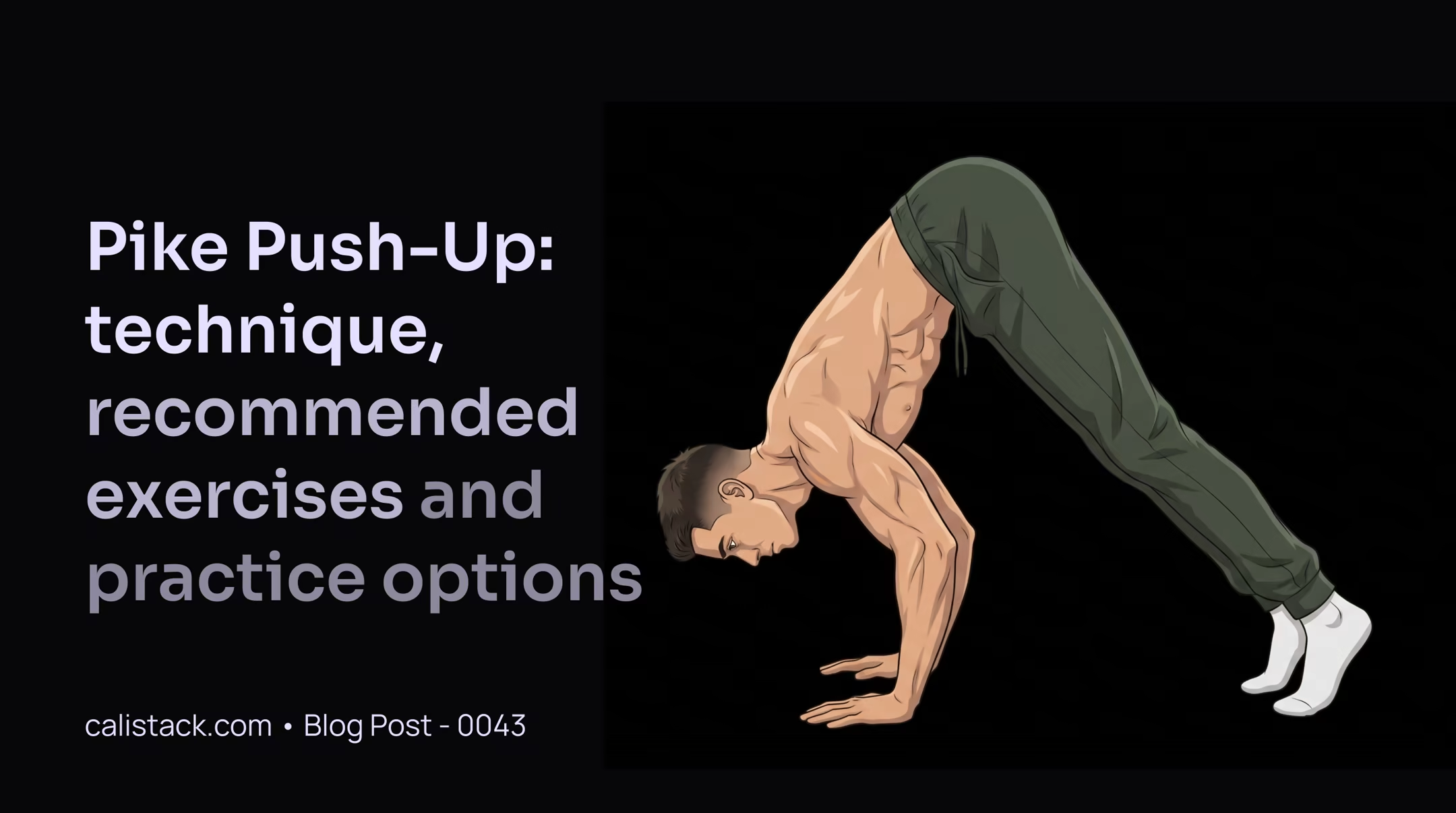
A pike push-up is a floor-based press with the hips raised, hands and feet supported, and the shoulders doing more of the work than in a regular push-up. It can help you practise an angled overhead press, but it does not teach freestanding handstand balance. The useful version is the one where you can keep your hips high, lower under control and press back without dropping your head or turning the movement into a standard push-up. Start with a range you can manage. There is no need to touch your head to the floor to make the exercise useful.
What counts as a pike push-up
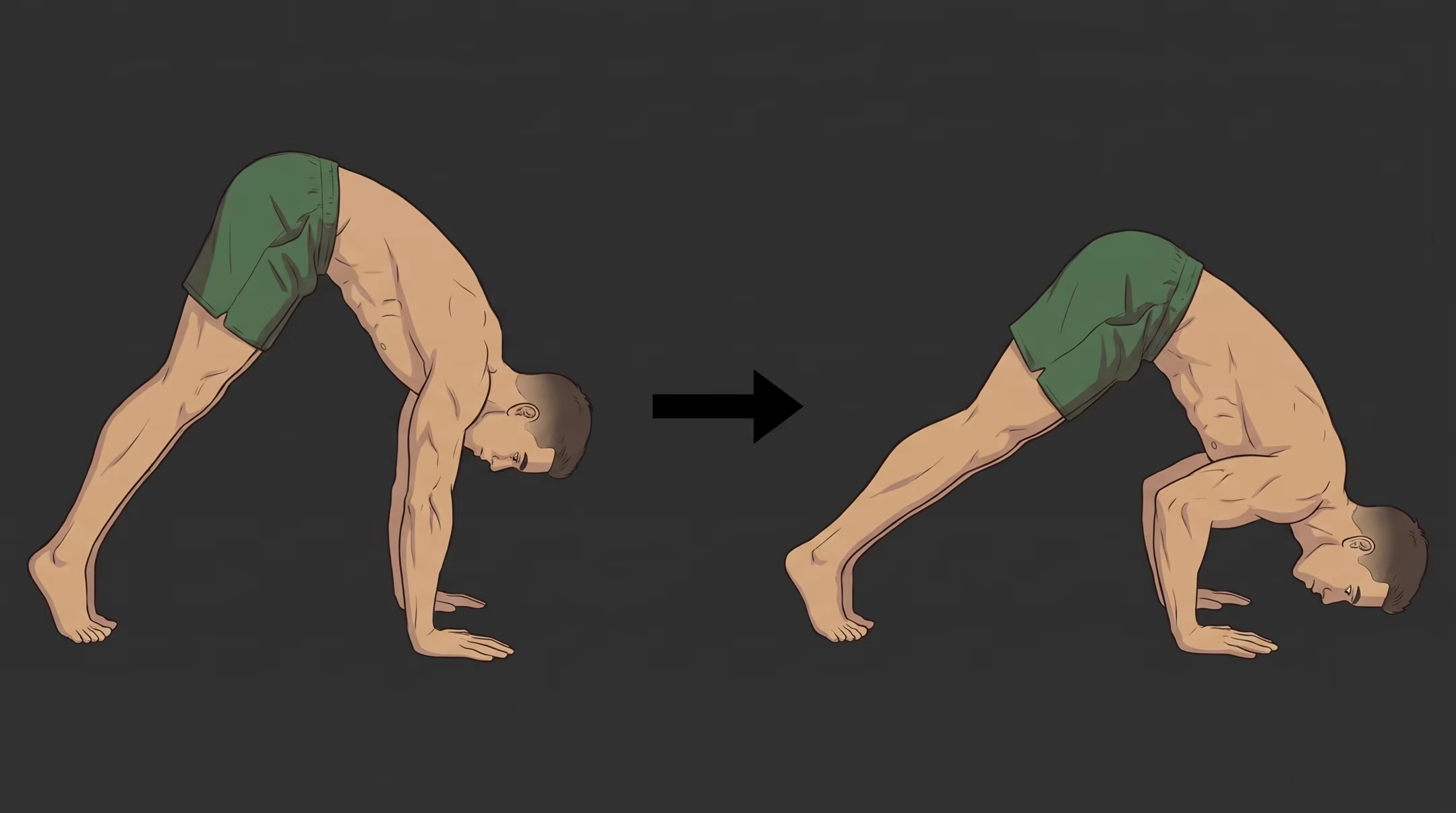
For this guide, the basic version starts with palms and feet on the floor, hips lifted into an inverted V, and elbows straight but not forced into a hard lock. Bend your elbows and move your head forward and down between or slightly ahead of your hands, then press back to the starting position. Keep the bend at your hips throughout the repetition. If your hips drop until your body is nearly horizontal, you have changed the movement into a different push-up pattern. Your feet stay supported; you do not need a handstand or a wall to do this version.
The exact hand width, elbow path and depth marker vary among coaching demonstrations. One source uses a head path ahead of the palms, while another describes lowering the head toward the floor; neither makes that exact cue a universal standard. Use a comfortable hand position and a target that lets you control the descent. Do not place bodyweight through your head or neck, bounce off a floor target, or crane your neck to reach a depth you cannot control. Check CaliStack's exercise video to see whether those cues match its Pike Push-Up variation.
Check your starting range
Begin with a pike position that feels stable through your hands and feet. A small bend in the knees is acceptable if keeping them straight forces your back to round or makes the position uncomfortable; record the bent-knee version as its own variation. Your heels do not have to reach the floor. Put your hands on a firm, nonslip surface with enough space to lower your head toward a clear target. If a full floor-level range feels too difficult, use a stable raised target that cannot slide, or practise a shorter range. Do not balance a stack of books or loose household objects under your head.
Before working sets, try a few easy pike supports and shallow press repetitions. Notice whether your shoulders can stay active, your elbows bend smoothly, and your head moves without being forced toward the floor. A repetition that ends early but remains controlled is more useful than a deeper one completed by collapsing. If the position causes pain, unusual pressure or numbness, stop that version. A coach can help adjust the hand-to-foot distance, knee bend, target height or total range. Those changes are practical options, not tests of character or proof of a particular weakness.
Press with control, not momentum
Set your hands around shoulder width or slightly wider if that feels better. Spread your fingers and press through the whole hand rather than letting the heel of the palm take all the pressure. Lift the hips, brace the trunk comfortably and let the shoulders move as you bend your elbows. Lower at a pace you can reverse. Keep the elbows angled diagonally back instead of flaring hard sideways, but do not force one exact angle if your joints or setup call for a small adjustment. Keep breathing; a brief pause above your target can help you check control.
Press through the hands to return to the pike, keeping the hips up rather than driving the chest forward. Finish each repetition at a position you can repeat. The goal is a smooth descent and press, not an exaggerated head touch or a fast partial movement. If you cannot reverse the bottom position, make the target higher or shorten the range. If you lose the hip angle near the end of the set, stop there rather than turning the remaining repetitions into regular push-ups. Record the version and target height so the next session can be compared fairly.
| Recommended exercise | How it differs from the press | Use it as an option when |
|---|---|---|
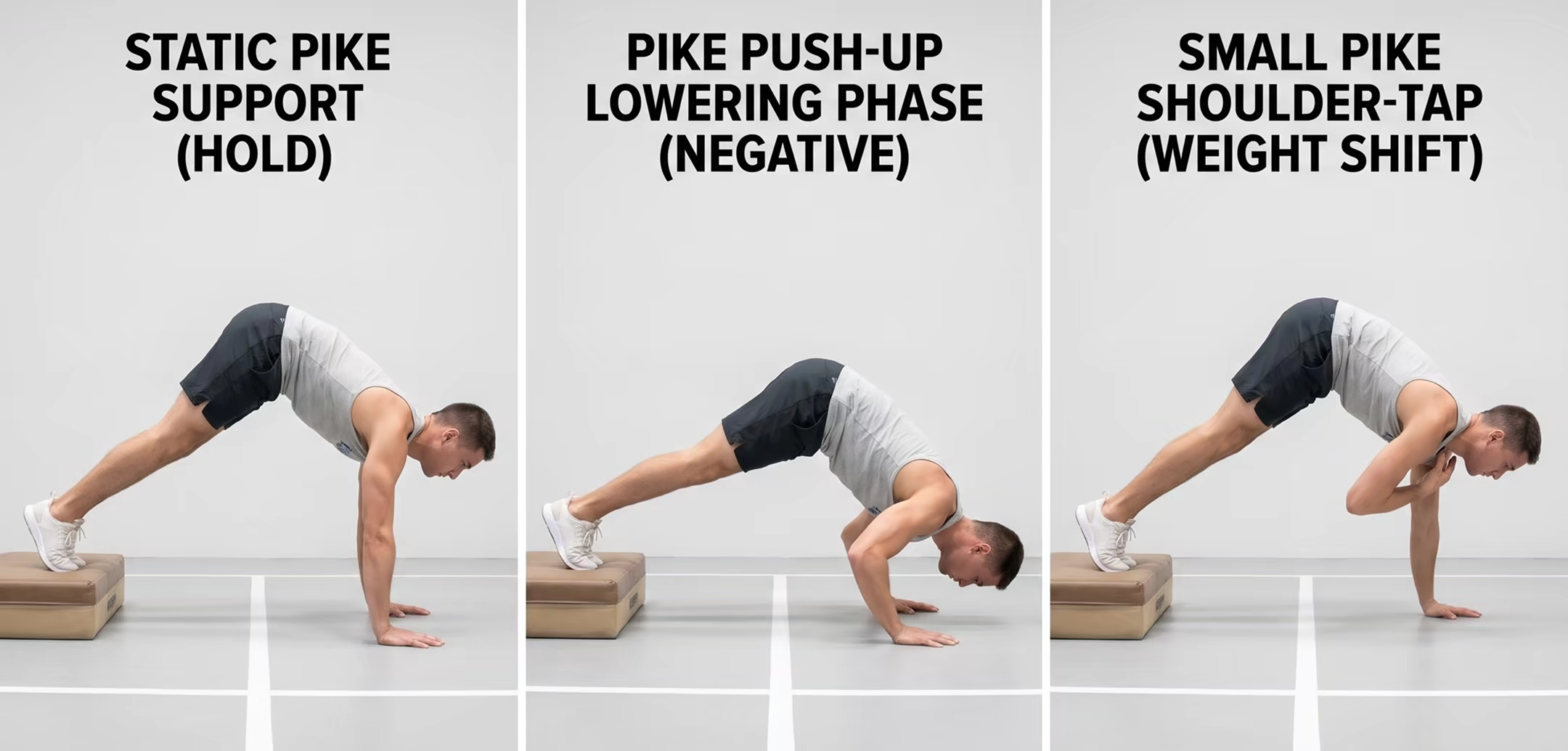
| Pike Shoulder Tap | A common shoulder-tap version shifts weight between hands and briefly lifts one hand; it is a support and weight-transfer task, not a pressing repetition. | A coach or demonstration confirms the exact setup and you can maintain a stable pike without twisting or collapsing. |
| Pike Push-Up Negative | The negative emphasizes the lowering phase of a pike press. The app's start and reset method are not confirmed by the name alone. | You can control the descent and have a safe way to reset; do not drop through the bottom or repeatedly jump into position. |
| Pike Hold | A static pike support holds a position rather than bending and extending the elbows through a push-up. | You want to practise a manageable support position before adding a dynamic press, if that matches the approved demo. |
These labels describe different tasks, not a compulsory ladder. A shoulder tap may add a balance demand, a negative may add a demanding lowering phase, and a hold may let you practise support without repeated pressing. Each name has more than one possible setup in the wider training world. Check the CaliStack video and ask a qualified trainer to confirm the intended version before treating any row in the table as an instruction. You do not need to perform all three movements in the same session, and none is automatically required before you may practise an easier pike push-up.
Choose a practice amount you can repeat
A sample block for discussion with a trainer might be two or three sets of four to eight clean pike push-ups, resting long enough to regain control between sets. Choose a range that leaves you able to finish each repetition without head pressure, hip collapse or momentum. This is an illustrative coaching example, not a dose established by the research or a CaliStack prescription. Someone who cannot manage that range can use a higher target or a shorter descent. If even the easiest setup is uncomfortable, do not force the movement; ask a coach to select another press.
Change one difficulty variable at a time. You might lower the target slightly, increase the range by a small amount, or use a little less knee bend. Do not lower the target, move the feet closer, add a set and reduce your rest all in the same workout. If you change several things together, it becomes hard to tell what caused a technique breakdown or fatigue. Keep the version stable for a few sessions, then review whether control and recovery remain acceptable before changing it. There is no universal number of pike reps that proves readiness for a handstand push-up.
A simple log can include the variation, target height, hand and foot positions, sets and repetitions, and whether the same range stayed controlled. Note if you used bent knees, a wall, parallettes or a different surface. If you used a pike hold or shoulder tap instead, record that separately rather than counting it as a pike push-up. That distinction matters because a longer hold and a stronger press are not interchangeable outcomes. The research on pike exercises and push-up variations does not give a validated app-unlock threshold or a universal progression path for this exact movement.
- Choose a stable floor setup and one range marker you can reproduce.
- Practise the pike support and a few easy repetitions before deciding on work sets.
- Stop each set while your hips, shoulder position and head path remain controlled.
- Record the version, target and repetitions, then review recovery before changing one variable.
- Ask a qualified coach to check the app's exact variants before using a negative or shoulder tap as a progression.
Troubleshoot without forcing a deeper rep
If your hips drop as you lower, bring the target higher or reduce the range. The goal is to keep the pike shape recognizable, not to reach the floor at any cost. If your head lands between your hands or your neck bends sharply, move the target ahead of the hands and ask a coach to check the path. If the head takes your weight, stop and use a higher target. A pike push-up should be a hand-supported press, not a head-supported balance.
If your elbows flare and the bottom feels uncomfortable, widen or narrow the hands slightly and reduce the depth while you check the movement with a coach. If your shoulders feel overloaded, choose an easier range rather than adding more repetitions. If you are moving too fast, pause at the top and lower more slowly, but only if that does not create pain or loss of control. Repeatedly failing at the bottom is not a useful test. A raised stable target, bent-knee option or pike hold may be more appropriate today.
Frequently asked questions
Frequently Asked Questions
Do I have to touch my head to the floor?
No. Use a range you can control without loading your head or neck. A stable raised target or shorter range is a reasonable coaching option while you build control.
Are pike push-ups the same as handstand push-ups?
No. In the basic floor pike push-up, your feet remain on the floor and your body stays in a pike. A handstand push-up adds an inverted support position and different balance and safety demands.
Should I do negatives before full repetitions?
Not necessarily. A negative is one option for someone who can control its descent and reset safely. It is not a required first step, and the app's exact version should be checked.
How many pike push-ups should I do before handstands?
There is no verified rep count that clears someone for handstands. Pressing strength, inversion comfort, entry and exit control, and balance are separate considerations.
Can I use a chair to elevate my feet?
Only use stable equipment that is designed or checked for exercise and cannot slide or tip. A chair is not automatically safe. The basic floor version does not require foot elevation.
Your next step
Pick one pike push-up version that lets you keep your feet supported, hips raised and head clear of pressure. Record the target and range, then repeat that setup before making it harder. Use Pike Shoulder Tap, Pike Push-Up Negative or Pike Hold only when the specific demonstration matches the task you intend to train; they are related options, not a required sequence. Explore the Pike Push-Up entry in CaliStack and view each listed movement's demonstration before choosing one; ask a coach if a variation is unclear.
Sources and evidence limits
Source check: . Research context is separate from an individual technique assessment. Sample programs are editorial examples, not validated unlock tests.
Ebben and colleagues measured peak vertical ground-reaction forces across six conventional push-up variations in 23 recreationally fit participants. [5]
This is indirect loading context: the study did not test the exact floor pike push-up. It does not establish that variation's shoulder effort, technique cues, sample training dose or a handstand-readiness threshold.
- [5] Ebben WP and colleagues. Kinetic analysis of several variations of push-ups (2011-10-01).
Abstract retrieved through Europe PMC; not a full-text assessment.
Want a clear plan for your next skill?
We built Calistack to show you the exact steps from where you are right now to your first handstand, muscle-up, or lever.