By Calistack Team · Editorial standards: Calistack editorial team
Full Pistol Squat: technique, recommended exercises and practice options
A full pistol squat combines single-leg strength, balance and a controlled range while the other leg stays forward. Use stable support or a shorter descent when needed, and record the version you actually perform. Related exercises are practice options, not mandatory prerequisites; do not force depth or train through pain.
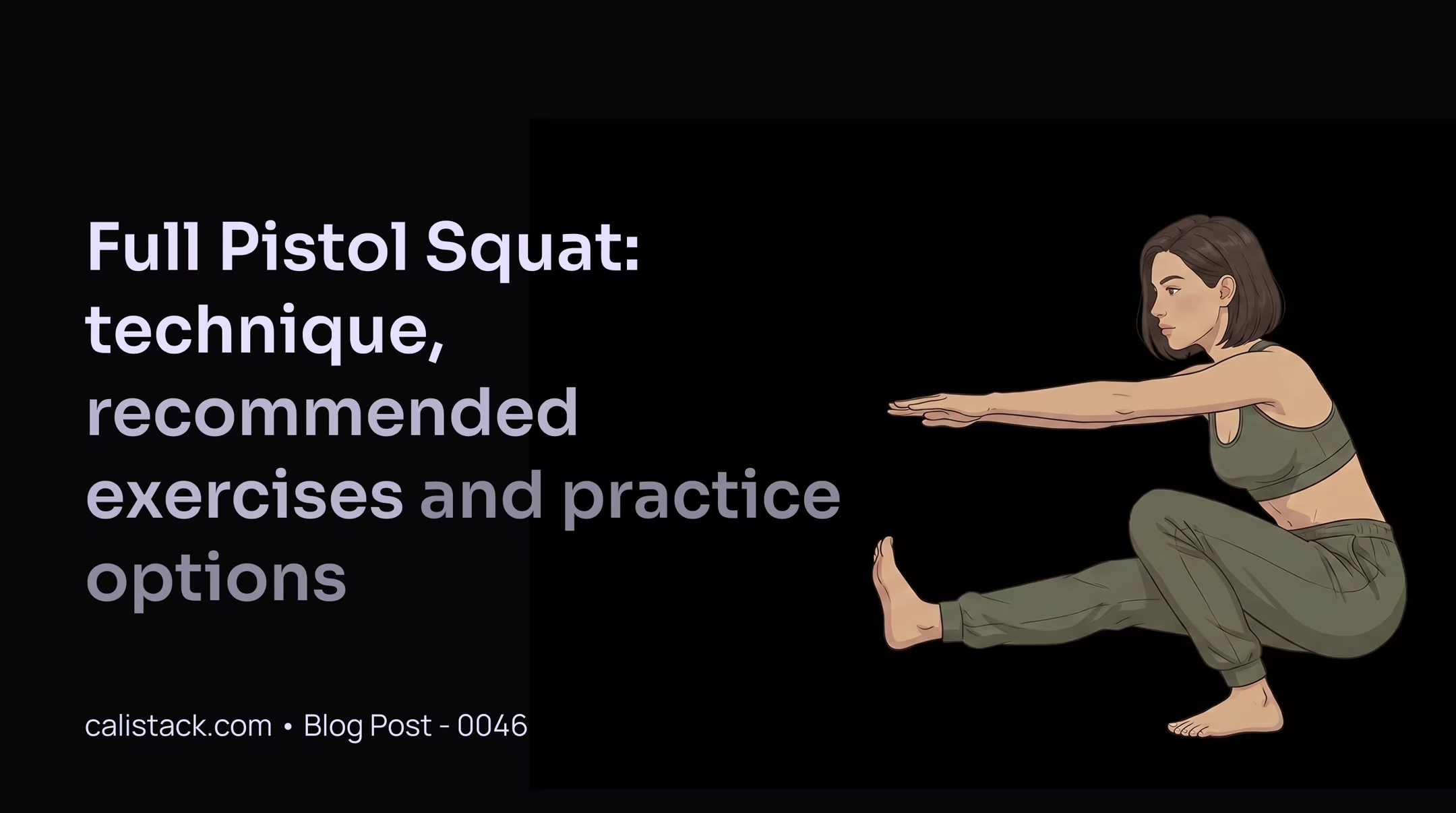
A pistol squat is a single-leg squat in which one foot supports you while the other leg stays lifted in front. The full version combines strength, balance, control and enough range for the shape you are using. If one of those parts is not ready, use a support or a shallower depth rather than dropping into the bottom and hoping to stand back up. There is no single depth label used by every coach or exercise library. In this guide, full means the deepest range you can repeat with control, the working foot planted, and the free leg clear of the floor. Record that range consistently instead of chasing a universal floor-touch standard.
Define the rep you are practising
Start tall on one foot. Keep the free leg forward and off the floor, then bend the working hip and knee to lower. Let the working knee travel in the direction of the toes while the heel stays grounded. Reach only a depth you can control, then press through the whole foot to stand. For a repeatable practice rep, use the same free-leg position, support and depth marker on both sides. The CrossFit movement standard uses a defined depth and a fully extended finish, while exercise-library instructions also permit depth to be limited by the individual's control. Those are not identical coaching contexts, so do not assume that every app uses the same standard.
The lifted leg has work to do too. Holding it forward calls for hip flexion and enough range to keep the foot from touching the ground as you descend. If that leg drops, you may lose balance or shorten the squat without noticing. Arms reaching forward can help counterbalance the body, but they do not replace the working leg. Your torso may lean forward to keep balance; forcing an upright torso is not a universal form rule. Use a mirror or video from the front and side only as feedback, not as a substitute for a coach when you are unsure about pain or technique.
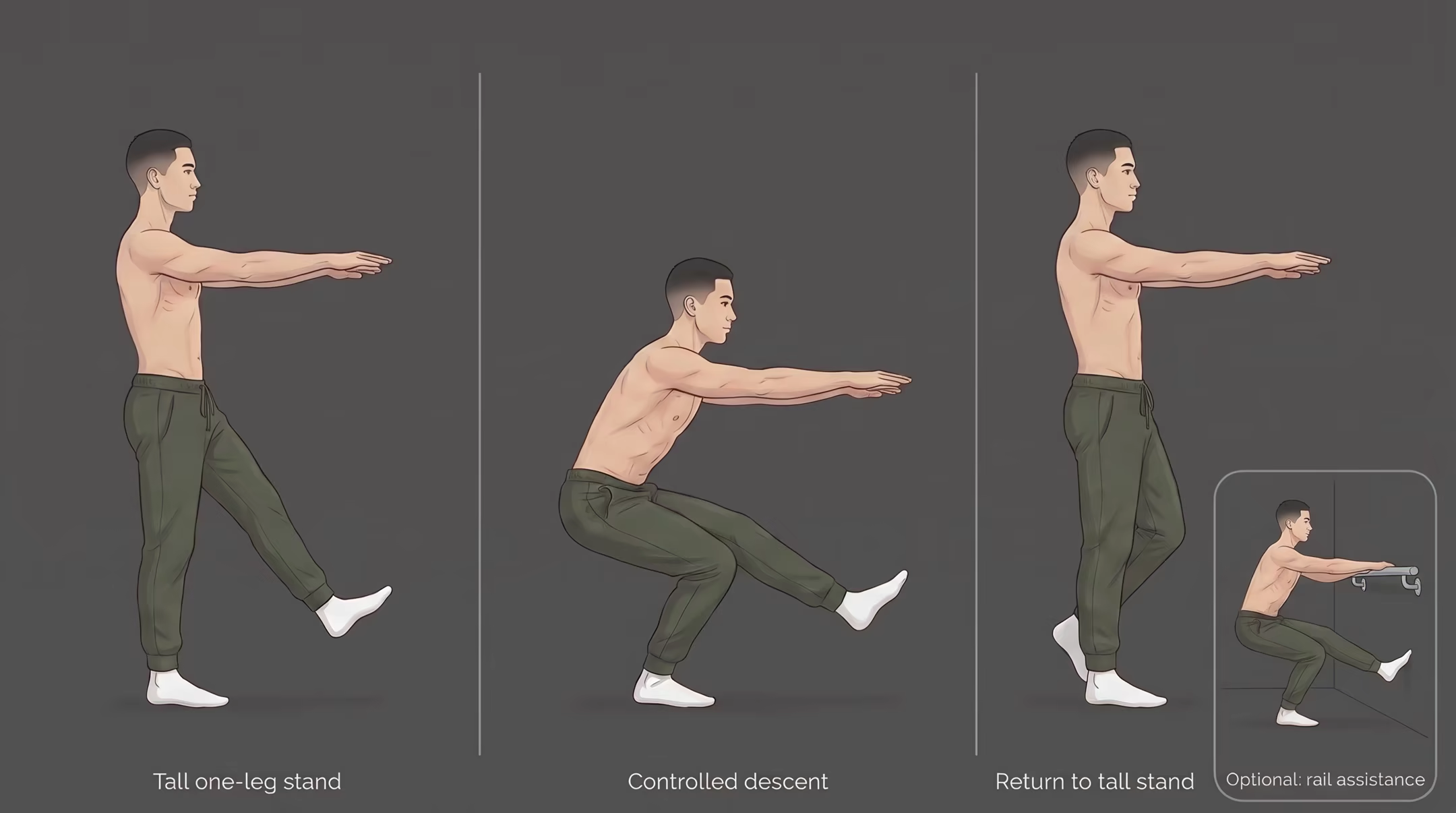
Assess the pieces before attempting the deepest version
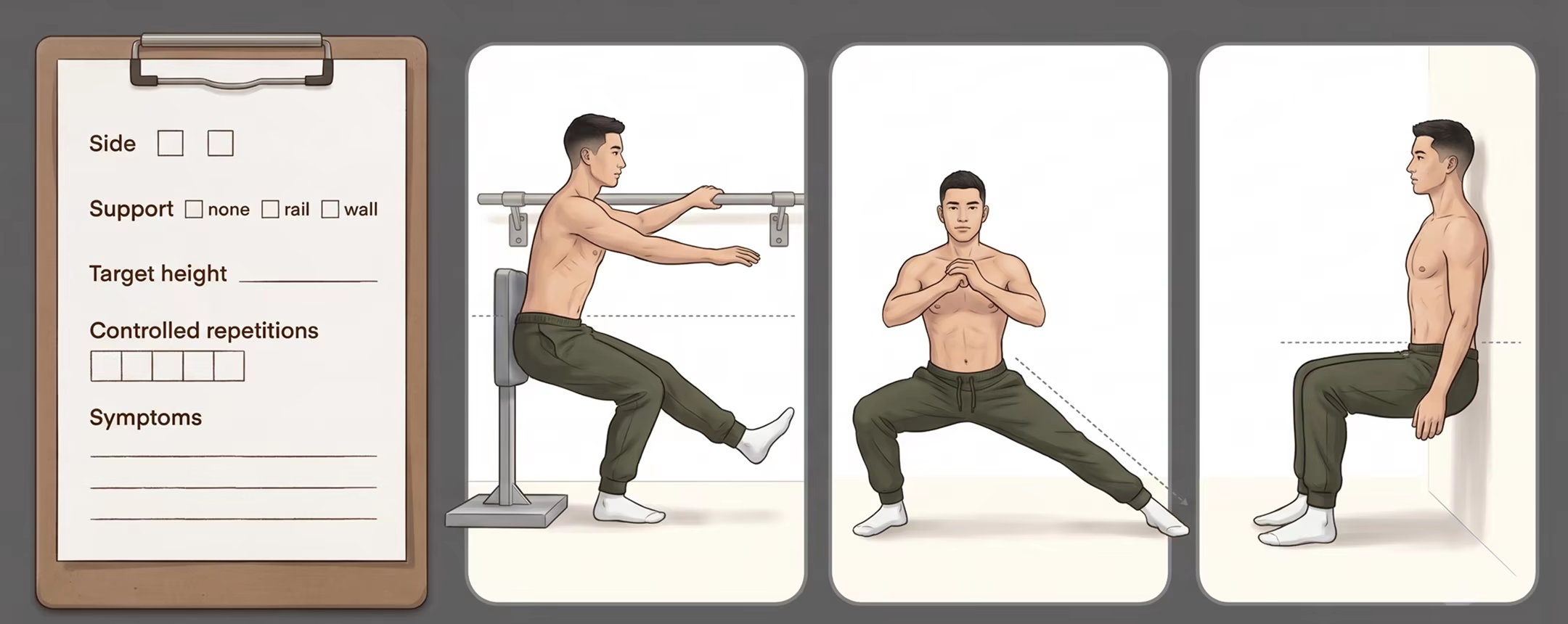
Use a stable rail or fixed support to check whether you can lower and stand on one leg through a comfortable range. Keep enough hand contact to prevent a sudden drop; you are learning the movement, not testing your grip. Then try a two-leg squat and a supported single-leg squat to a firm, stable target, such as a box designed for exercise. The target gives you a repeatable stopping point. Do not sit down heavily or use a rolling chair. If the target is too low to reach smoothly, raise it. If one side feels different, note the difference without trying to diagnose its cause.
Ankle motion, knee and hip movement, strength and balance can all affect how deep a single-leg squat looks. Research on single-leg squat mechanics reports associations between depth and joint angles, but the studies used specific participants and task standards; they do not provide a universal mobility test or a pistol-squat readiness number. A heel that lifts, a free leg that drops or a loss of balance can each be a reason to reduce the range or use support. They do not prove that one joint is injured or that stretching alone will fix the movement.
Check the two sides separately. Start each set with the side that needs more attention, then use the same number of controlled repetitions on the other side rather than forcing the stronger side to do extra work. Record whether you used a rail, how high the target was, whether the heel stayed down and how far you descended. If the working knee moves inward or you lose the foot's contact with the floor, reduce the range and ask a trainer to review the movement. The aim is a repeatable practice standard, not a perfect-looking screenshot.
| Recommended exercise | What it changes | How to use the idea |
|---|---|---|
| Assisted Pistol Squat | A support can reduce the balance demand and help you control a one-leg descent and return. The app's exact assistance method is not confirmed by the name. | Ask for the approved demonstration. A fixed rail or coach-selected support is one common option; use only the method shown and keep the amount of help consistent. |
| Cossack Squat | A side-to-side squat loads one leg while the other stays longer and more extended. It trains a different direction from the forward free-leg pistol. | Use it as a separate lateral squat option if it suits your training. It is related lower-body practice, not a required step to a pistol. |
| Wall Sit (Single-Leg) | The name suggests a wall-supported single-leg hold, but the exact leg position and depth depend on the demonstration. | Verify the app version before trying it. A static hold does not rehearse the full pistol's descent and return. |
| Wall Sit | A bilateral wall-supported hold keeps both feet on the floor and removes some balance demand. | It can be a general leg-strength option if appropriate, but it does not replace controlled single-leg practice or prove readiness for a pistol. |
Do not treat the table as a staircase. A Cossack squat can be useful for lateral movement practice, while a wall sit is a static hold. They may fit your wider training, but neither has to be completed before you try an assisted pistol. The direct recommendation list is a set of related choices, not evidence that the app's graph represents a universal coaching sequence. You also do not need all four options in one session. Choose one version that addresses the current limitation, then record what it actually asks you to do.
Practise a controlled range before adding depth
A coach-reviewed sample block might use two or three sets of three to five assisted repetitions per side to a stable target. Choose enough hand support to rise smoothly, and rest until you can repeat the same technique. This is a sample option, not a tested prescription or a universal readiness rule. If a shallower range is the only one you can repeat today, use it. When the same range feels controlled across several sessions and recovery is comfortable, ask whether to lower the target slightly or reduce assistance. Change one variable, not both at once.
Use a fixed depth marker if you want to compare the sessions. It might be a target height or a consistent visual landmark chosen with a coach. Record the support used, reps per side, depth, whether the heel stayed planted and whether you needed to catch yourself. Do not count a repetition as progress simply because you reached lower if you fell into the bottom or could not stand. Better control at the same depth is progress worth noting. Avoid testing a maximum depth when tired; a fatigued attempt may tell you more about fatigue than about skill.
- Choose a fixed support or stable target and confirm it will not slide or tip.
- Practise a shallow supported repetition on each side, keeping the free leg off the floor.
- Pick one depth you can lower to and rise from without a sudden catch or bounce.
- Record support, depth and side-specific control before ending the set.
- Ask a coach whether to reduce support or lower the target at a later session; do not change both at once.
Fix the part that changes first
If you cannot keep the free leg forward, use more hand support or a higher target. If the heel lifts before you reach the target, reduce the range and ask a trainer to check your foot position. Do not force the heel down by leaning or twisting. If you fall backward from the bottom, the current depth may exceed the strength or balance you can control; raise the target and use the rail. If the working knee caves inward or the foot rolls, stop the set and get feedback rather than pushing through more repetitions. These observations guide a coaching conversation, not a diagnosis.
If one side is noticeably less steady, keep the same practice version on both sides and note the difference. Do not add a large amount of extra volume to the weaker side without a reasoned plan. If the limiting factor seems to be holding the free leg, practise a separate supported version or ask a coach for an appropriate exercise; do not turn every repetition into a toe-touch or a two-leg squat and still call it a pistol. When the set becomes a series of balance saves, stop. The next decision is to restore a controllable range, not to make the workout longer.
Frequently asked questions
Frequently Asked Questions
How deep is a full pistol squat?
Depth standards vary. For this guide, use the deepest range you can repeat with control, a planted working foot and the free leg off the floor. If you are following a sport or app standard, confirm its exact demonstration.
Can I hold onto something while learning?
Yes, if the support is fixed and appropriate for exercise. Use it to control the movement and record how much assistance you need. Do not hold a chair or other object that can slide or tip.
Does a Cossack squat prepare me for every part of a pistol?
No. It is a lateral squat with a different leg position. It may be a related training option, but it does not reproduce the pistol's forward free leg or prove readiness for the full movement.
Should both legs reach the same depth?
Not necessarily at first. Record each side separately, use a controllable range, and avoid forcing the less steady side to match the other. A coach can help decide how to practise any difference.
How many assisted pistols should I do before trying the full version?
There is no validated universal number. A coach should consider your control, support, range, recovery and confidence. Repetition counts in a sample plan are coaching examples, not app unlock criteria.
Choose the next useful option
Before your next session, decide whether balance, depth, free-leg position or the return to standing is the part you want to practise. Choose one supported range, keep the setup consistent and record both sides. Use Assisted Pistol Squat, Cossack Squat, Wall Sit (Single-Leg) and Wall Sit as separate related options after checking their actual demonstrations; none is a compulsory prerequisite. Explore Full Pistol Squat in CaliStack and its recommended movements once the app's current availability and exercise-specific link have been confirmed.
Sources and evidence limits
Source check: . Research context is separate from an individual technique assessment. Sample programs are editorial examples, not validated unlock tests.
Zawadka and colleagues found associations between single-leg squat depth and sagittal-plane knee and ankle angles in 58 healthy young adults. [10]
Participants performed maximal-depth single-leg squats, not necessarily the free-leg-forward pistol standard described here. Associations do not establish causation, mobility diagnoses, readiness thresholds or a progression plan.
- [10] Zawadka M and colleagues. Sex-dependent differences in single-leg squat kinematics and their relationship to squat depth in physically active individuals (2020-11-11).
Abstract retrieved through Europe PMC and full-text XML retrieved from PubMed Central on 2026-11-17; the task was a maximal-depth single-leg squat, not necessarily a free-leg-forward pistol squat.
Want a clear plan for your next skill?
We built Calistack to show you the exact steps from where you are right now to your first handstand, muscle-up, or lever.