By Calistack Team · Editorial standards: Calistack editorial team
Hollow Body Hold: technique, recommended exercises and practice options
The hollow body hold trains a sustained shape rather than repeated trunk movement. Try a bent-knee or shorter-lever version if you cannot keep the position steady while breathing. End the hold when the shape changes, and use a plank as a related option rather than as a required step.
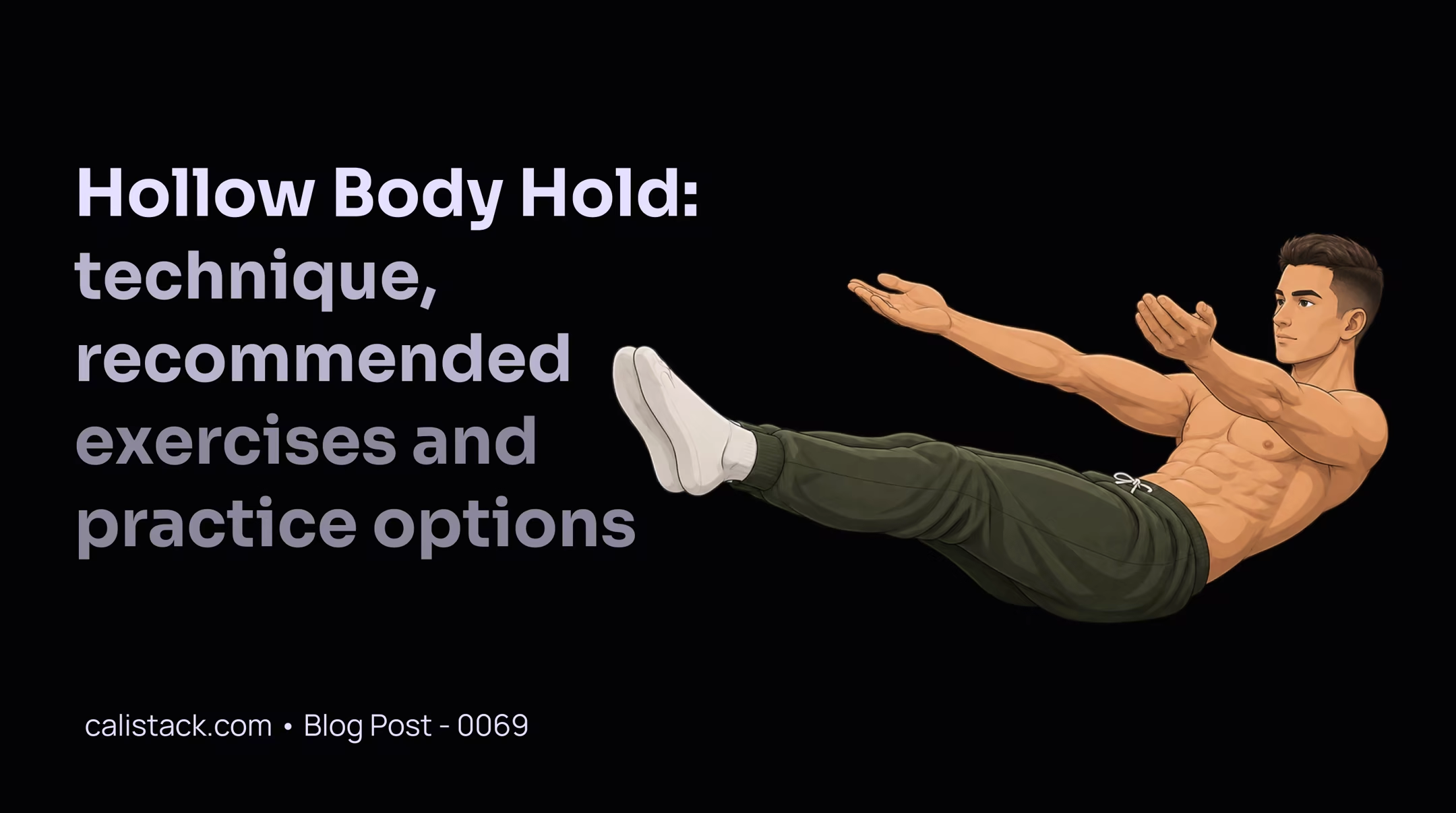
A hollow body hold is a supine body position you maintain while your arms and legs reach away from your trunk. In a common gymnastics reference, the lower back stays in contact with the floor, the ribs and pelvis stay controlled, and the body forms a shallow curve rather than an arch. The hold ends when you can no longer keep the agreed shape comfortably.
The exercise is harder when the arms and legs extend farther from the trunk. You do not need the longest version or a one-minute hold to make practice useful. This article describes one reference version. If the app shows a different position, compare that demonstration with these cues and ask a qualified coach which version you are practicing.
Find the position before extending the limbs
Lie on a mat with your knees bent and feet resting on the floor. Exhale gently and find a trunk position that keeps your lower back in comfortable contact with the mat. Do not force the spine down if that creates pain. Keep your neck relaxed and look toward the ceiling or slightly toward your legs. Start with your arms beside you or reaching forward, then lift the shoulders a small amount if that remains comfortable.
From there, lift one foot or both feet only as far as you can keep the same body shape. The full hollow reference often uses arms near the ears and longer legs, but that longer lever is not the only valid practice choice. You might keep knees bent, reach your arms forward, or lower one leg at a time. Use the easiest option that gives you a clear, repeatable position.
Breathe during the hold. A useful effort is one you can manage without straining your face or bracing so hard that you cannot breathe normally. If your lower back lifts, your ribs flare, your legs drift or you hold your breath, shorten the lever or end the set. The purpose is to practice the selected position, not to make discomfort part of the standard.
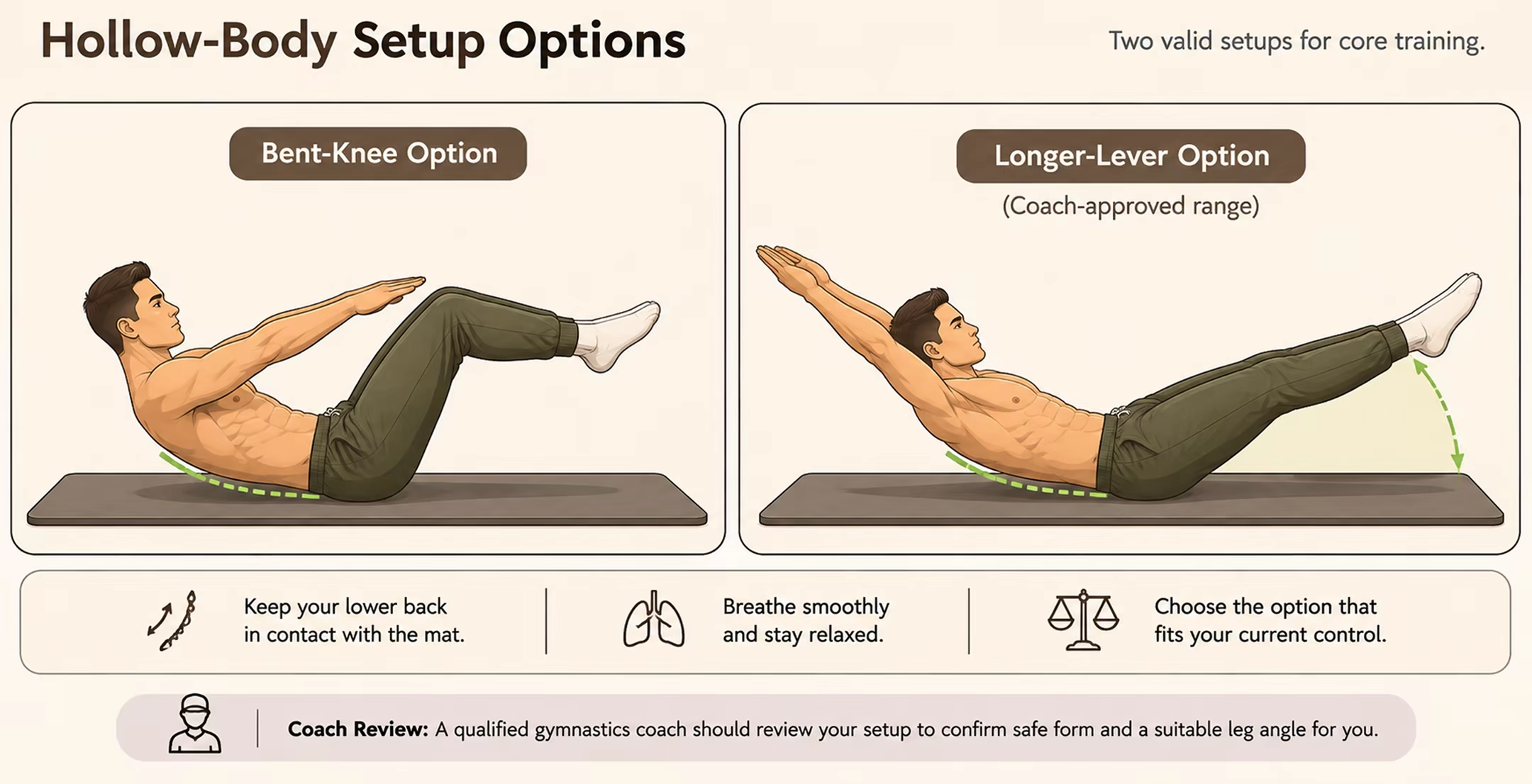
Do not confuse the hold with a crunch or a hollowing cue
The hollow body hold is a sustained whole-body position. It is not a series of sit-ups, and it is not the same as drawing the abdomen inward during a clinical abdominal-hollowing exercise. Research on hollowing cues or plank exercises does not, by itself, prove that this gymnastics hold prevents pain or transfers automatically to another skill. Keep the claim modest: you are rehearsing a body shape in this position.
A hollow hold can be one part of calisthenics practice. That does not guarantee that it will give you a handstand, front lever or muscle-up. Each skill has its own balance, support, apparatus and movement demands. If your goal is a specific skill, practice that skill at a suitable level and ask a qualified coach how much the hold belongs in your plan. Use this exercise to practice a position you can reproduce. You might notice whether your arms remain comfortable overhead, whether your legs stay together, or whether moving one leg changes your trunk position. Pick one observation for a set and keep the variation simple. If you change arm position and leg range together, you may have made the hold harder, but you will not know which adjustment caused the change. A short log can record the version, hold time, breathing, position and comfort. That record helps compare practice; it is not a diagnosis or a score that says a different skill is safe.
How the recommended Plank relates
The supplied exercise data lists Plank as the direct recommendation for Hollow Body Hold. A plank is a front-support exercise, often held on hands or forearms and feet, while the hollow hold is performed on the back. Both can involve maintaining trunk position against gravity, but the support points, shoulder demands and body orientation differ. A plank is a related option, not a required warm-up, test or prerequisite.
If you choose a plank, use a stable surface and a version you can leave safely. A wall or elevated support can make a front plank easier for some people; placing the knees down is another common adjustment. Keep breathing, stop before the body position changes, and do not assume that a longer plank proves you are ready for a longer hollow hold.
| Option | What changes | What to watch |
|---|---|---|
| Knees bent, arms forward | Shorter lever and lower reach demand | Can the lower back stay comfortably in contact while you breathe? |
| One leg lifted | One limb moves while the other remains supported | Does the trunk stay quiet as the leg moves? |
| Both legs lifted, knees bent | More leg load without fully straightening the knees | Does the pelvis stay in the chosen position? |
| Arms overhead and legs longer | Longer levers increase the challenge | Can you keep the same shape without arching or holding your breath? |
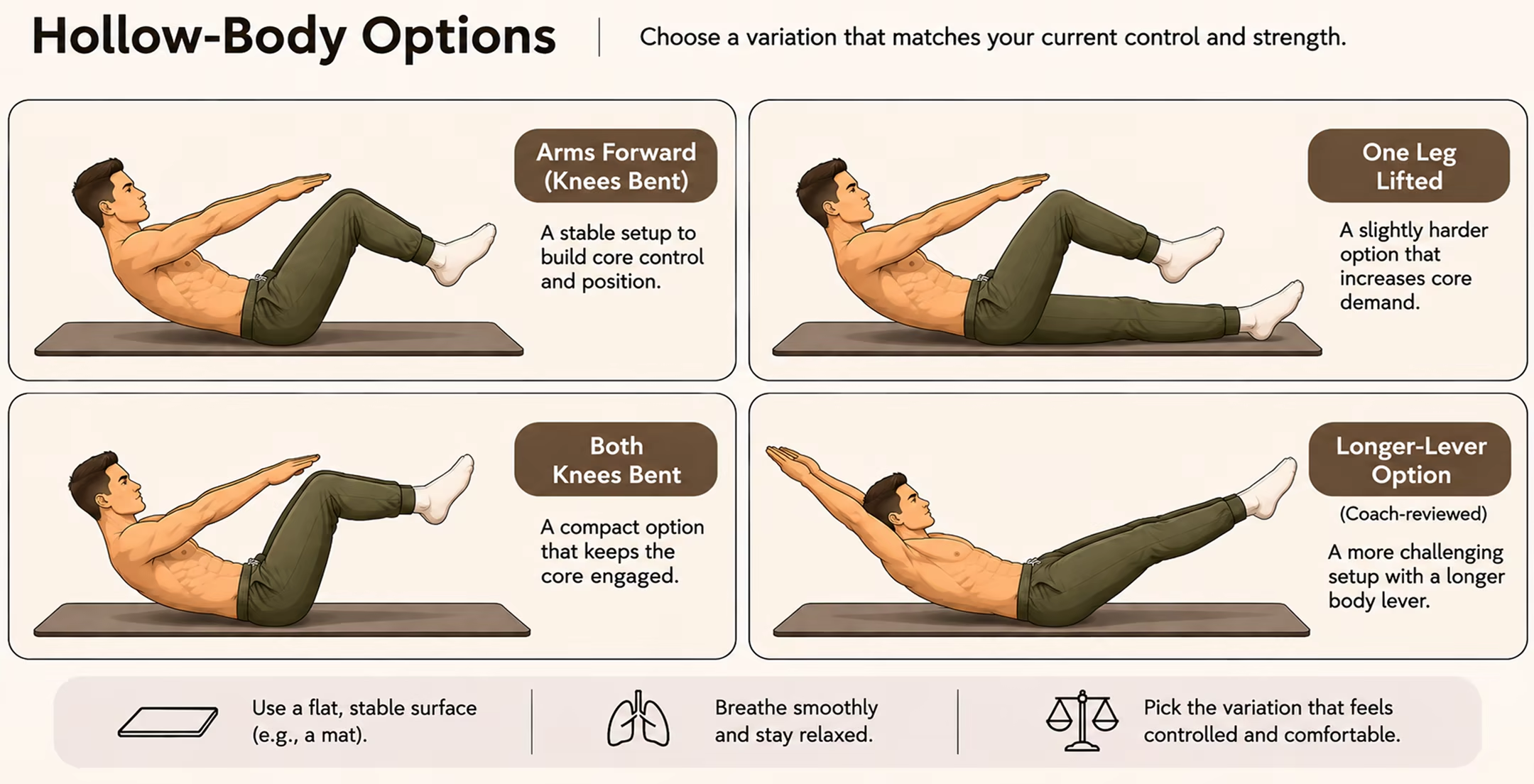
Practice briefly and record the shape
The exercise export gives no hold time, set count, rest interval or readiness rule. The sample below is an editorial coaching example, not a research-validated prescription or app requirement. Adjust it to your ability and stop if the position becomes painful or uncomfortable. A qualified trainer can help you choose the variation; this written description is not an individual assessment.
- Check the mat and floor. Lie down and find a comfortable starting position before lifting the legs.
- Try two or three short holds of about five to fifteen seconds in a bent-knee or arms-forward version. This range is only a sample; use less time if needed and rest until you can repeat the same shape.
- End each hold when the lower back lifts, the ribs flare, the legs drift or you cannot breathe comfortably. Do not extend the set to chase a timer.
- Record the version, arm and leg positions, hold duration before the shape changed, breathing and comfort. Next time, change one feature only if the current position is repeatable.
A useful note might say: hollow hold, knees bent, arms forward, two short holds, same position on both attempts, breathing comfortable. That record describes a practice session; it is not a testimonial or measured training result. If the same version becomes easier, you can discuss a small change, such as reaching farther with the arms, with a coach. There is no required time before you make that decision.
Common position changes and what to do
If your lower back arches away from the mat, bring the knees closer or move the arms forward. If you cannot find a comfortable position, stop and ask a trainer to check the setup rather than pressing harder into the floor. If your neck gets tired, lower your head or choose a version that does not require lifting the shoulders. The exercise should not become a neck endurance test.
If the legs shake or sink, shorten the hold and adjust the lever. Shaking by itself does not tell you whether you are injured or ready for a harder version. If you hold your breath, use a smaller position and breathe normally. If discomfort persists, stop and seek appropriate professional guidance. A warm-up does not make pain safe.
Hollow body hold questions
How long should I hold a hollow body?
There is no universal time requirement. Use a short hold you can control and end it when the agreed shape changes. A longer timer is not automatically better practice.
Does a 60-second hollow hold prove I am ready for a handstand?
No. A floor hold and an inverted handstand differ in support, balance and equipment. One time score cannot certify readiness for a different skill.
Is a plank a harder hollow hold?
No. A plank is a separate front-support exercise. It may be related trunk practice, but the support points and body orientation differ.
Should my lower back always be pressed flat?
The common gymnastics reference keeps the lower back in contact with the floor, but do not force a position that hurts. Shorten the lever or ask a qualified trainer for another option.
Your next step
Choose a bent-knee or arms-forward hold, note the position, and end it while you still have control. Explore Hollow Body Hold in CaliStack and compare the demonstration with your chosen version. Plank is a related option, not a required step or a promise of transfer to another skill.
Want a clear plan for your next skill?
We built Calistack to show you the exact steps from where you are right now to your first handstand, muscle-up, or lever.