By Calistack Team · Editorial standards: Calistack editorial team
One Leg L-Sit: the asymmetric hold and how to compare sides
A one leg L-sit is a held support with one leg extended and the other tucked, so your two sides work differently at once. Choose which leg to extend, keep the hips level, and record each side as its own entry. One side often feels harder, so compare the sides over time rather than treating it as a flaw.
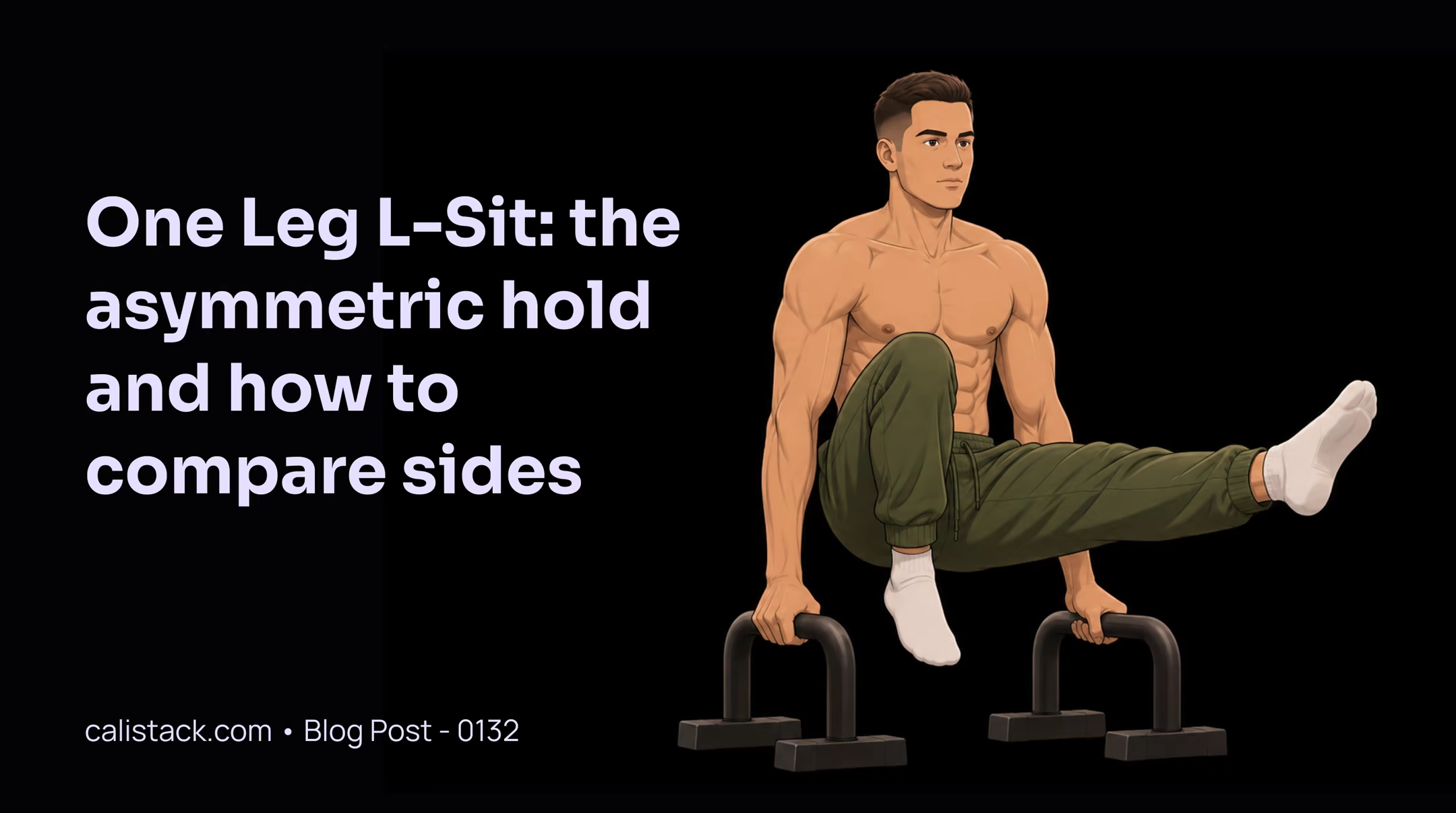
A one leg L-sit is the first version where the shape stops being symmetrical. One leg reaches forward; the other stays folded. The support is the same as a tuck, but the lever is not, and the difference between your two sides becomes part of the exercise rather than a detail you can ignore. This guide covers the shape, how to choose which leg to extend, why one side often feels harder, and how to keep a record that lets the two sides be compared honestly.
What makes a one leg L-sit asymmetric
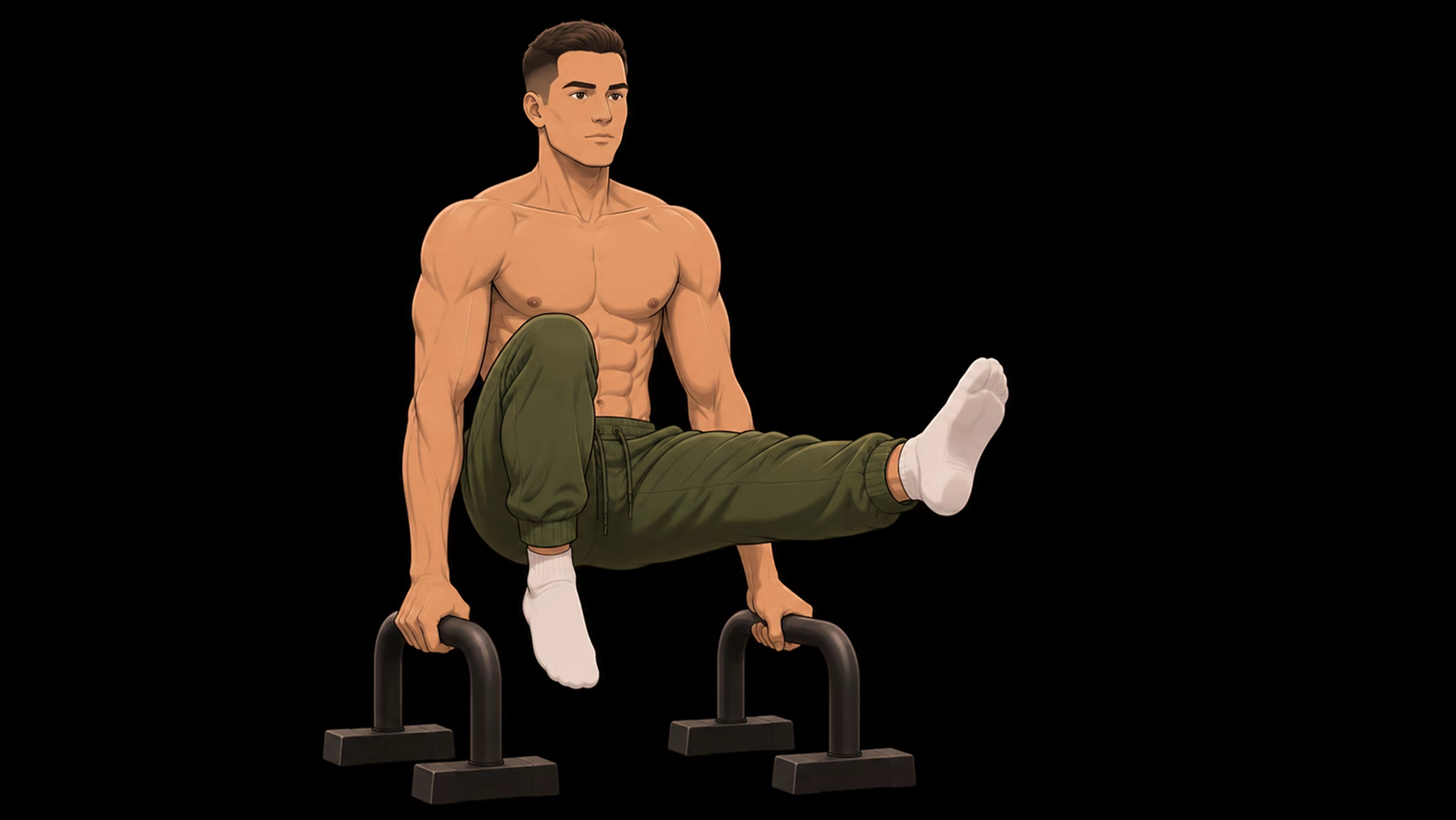
A one leg L-sit is a held support with your hips lifted, your hands pressing down, one leg extended forward at roughly hip height and the other knee folded toward your chest. The torso stays upright and the hips stay level. The extended leg is a longer lever than the tucked one, so the two halves of your body are doing different amounts of work at the same time. You hold the shape, then swap sides or lower.
It is not a tuck L-sit hold, because one leg is extended. It is not a full L-sit, because one knee stays bent. It is not a one-arm variation, and it is not a stretch. The published L-sit guide places it in the wider family; this article stays with the asymmetric hold and the side-to-side question that the other guides do not cover.
Its place between the tuck and the full L-sit
In the CaliStack skill tree, One Leg L-Sit sits between Tuck L-Sit Hold and L-sit. Tuck L-Sit Hold is its parent and L-sit is its only child. That makes it the first node where one leg is long and the other is short, before both legs extend. The tree is a suggested order, not a requirement, and the app supplies no sets, hold times or readiness thresholds.
| Shape | Legs | Lever | What it adds |
|---|---|---|---|
| Tuck L-Sit Hold | Both knees bent | Short and even | A held support with the least leg length |
| One Leg L-Sit | One extended, one bent | Long on one side, short on the other | An asymmetric hold and a side comparison |
| L-sit | Both extended | Long and even | The full two-leg lever |
The table is the reason the three articles are separate. A tuck teaches you to press and lift with a short lever. A one leg hold keeps that support and adds length on one side only. A full L-sit adds length on both. Moving from one to the next changes the lever, not just the effort.
The One Leg L-Sit record lists five recommended movements: Tuck L-Sit Hold, Seated L-Sit Leg Raise, Hollow Body Hold, Hanging Knee Raise and Leg Raises. The names are useful starting labels, but they do not confirm the app's exact setup, range or technique. Treat each as a related practice option, not a compulsory prerequisite or an instruction to train all five together. The first two work on support and lifting, Hollow Body Hold on trunk position, Hanging Knee Raise and Leg Raises on lifting the legs without the asymmetric support.
Choosing which leg to extend
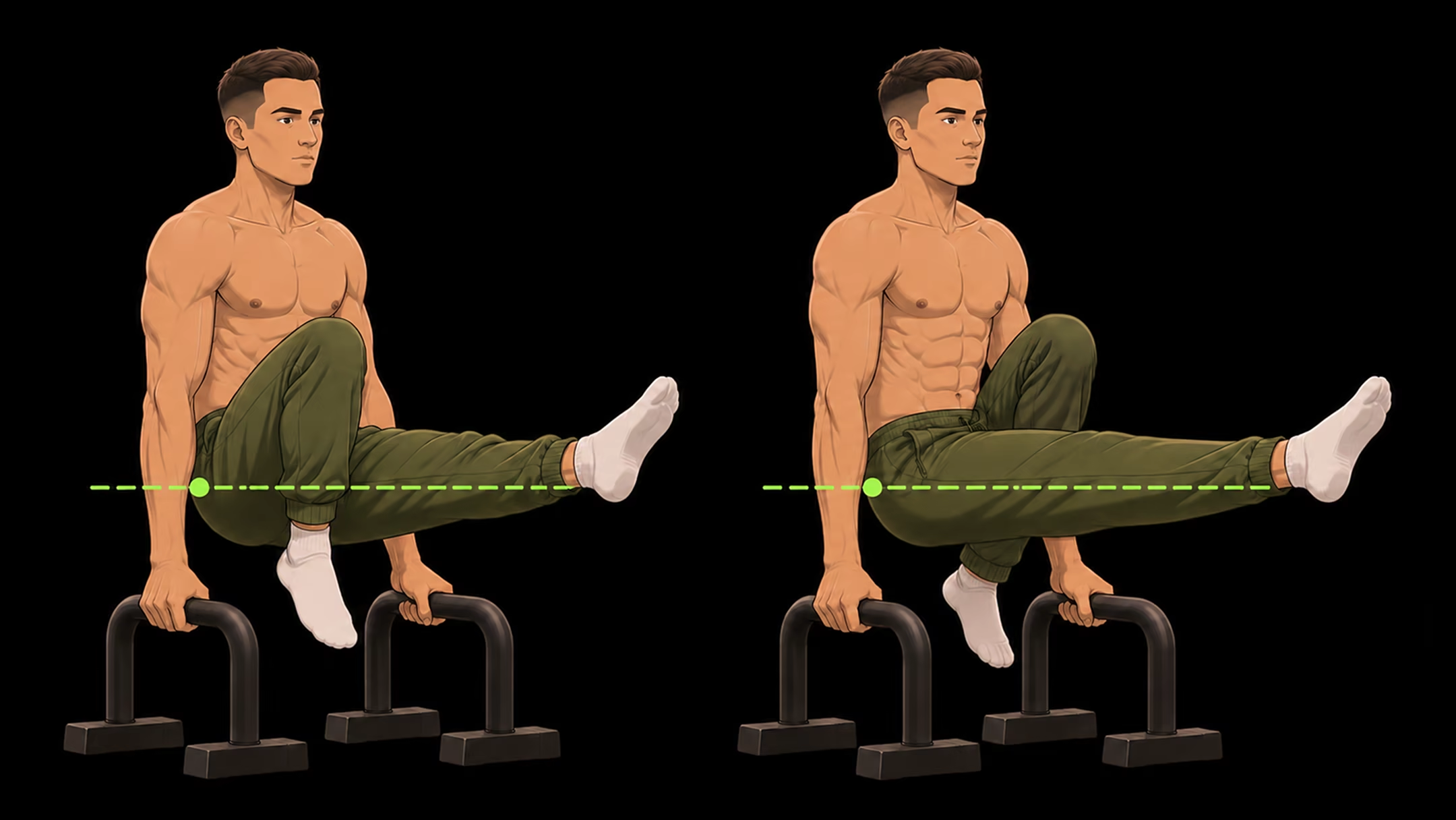
There is no rule that says which leg must extend. A practical default is to start with the side that can reach forward without the hip dropping or the torso twisting, then treat the other side as a separate skill with its own range. Some people alternate sides within a session; others spend a block on one side. Either is defensible. What matters is that you know which leg was extended, because left extended and right extended are different tasks and should not share one number.
If neither side feels clearly easier, pick one, record it, and keep the choice fixed for a few sessions before swapping. Changing the side every set makes it hard to tell whether a change came from practice or from the switch.
Holding the shape, then swapping
- Set your hands beside your hips or on stable parallettes, press down and lift the hips.
- Fold both knees toward your chest first, so you begin from a tuck you can hold.
- Extend one leg forward to about hip height, keeping the knee as straight as you can control and the hips level.
- Hold the shape without letting the extended leg sink or the torso rotate toward the tucked side.
- Fold the extended leg back in, lower the hips, reset, and repeat on the other side in its own set.
The swap is where most records go wrong. If you extend the left leg, hold, then immediately extend the right without resetting, the second side starts from a different position and the comparison is unfair. Reset the tuck, breathe, then set the other side. One illustrative example is three holds of five to eight seconds on each side, with rest between, but that is an example for discussion, not a dose or a readiness test.
Why one side often feels harder
A side difference is common, and it is not automatically a problem. The two hips can differ in how much hip flexion they produce, how well the hip flexors hold the leg up, and how much hamstring length lets the knee stay straight. Trunk control and the way you shift weight over the supporting hand can differ too, and most people have a preferred side for balance. None of those explanations can be confirmed from a paragraph, and this article cannot assess which one applies to you.
Direct research on the one leg L-sit is absent; the closest evidence is about the full ring L-sit. In a small study of ten elite male gymnasts, the training group's hip symmetry index during a two-second ring L-sit was about 20 percent at baseline, where a lower number means more symmetry, and about 4 percent after an eight-week Pilates program. The groups had five people each. That is indirect: the task was a two-leg ring hold in advanced gymnasts, not a one leg hold on the floor, and the intervention was not this exercise. It does suggest that side differences are normal enough to measure rather than a personal flaw.
| What to compare | Why it can differ | What to record |
|---|---|---|
| Height of the extended leg | Hip-flexor strength and the length of the lever you can control | Whether the thigh reached hip height or stopped lower |
| Knee of the extended leg | Hamstring length and the choice to keep it straight | Straight, slightly bent, or clearly folded |
| Hip level | Trunk control and weight shift over the supporting hand | Level, or rotated toward the tucked side |
| How long the shape lasts | Endurance on that side and the support | Seconds before the leg sank or the hips dropped |
Manageable alternatives for a lopsided hold
If the extended leg will not stay at hip height, lower it. A shorter lever is still the same task, and it keeps the hips level, which is the point of the variation. The extended leg is held by hip flexion and the tucked knee still has to stay folded, so the compression work does not disappear when the leg comes down; it just becomes easier to control. A slightly bent knee is another manageable version; straighten it only as far as you can keep the thigh up. If the support is the limiter rather than the leg, use higher parallettes or a shorter hold. If one side is far behind, give that side its own reduced range instead of matching the stronger side. Record which version you used, because a lower leg is not a worse result, only a different one.
Keeping a separate record for each side
Log left extended and right extended as separate entries. Include the surface, the height of the extended leg, whether the knee stayed straight, the seconds held, and the first thing that changed. An entry such as parallettes, left leg extended to hip height, right knee tucked, five seconds, left leg began to sink is more useful than one combined total. If you practise both sides in one session, keep the sets separate in the note.
No hold time certifies the next step. A better signal is that both sides can hold the same shape for a comparable interval with level hips, and that the difference between them is stable rather than growing. When that is true, change one thing: a little more height on the weaker side, a straighter knee, or a full L-sit attempt in its own block.
One leg L-sit questions
Which leg should I extend?
There is no universal rule. Start with the side that can extend without the hip dropping or the torso twisting, record it, and treat the other side separately.
Is a one leg L-sit easier than a tuck?
Not necessarily. The support is similar, but one leg is a longer lever, so the asymmetric shape can be harder even though one knee is bent.
Why does one side feel weaker?
Side differences are common and can come from hip-flexor strength, hamstring length, trunk control or weight shift. If the difference is new, painful or worsening, ask a qualified professional.
Should I train both sides in one session?
Yes, if both are comfortable, but keep the sets and the records separate so a change on one side is not hidden by the other.
Even out one side at a time
Choose one side, set the tuck, extend the leg only as far as you can keep the hips level, and write down what changed first. Then repeat on the other side in its own set. If you use CaliStack, open One Leg L-Sit and compare its demonstration with the shape described here; the tree places it after Tuck L-Sit Hold and before L-sit, but that is a suggested order rather than a schedule.
Sources and evidence limits
Source check: . Research context is separate from an individual technique assessment. Sample programs are editorial examples, not validated unlock tests.
Gil, Yoo and Yoon studied ring L-sit stability after an eight-week Pilates core-training program in ten male elite gymnasts. [9]
The task was a two-leg ring hold in advanced gymnasts, not a one-leg floor hold, so it does not establish a way to compare sides or a hold time.
- [9] Hojong Gil, Sihyun Yoo and Sukhoon Yoon. Effects of an 8-week Pilates Core Training on the Stability and Symmetry of the L-sit on Rings (2017-01-13).
Full publisher article retrieved on 2026-11-10; the page lists electronic publication on 2017-01-13 for a 2016 journal issue. Ten male elite gymnasts participated.
Want a clear plan for your next skill?
We built Calistack to show you the exact steps from where you are right now to your first handstand, muscle-up, or lever.