By Calistack Team · Editorial standards: Calistack editorial team
Hanging leg raise: straight legs, a quiet swing and an honest range
A hanging leg raise is a straight-leg lift from a bar, so grip and swing often set the limit before your trunk does. Set the hang, choose a range you can stop at, and end the set when your grip starts to open. Record the endpoint and knee position so technique changes do not look like strength changes.
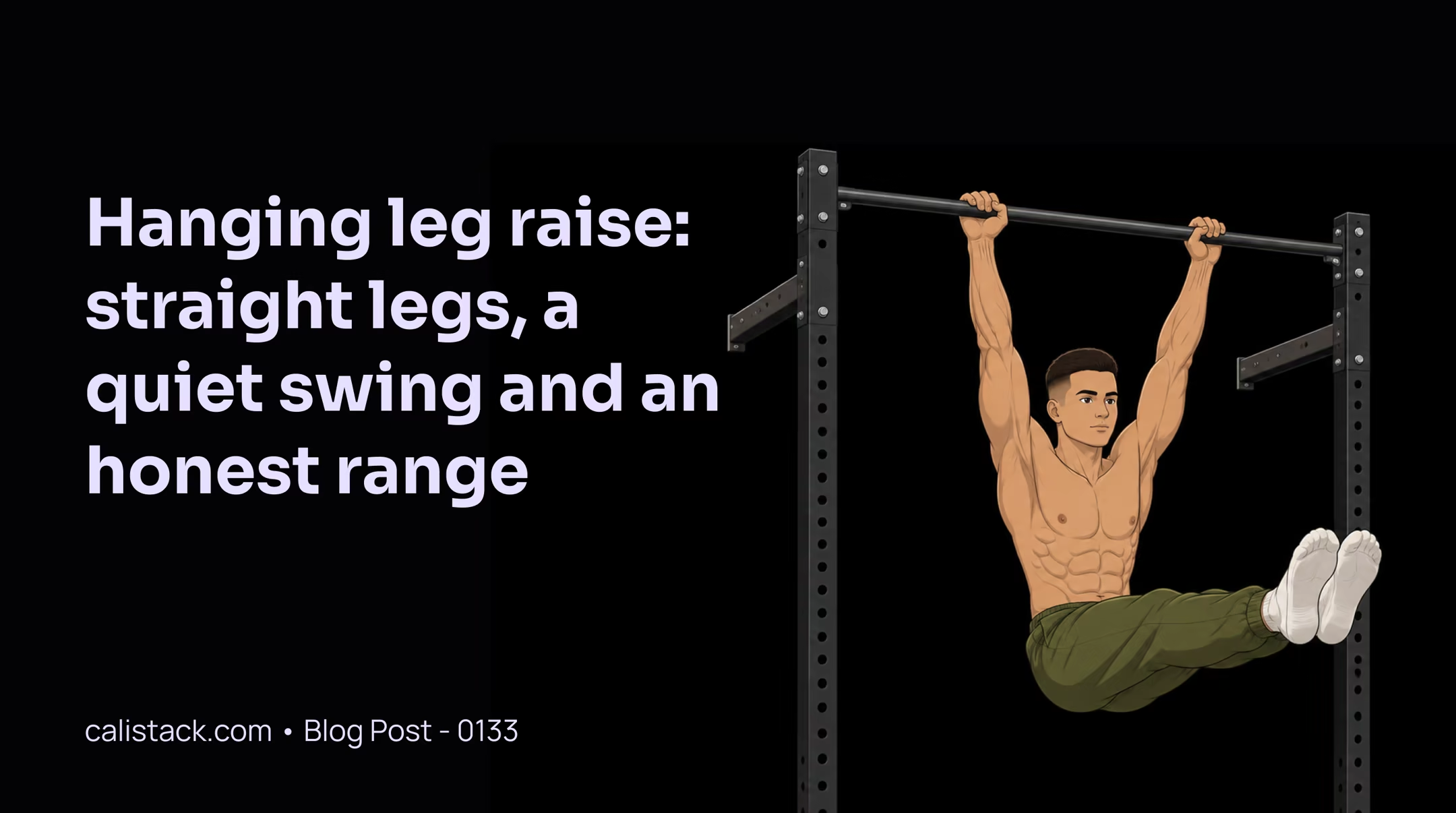
A hanging leg raise looks like a floor leg raise moved onto a bar. It is not. The bar takes the support away from your back and hands it to your grip, and the free-hanging body gives every lift something to swing against. That is why two people with similar trunk strength can have very different experiences of the same exercise: one is working against a lever, the other against a pendulum.
A straight-leg lift, not a knee lift with long shins
For this guide, a hanging leg raise is a repetition from a full hang in which the knees stay straight, the legs travel in front of the body to a height chosen before the rep, and the legs return without the body swinging into the next rep. The bar is fixed, the feet never touch it, and the lift comes from the trunk and hips rather than from a kick.
Three things get called a hanging leg raise and are not. Bent knees make it a hanging knee raise, a shorter lever and a different record. A swing that carries the legs up is a kip, even a small one. A repetition that begins with a jump from the floor is a jump and a hang. A straight-leg lift that stops at hip height is still a hanging leg raise, but write the endpoint down or the number means nothing.
Where it sits, and what the branch assumes
In the skill tree, Hanging Leg Raise sits after Hanging Knee Raise and before Toes-to-Bar Progression. Its parent is Hanging Knee Raise, and the branch above it runs from Leg Raises, which follows Mountain Climbers. The tree is a suggested order, not a requirement, and the app supplies no sets, hold times or readiness thresholds; nothing in it declares you ready to move up.
CaliStack lists three recommended movements for Hanging Leg Raise: Mountain Climbers, Hanging Knee Raise and Leg Raises. The names are useful starting labels, but they do not confirm the app's exact setup, range or technique. Treat each as a related practice option, not a compulsory prerequisite or an instruction to train all three together.
Mountain Climbers are a plank with alternating knee drives. They train pace and hip-flexion endurance under a supported trunk and never load the grip. If your hanging set falls apart because you cannot keep a rhythm, they are a reasonable separate choice, but they will not teach the straight-leg hang shape.
Hanging Knee Raise is the closest neighbour and the obvious easier option: same bar, same grip, shorter lever. It is also a different record, because a knee raise to the chest is not a straight-leg raise to the same height. Leg Raises is the floor version, and the existing Leg Raises guide already covers it. Here it matters as a contrast. On the floor the back has a surface and the hands hold nothing, so the trunk and hip-flexion task overlaps but the grip, the swing and the overhead shoulder position do not exist.
| Version | Support and lever | What it changes |
|---|---|---|
| Mountain Climbers | Plank on the hands; no hang; alternating knee drive | Trains rhythm and hip-flexion endurance, not the straight-leg hanging shape |
| Hanging Knee Raise | Full hang; knees bent; short lever | Keeps the grip and swing demand but removes the straight-leg lever |
| Hanging Leg Raise | Full hang; knees straight; long lever | Adds the straight-leg lever and more swing to control than a knee raise |
| Toes-to-Bar Progression | Full hang; feet travelling toward the bar | Adds range and a target above the hips; a separate method with its own record |
| Leg Raises | Supine on the floor; no grip | Keeps a hip-flexion task with a surface behind the back and nothing to hold |
Read the table by the column that names your limit. If the grip fails first, every bar row shares that problem and the floor row is the one that removes it. If the legs swing, the knee raise and a shorter range are the levers you can change. If range is the goal, Toes-to-Bar Progression is the next method on the tree, but it is a different exercise with a different record, and this guide does not teach it.
Set the hang before you lift
- Check the bar and the floor. The bar must be fixed and rated for bodyweight, with clear space in front of you and a safe way to step on and off.
- Take a grip you can repeat. Shoulder-width overhand is a common choice; the grip you log should be the grip you use next time.
- Hang with straight arms and let the body settle. Wait until the legs have stopped moving before the first rep.
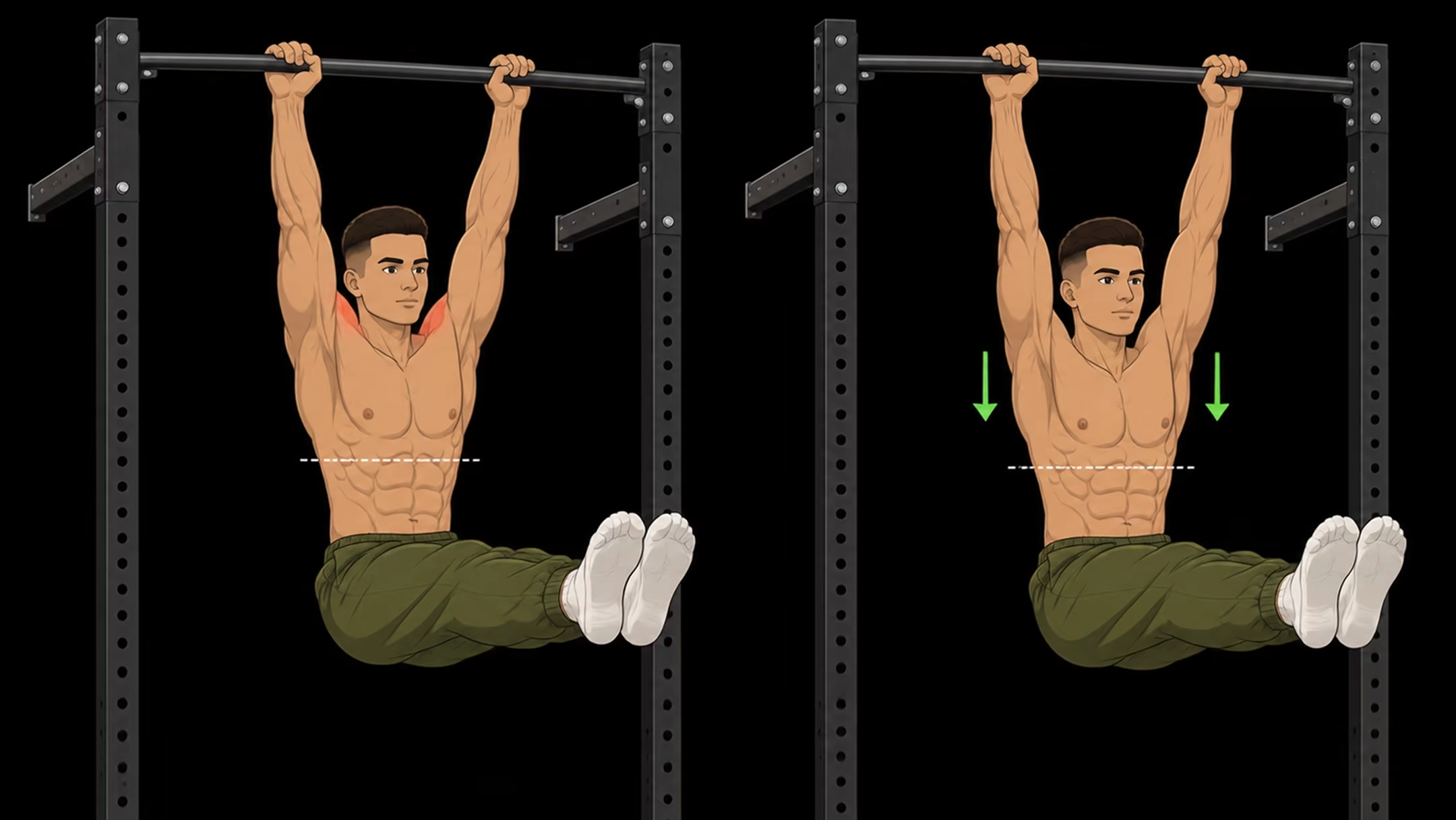
- Choose the shoulder position. A passive hang leaves the shoulder blades high; a small pull down sets them before the lift. Pick one and keep it for the set.
- Set the ribs and the legs. A little tension through the trunk stops the lift becoming a swing.
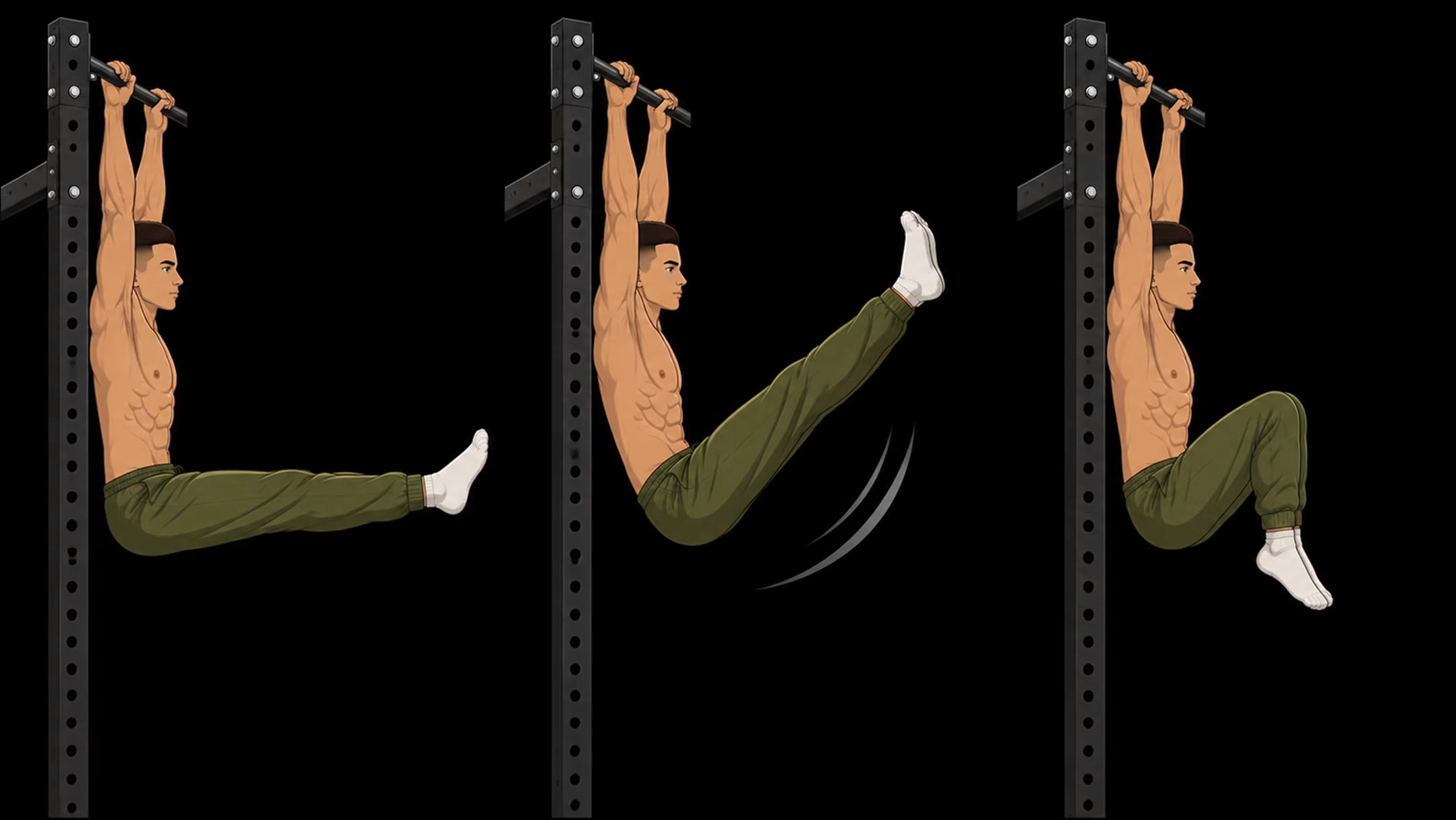
- Lift to the chosen endpoint, stop for a moment, and lower more slowly than you lifted.
- Let the body stop at the bottom. The next rep starts from still, not from the return swing.
The shoulder position is easy to skip. At the bottom of a hang the arms are overhead and the shoulder blades sit around the rib cage, and how much you pull them down changes the first centimetres of the lift. Prinold and Bull tracked the scapula through pull-ups in eleven experienced men and found it rotates and tilts through the repetition; they did not test leg raises, so treat this as indirect support for deciding on a shoulder position rather than letting it happen. Keep the neck long rather than craning at the bar, and keep breathing; if you cannot breathe and hold the shape, the range is too long for that day.
A small block, written as an example
The app gives no sets, repetitions, rest or readiness targets. What follows is an editorial example for a generally healthy adult with a checked bar and a comfortable hang, not a validated programme. Start with fewer repetitions than you think you need, because the grip and the trunk tire at different rates.
- Warm up with an easy hang and a few knee raises rather than a set of straight-leg lifts.
- Do two or three sets of three to five repetitions at one endpoint, resting long enough that the next set starts from a still body.
- Stop the set when the grip begins to open or the legs no longer stop where you aimed.
- Write the endpoint and the grip beside the number.
Three sets of five is an illustration, not a target. Some readers will do better with two sets of two; others will find that one set at a shorter range is the honest choice. The useful question is whether the last repetition looked like the first, not whether you matched a number from an article.
The errors that turn a lift into a swing
A common error is a small kick to start. The hips snap, the legs arrive at the endpoint, and the return carries the body into the next rep. The consequence is a set that trains timing rather than control, and a record that cannot be compared with a strict set. The correction is to pause at the bottom until the legs are still, even if that means one repetition instead of five.
The second is shrugging into the ears as the legs rise, which usually means the shoulder position was never set and the neck is doing work the trunk should do. The third is chasing height. A straight-leg raise to hip height with a still body is a better record than a raise to the bar with a swing, and the two are different exercises. If the feet only reach the bar on the third rep, the first two are the honest ones.
What the hanging studies measured, and what they did not
McGill, Andersen and Cannon recorded fourteen men performing a hanging straight leg raise and estimated roughly 3000 newtons of spinal compression, with rectus abdominis above 130 per cent of a maximum voluntary contraction and external oblique at 88 per cent. Those are modelled estimates from a small sample, not measurements of your spine, and the study did not test beginners, grip positions or how many repetitions anyone should do. It does support one practical point: a straight-leg lever from a bar is a substantial trunk task, not a warm-up.
Two floor studies are indirect here. Lee measured leg raises in twenty healthy adults and found the ratio of rectus abdominis to rectus femoris activity rose once hip flexion passed about 45 degrees, which suggests the hip flexors carry more of the early range. Andersson and colleagues tested six men across 38 exercises and found the hip flexors highly active whenever the legs were lifted, with the abdominals clearly involved in bilateral leg lifts. Neither used a bar. They help explain why the bottom of the range feels different from the top; they do not establish a correct height. None of the studies reviewed here tested a hanging leg raise programme, a grip-training effect or a readiness test, so any repetition count offered as proof is coaching convention rather than a finding.
Record the endpoint, then change one thing
A useful entry reads: overhand shoulder-width, passive hang, three sets, three straight-leg raises to hip height, last rep slower than the first, grip comfortable. That is comparable. Ten leg raises is not, because the next session may start from a different bar, a different height or a swing. Readiness has no universal number. What you can observe is narrower: the same endpoint across sets, a still body at the bottom, and a grip that is not the reason the set ended. When that holds for several sessions, change one variable, such as a little more height or a slower lowering. If the change makes the next rep worse, go back.
Hanging leg raise questions
Should my knees stay straight?
Straight knees are what separates this from a hanging knee raise, but straight legs that swing are not a better exercise. If you cannot keep the knees straight and stop the swing, bend them and record a knee raise.
How high should the legs go?
There is no universal height. Hip height, chest height and toes to the bar are different records. Choose one, stop there, and compare like with like.
Is my grip or my core the limit?
Often the grip. Test it by hanging for a while without lifting. If the hands fail before the trunk, the set is a grip set, and training the hang separately is the honest fix.
Do I need hanging knee raises first?
No. The tree puts Hanging Knee Raise before Hanging Leg Raise, but that is a suggested order. A knee raise is the obvious easier option, not a gate you must pass.
Pick the lever you can stop
Before the next session, choose the support, the grip, the shoulder position and one endpoint, and write them down. Keep them fixed long enough to see whether the last rep still looks like the first. If you use CaliStack, the Hanging Leg Raise entry sits between Hanging Knee Raise and Toes-to-Bar Progression, and the log is a sensible place to keep the endpoint beside the repetition count; the app does not tell you how many to do.
Sources and evidence limits
Source check: . Research context is separate from an individual technique assessment. Sample programs are editorial examples, not validated unlock tests.
Andersson and colleagues measured abdominal and hip-flexor activity across training exercises including leg lifts. [14]
The study did not test a hanging version, grip endurance, a range endpoint or a repetition target.
Want a clear plan for your next skill?
We built Calistack to show you the exact steps from where you are right now to your first handstand, muscle-up, or lever.