By Calistack Team · Editorial standards: Calistack editorial team
Dragon Flag Tuck: technique, recommended exercises and practice options
A tucked dragon flag uses bent knees to shorten the lever while your upper back stays supported. Choose a range you can lower through without changing shape, and stop before you lose control. Hollow holds are a separate way to practise trunk position, not a requirement for trying this variation.
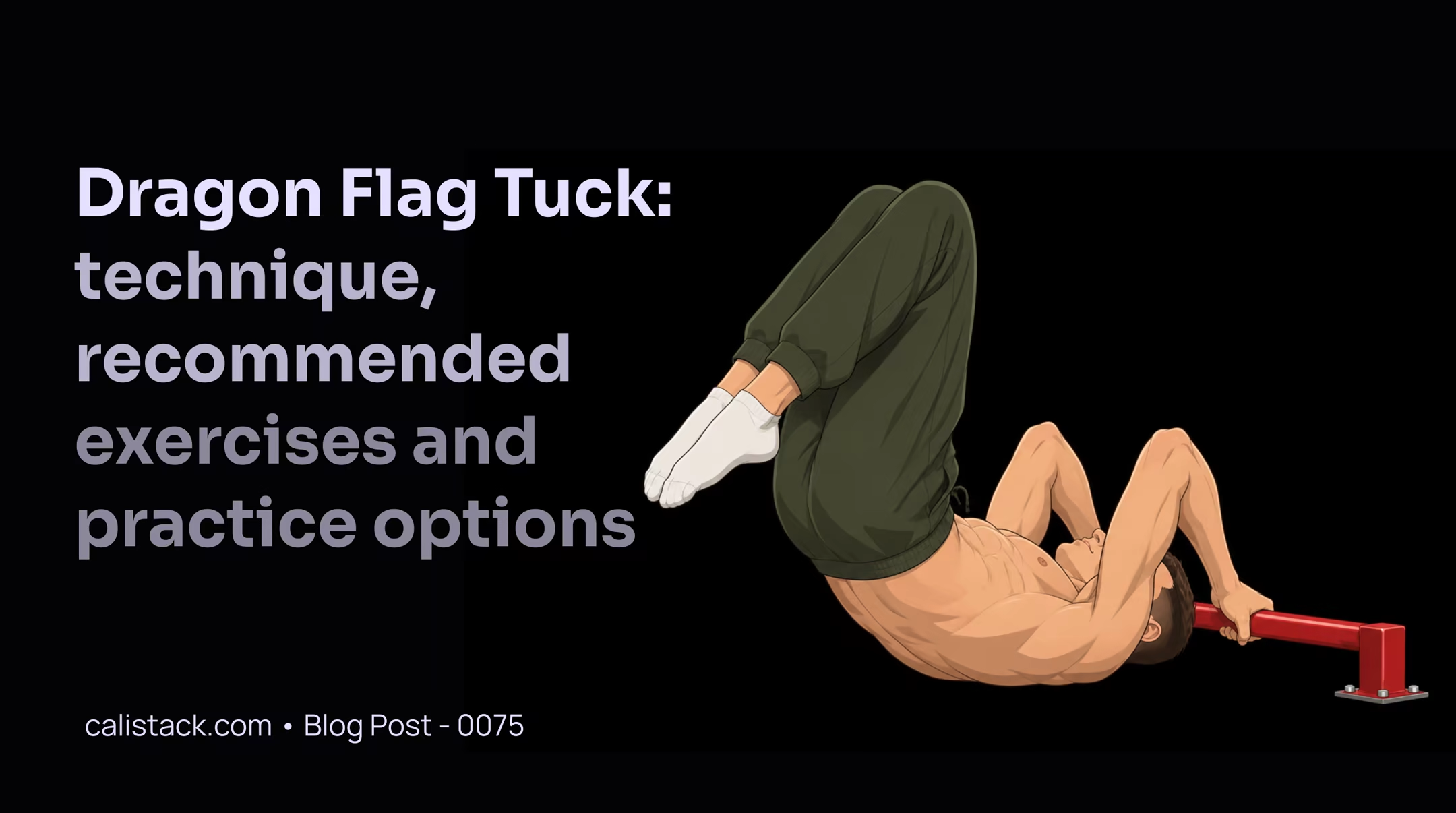
A Dragon Flag Tuck uses bent knees to shorten the body lever compared with a straighter-leg dragon flag. That change can make the variation more manageable, but it does not make the exercise beginner-proof. You still need a stable anchor, a coach-confirmed version, and control of the movement you are actually practicing. CaliStack's exact demo has not been confirmed, so this guide separates a general coaching definition from any app-specific standard.
Define the tuck before you train
The name can refer to different tasks: a static tucked hold, a slow lowering, a raise-and-lower repetition, or one of several positions between a tight tuck and a straight body. Coaching sources do not all use the same progression or readiness rule. Calisthenic App distinguishes tuck, advanced tuck, half lay and full versions; 12 Minute Athlete describes one-leg-tucked negatives before full negatives. Those are examples of coaching approaches, not proof that every trainee must use that order.
For this article, a tucked dragon-flag practice means the knees remain bent toward the chest while a person holds or lowers the torso and legs as a controlled unit from a secure anchor. The shoulders and upper back, not the head or neck, bear the support. This is a general working definition, not a claim that every app version looks the same. If you plan to practice the CaliStack movement, check whether its demonstration is a hold, negative or dynamic repetition and what support it uses. Ask a qualified trainer to help identify the version and its range.
Choose the equipment and starting position carefully
Use only an immovable bench or fixed structure designed to take the force of the exercise. The support must not slide, tip, fold or roll. A person often grips a handle or edge behind the head to counter the body's movement; inspect that grip point and ask a trainer to show how to enter and leave the position. Do not assume that any table, bed frame or portable bench is a safe anchor. Keep the surrounding floor clear.
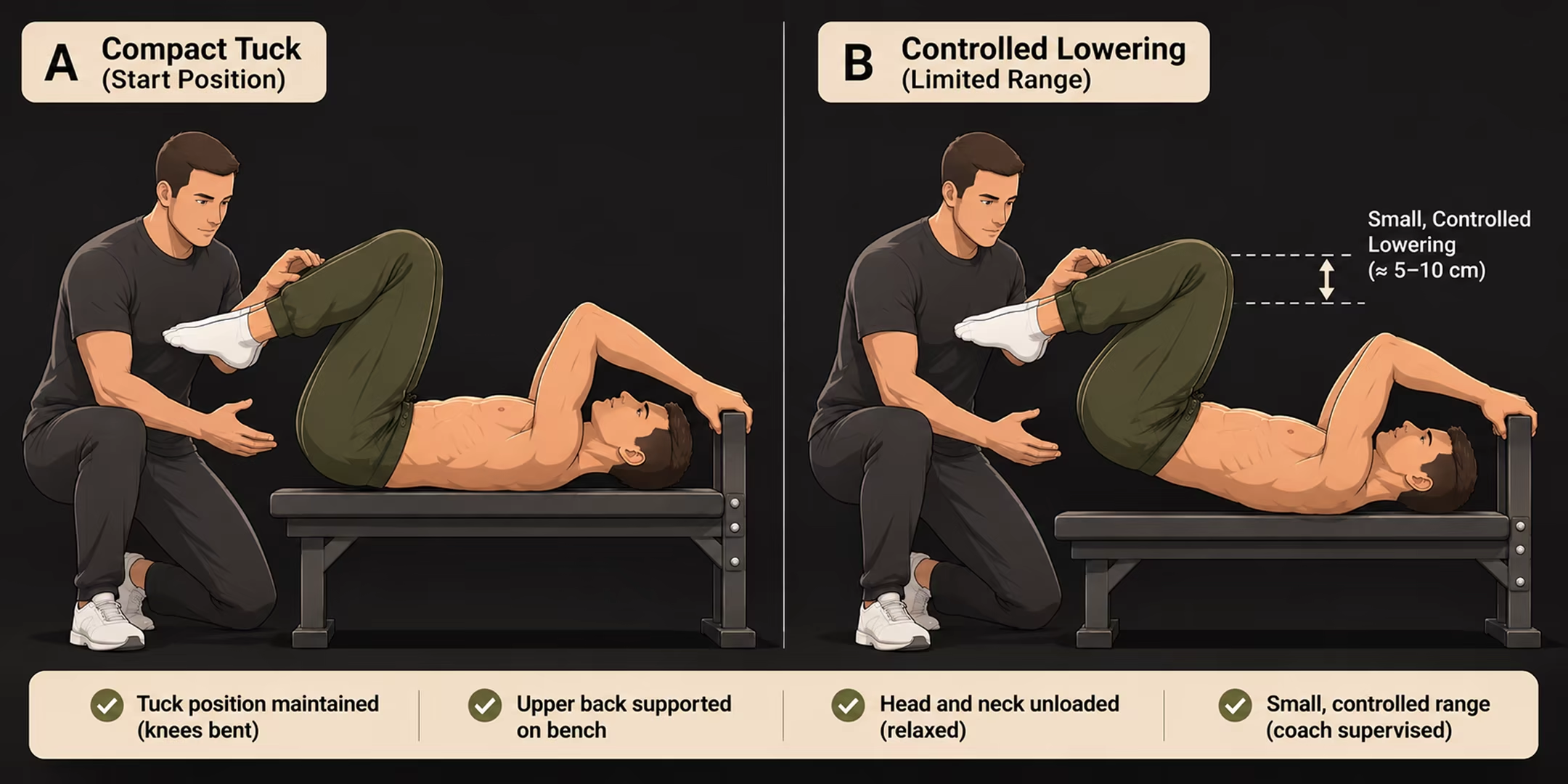
A coach can first check whether you can lie on the support comfortably, hold the anchor without wrist or shoulder strain, and keep the head and neck relaxed. If the setup forces your neck into pressure or your grip is slipping, do not start a repetition. The correct amount of range depends on the confirmed variation and the person's control; this guide does not set a universal bottom position.
Use a coach-checked movement standard
- Confirm the anchor and the approved entry and exit with a qualified trainer. If you cannot get into and out of the position deliberately, do not attempt the exercise alone.
- Adopt the demonstrated tucked shape. Keep both knees bent in the position your coach has selected; do not extend a leg to make the exercise look harder.
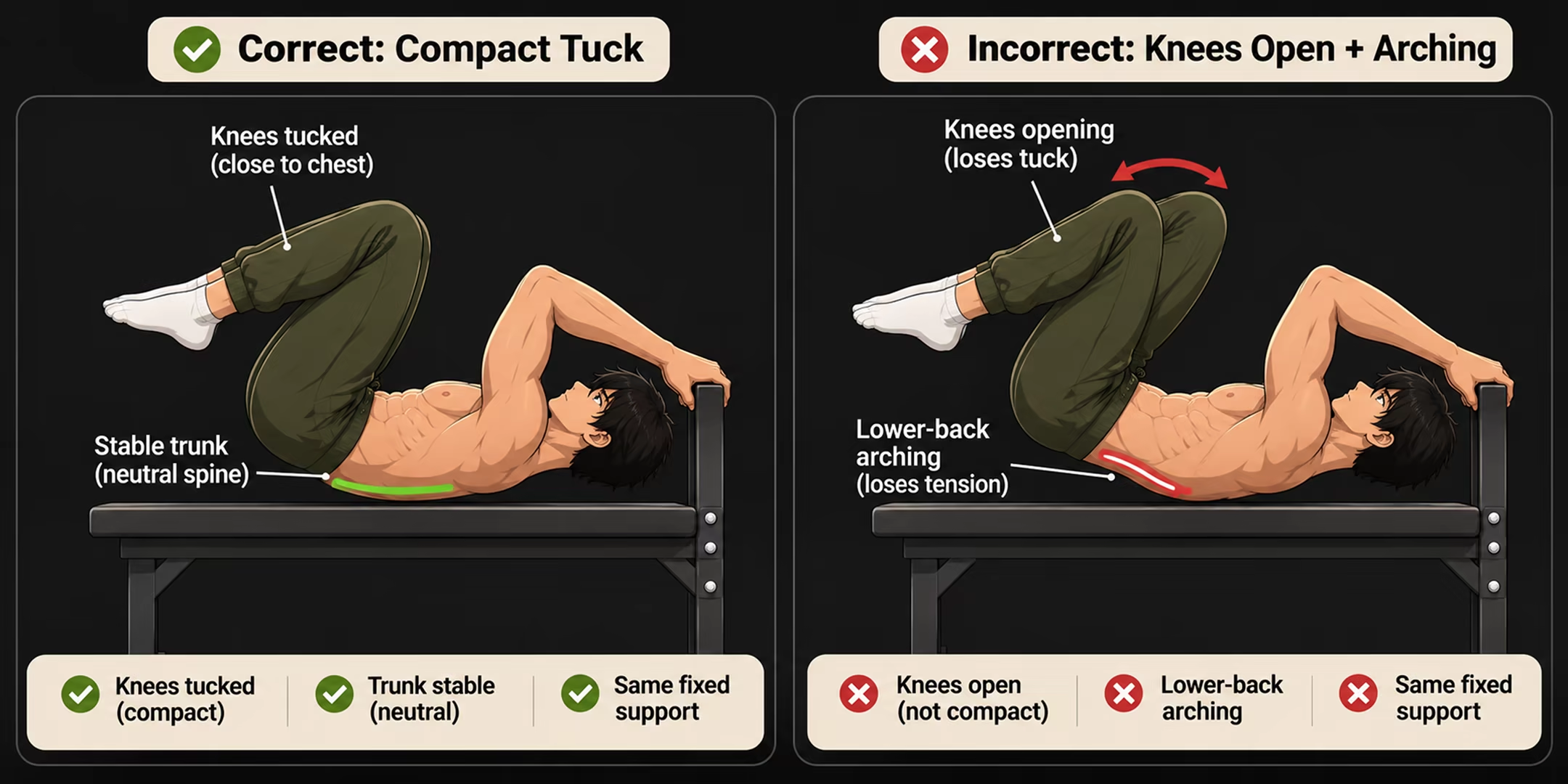
- Maintain the trunk shape through only the coach-approved range. Stop before the lower back arches, the ribs flare, or the legs swing away from the tuck.
- Return to the starting support using the taught route. Do not drop the body, roll onto the neck, or continue after your grip or body position changes.
If a demo shows a static hold, record the hold separately from a lowering repetition. If it shows a negative, do not label a raise-and-lower rep as equivalent. A shorter lever generally reduces the external demand compared with extending the legs, but the precise difficulty also depends on body position, angle, range, support and individual strength. The label tuck alone does not tell you how hard a particular version is.
Use the recommended exercises as options, not a ladder
CaliStack's data links four exercises to Dragon Flag Tuck, but it does not say whether those links mean preparation, alternatives, or simply related movements. The descriptions below refer to common exercise categories, not confirmed app videos. Choose only an option that matches your goal and current ability; you do not have to complete all four before considering the tuck.
| Recommended movement | General movement idea | Possible use |
|---|---|---|
| Plank | A held body position that asks the trunk to resist changing shape. | A separate way to practice trunk control. A plank result does not certify readiness for a dragon flag. |
| Hollow Body Hold | A floor-based body shape often used in gymnastics and calisthenics practice. | Can help a coach assess whether you can maintain a chosen trunk position, but no universal hold time is a prerequisite. |
| Hanging Knee Raise | A knee-lifting task performed from a hanging support, if that is the app's demonstrated version. | Related trunk and hip practice with a different anchor and loading direction; it is not a dragon-flag substitute. |
| Leg Raises | A broad exercise name used for multiple lying or hanging variations. | Verify the exact app demo first. The name alone does not establish its setup, difficulty, or role in training. |
The Calisthenic App guide recommends a hollow-body hold and describes several body-length options, while 12 Minute Athlete uses candlestick and tucked-negative variations. Their details differ, and the published thresholds are coaching choices rather than trial-tested readiness cutoffs. Use these pages as examples of how coaches explain the skill, not as evidence that one exact sequence prevents injury or works for everyone.
A conservative practice option
If you have no in-person coaching or approved demonstration, do not attempt a dragon-flag negative from written instructions. A lower-risk planning option is to ask a trainer to choose one familiar movement, such as a plank or hollow-body variation, and review whether you can maintain that position comfortably. Those exercises are still separate skills, and they do not guarantee that the dragon-flag setup is appropriate.
After a trainer confirms the exact tuck and you can enter and leave it safely, a small sample block might use one or two sets of two to four controlled repetitions or brief holds, with full recovery between attempts. These amounts are an editorial example only, not a researched dose or app benchmark. The coach should decide whether that means a hold, a partial lowering or another demonstrated version. Stop each set while the position is still controlled; do not add extra attempts to compensate for an uncertain rep.
- Record the exact variation shown: static hold, negative, or dynamic repetition.
- Write down the support used, the tuck shape, the range, and the number of clean attempts.
- Note whether the back shape, grip and exit stayed controlled, and how you felt after the set.
- Change only one feature at a time, such as range or hold duration, and do so with the trainer's approval.
| Observation | Next decision to discuss |
|---|---|
| The anchor moves, grip slips, or entry is uncontrolled. | Do not continue; change the setup or choose another exercise with the trainer. |
| The tuck opens or the back arches during the movement. | Reduce range or return to a separate core exercise chosen by the coach. |
| The neck or head takes pressure. | Stop and have the position and support checked before any further attempt. |
| The same version stays controlled and recovery is comfortable. | Repeat it and ask the coach whether one small change is appropriate; no rep count automatically unlocks a harder version. |
Mistakes that change the exercise
Opening the knees or extending the legs increases the lever and changes the task. It is not a correction for a failed repetition. If the body shape changes, reset or end the set. Swinging the hips to get into position also makes the attempt different from a controlled tuck. Use the entry your trainer taught instead of kicking upward.
A second common problem is chasing a lower position because a photo or online routine shows one. There is no universal floor distance that every person must reach. A smaller range may be the appropriate choice for the demonstrated version. If you feel pressure through the neck, sharp back pain, shoulder pain, or loss of control, stop rather than trying to hold the shape harder.
What the evidence supports
The inspected dragon-flag instruction pages are coaching resources, not controlled trials of Dragon Flag Tuck. A general review of core-stability exercise principles discusses trunk control and exercise progression, but it does not validate a dragon-flag progression, a minimum hollow-hold time, or a specific tuck dose. This article therefore presents its sample practice as editorial, makes no deadline promise, and does not claim that the movement treats or prevents back pain.
Dragon Flag Tuck questions
Is Dragon Flag Tuck safe for beginners?
The name alone does not tell you whether a version is suitable. Because support, body position and range matter, have a qualified trainer confirm the exact demo and equipment before attempting it.
Do I need a 30-second hollow-body hold first?
No universal 30-second rule is established by the evidence reviewed here. A coach may use a hold as one observation, but it is not a guarantee of readiness.
Are hanging knee raises and leg raises prerequisites?
No. They are related exercises in the supplied database list. Hanging knee raises use a different support, and Leg Raises can refer to different variations; check the specific app demonstration.
Should I train the full dragon flag after the tuck?
Not automatically. A straighter body creates a different lever and load. Let a qualified coach review control, equipment, range and recovery before changing the variation.
What should I do if I feel pain or neck pressure?
Stop the attempt and do not test the position again to see whether it passes. Ask a qualified health professional about persistent or concerning symptoms, and have a trainer check the exercise setup separately.
Explore Dragon Flag Tuck in CaliStack and check the demonstration for the variation you intend to practice. Plank, Hollow Body Hold, Hanging Knee Raise and Leg Raises are separate options, not steps that everyone must complete in order.
Want a clear plan for your next skill?
We built Calistack to show you the exact steps from where you are right now to your first handstand, muscle-up, or lever.