By Calistack Team · Editorial standards: Calistack editorial team
Dragon Flag: technique, recommended exercises and practice options
The dragon flag is an advanced exercise that uses a fixed support while you raise and lower your body as one shape. Start with a shorter lever if you cannot control the descent without folding at the hips. Choose related exercises for the part you need to practise, not as mandatory steps.
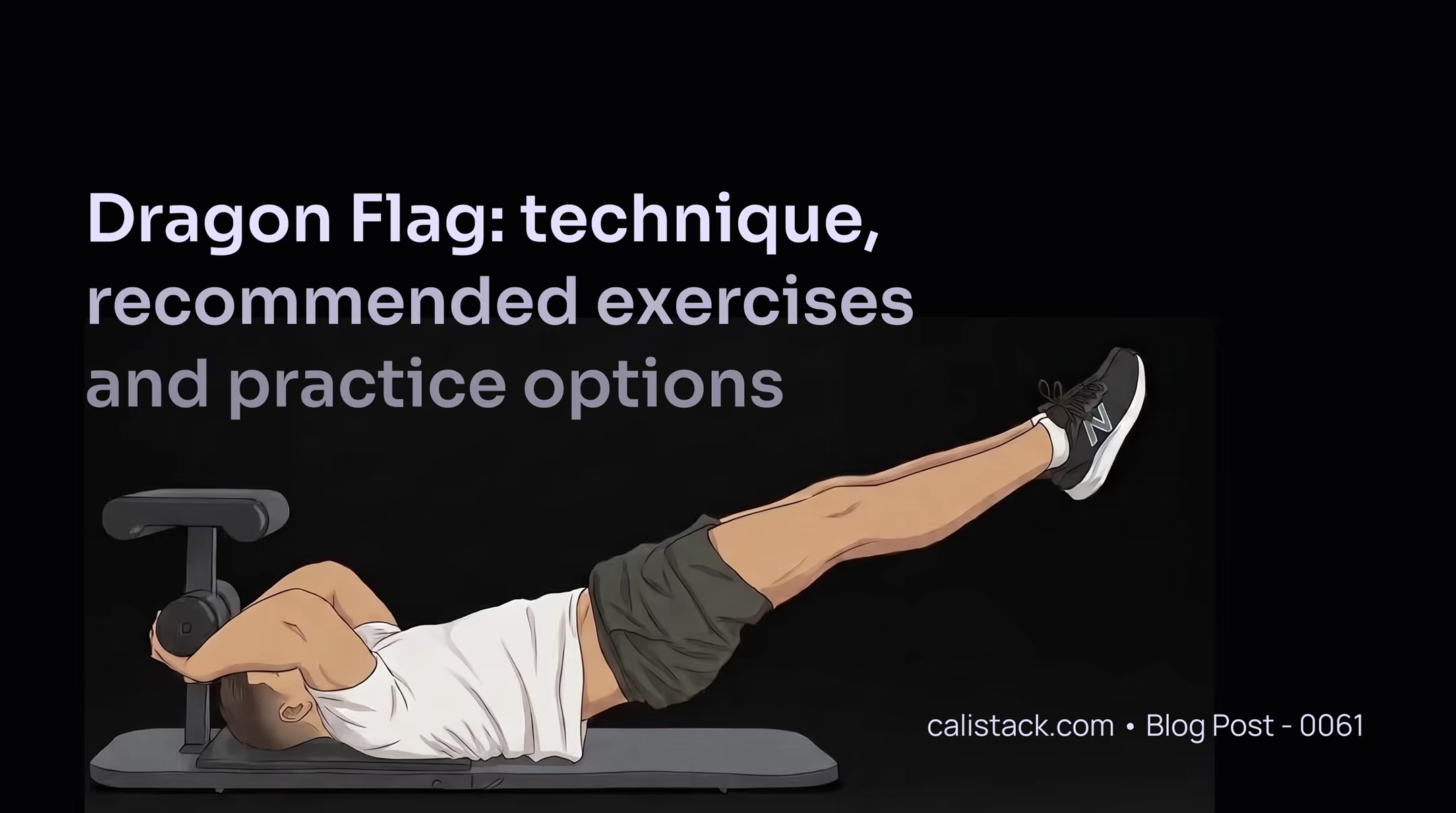
A dragon flag is a demanding bodyweight movement performed against a fixed support. The goal is to move the body as one controlled shape while the shoulders and upper back remain supported, rather than folding at the hips or letting the legs fall. It is an advanced exercise, not a test everyone needs to pass, and there is no research-backed deadline for learning it.
The name covers different setups and ranges. This guide describes a conservative bench-based reference so readers can understand the idea, but it does not claim to match the exact Dragon Flag video in CaliStack. Have a qualified coach check the app demonstration, handhold, shoulder contact and movement range before using this as technique instruction.
Define the version before practicing
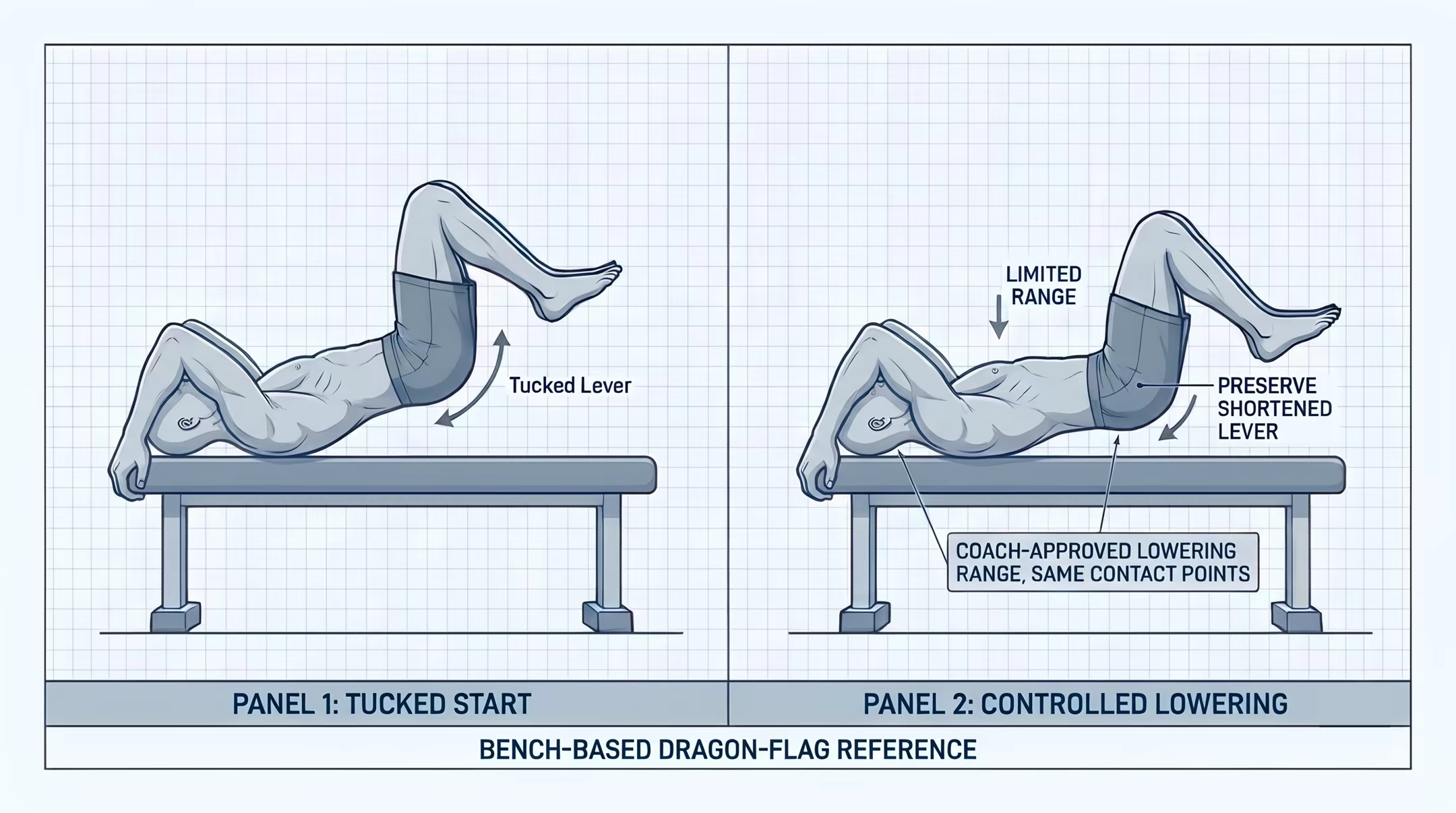
For the reference movement here, the athlete lies on a stable bench, grips a fixed handhold behind the head, and supports the upper back and shoulders on the bench. The legs and trunk move together through a range chosen by a coach. The head and neck are not a support point. A full dragon flag is often shown with the body nearly straight as it lowers, but a short-range tuck can be a different, more manageable task.
Before each attempt, check that the bench cannot tip or slide and that the handhold is designed to resist your bodyweight. A wall, loose table edge or movable household object is not a verified anchor. Make sure the area is clear so the athlete can stop and return to the surface without striking nearby equipment. If the setup cannot be checked, choose a floor exercise instead.
The coaching standard should be simple enough to repeat: same support, same starting position, same chosen range, and no sudden change in body shape. Keep the neck relaxed. If the hips fold, the lower back arches sharply, the grip shifts or the descent accelerates beyond control, end the repetition. The answer is not to force a lower position or hold your breath longer.
Choose a manageable version, not a universal rung
A shorter lever is one way to reduce the challenge. Bending both knees or using a tuck can reduce the distance of the legs from the support. A coach may also select a smaller lowering range, a foot-supported drill or another exercise that lets you practice trunk control without lifting the whole body. These are choices, not steps everyone must complete in order. A person may need a different option because of equipment, training history or comfort.
Do not use a timed hollow-body hold or a specific number of negatives as proof that you are ready. Some instructional pages propose fixed benchmarks, but they are editorial rules from those pages, not validated universal tests for this exercise. The decision belongs to an appropriate coach who can see your setup and movement.
| Choice | What may change | What to verify |
|---|---|---|
| Short tuck or bent-knee lever | The legs move closer to the support and shorten the lever | Can the coach-selected range stay controlled without a hip fold? |
| Small-range lowering | The athlete stops before the most demanding part of the range | Does the same bench, grip and body shape remain stable? |
| Single-leg or half-lay variation | Leg position and loading may become asymmetric or intermediate | What does the actual demonstration define, and is the movement controlled on both sides? |
| Full straight-leg range | A longer lever and greater range increase the task | Has a qualified coach observed the entry, range and return? This guide does not certify readiness. |
Use the listed related exercises as options
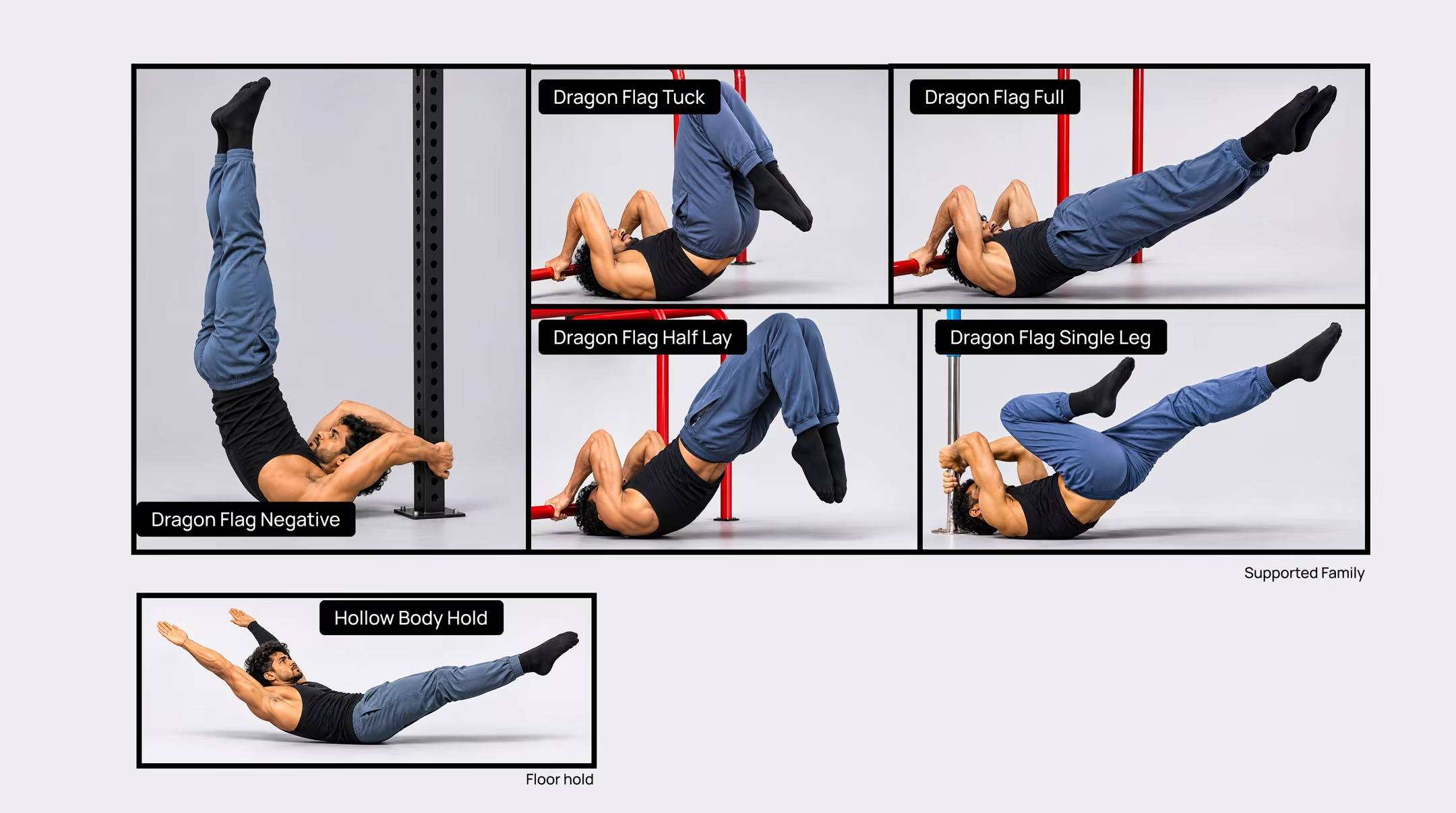
CaliStack lists five recommended movements for Dragon Flag. The names are useful starting labels, but they do not confirm the app's exact setup, range or technique. Treat each as a related practice option, not a compulsory prerequisite or an instruction to train all five together.
Hollow Body Hold: this is a floor-based bodyline hold rather than a bench-supported dragon flag. It can give you a lower-load way to notice whether you can maintain a chosen trunk shape. It does not prove that you can control a long lever under the different support and loading of a dragon flag. Choose a bent-knee version if the longer position is not controlled.
Dragon Flag Negative: the name suggests an emphasis on lowering, but the exact starting point and endpoint in the app are unconfirmed. If the demo shows a descent from a supported raised position, it can be a demanding eccentric variation. Do not jump into place or drop through the bottom. Ask a coach to verify the entry, assistance and return before attempting it.
Dragon Flag (Tuck → Full): the title suggests a change from a tucked to a longer body position, but it does not reveal whether the exercise is a hold, repetition or transition. Check the actual video. In general, extending the legs changes the lever, so practice a small coach-approved change rather than opening fully because a label contains the word Full.
Dragon Flag Single Leg: a one-leg variation may shorten the lever on one side, but it also changes the body's symmetry. The app demonstration should confirm which leg bends and how the other leg moves. If the pelvis twists or one side loses control, stop and ask for a different option rather than alternating through poor repetitions.
Dragon Flag Half Lay: the name suggests an intermediate leg position between a tuck and straight legs, but the exact angles are not confirmed. Treat it as a separate variation until a coach checks the video. Do not assume that it is easier than every single-leg version for every athlete; lever length, asymmetry and range all matter.
A cautious sample block for coach review
The exercise export gives no sets, repetitions, rest periods or readiness thresholds. This sample is an editorial coaching example, not a tested prescription. Because the full movement is advanced and the support setup matters, have a qualified coach select the actual drill and watch the first practice.
- Check the bench, handhold, floor and clear space. If any part moves or cannot be verified, do not attempt the bench variation.
- Begin with comfortable general movement, then use a floor-based trunk exercise or a coach-approved tucked setup. Do not treat a warm-up as permission to continue through pain.
- Choose one short-range option. A conservative example might be one or two sets of a few slow, controlled repetitions, with full recovery between them. Stop before the shape changes; do not add negatives, full repetitions and long holds as a bundle.
- Record the exact variation, lever, range, support, repetitions, control and how you feel afterward. Repeat a comparable setup before considering one small change with the coach.
If the coach chooses a static position instead of repetitions, end the hold when you can no longer keep the agreed shape or breathe comfortably. The point is repeatable practice, not a maximum-time contest. No specific number of seconds or repetitions in this example has been established as a pass mark.
Fix the breakdown by changing the task
If the hips bend as the legs lower, the current lever or range may be too demanding. Shorten the lever, reduce the range or return to a coach-approved floor option. If the lower back arches and you cannot restore the agreed shape, end the attempt rather than pushing through to a lower position. A smaller controlled movement is a better comparison than a longer uncontrolled one.
If your grip slips, the bench shifts or your head moves toward the surface, stop. Recheck the setup with a coach; do not add a stronger grip squeeze to an unstable anchor. If one side drops first during a single-leg option, return to a symmetrical choice or have a coach assess whether the movement suits you.
If progress stalls, compare the same variation and range across several practices. Check whether fatigue, support position or leg angle changed. You may be better served by a shorter lever, fewer repetitions or more recovery. More difficult work is not the only form of progress, and this guide does not promise a timeline.
Dragon flag questions
Is the dragon flag a beginner core exercise?
No. The full version places substantial demands on body control and a secure support setup. A beginner can train other appropriate trunk exercises without attempting a full dragon flag.
Should I master a 60-second hollow hold first?
There is no universal, research-validated 60-second rule for dragon-flag readiness. A hollow hold is a different exercise and does not certify control of the bench-supported movement.
Are negatives the best way to learn it?
This guide cannot establish a best method. A negative may be demanding, and the app's exact variation is unconfirmed. Have a coach choose an option you can enter, control and exit safely.
How long will it take to learn a dragon flag?
There is no dependable timeline for everyone. Equipment, starting ability, practice choices and recovery differ, and no deadline is promised here.
Your next practice decision
Before trying the full movement, confirm what the Dragon Flag demonstration shows and which support it uses. If a qualified coach can review the setup, practice one manageable variation and record its range and control. Explore Dragon Flag in CaliStack and compare its demonstration with the version you plan to practice. The listed movements are options, not a required order.
Want a clear plan for your next skill?
We built Calistack to show you the exact steps from where you are right now to your first handstand, muscle-up, or lever.