By Calistack Team · Editorial standards: Calistack editorial team
A beginner calisthenics routine when you cannot do a push-up or pull-up
If you cannot do a push-up or pull-up yet, start with a wall or incline push-up and a pulling option you can control on secure equipment. Add simple leg and trunk work. Repeat the same setup across two sample sessions so you can compare your reps before changing the difficulty.
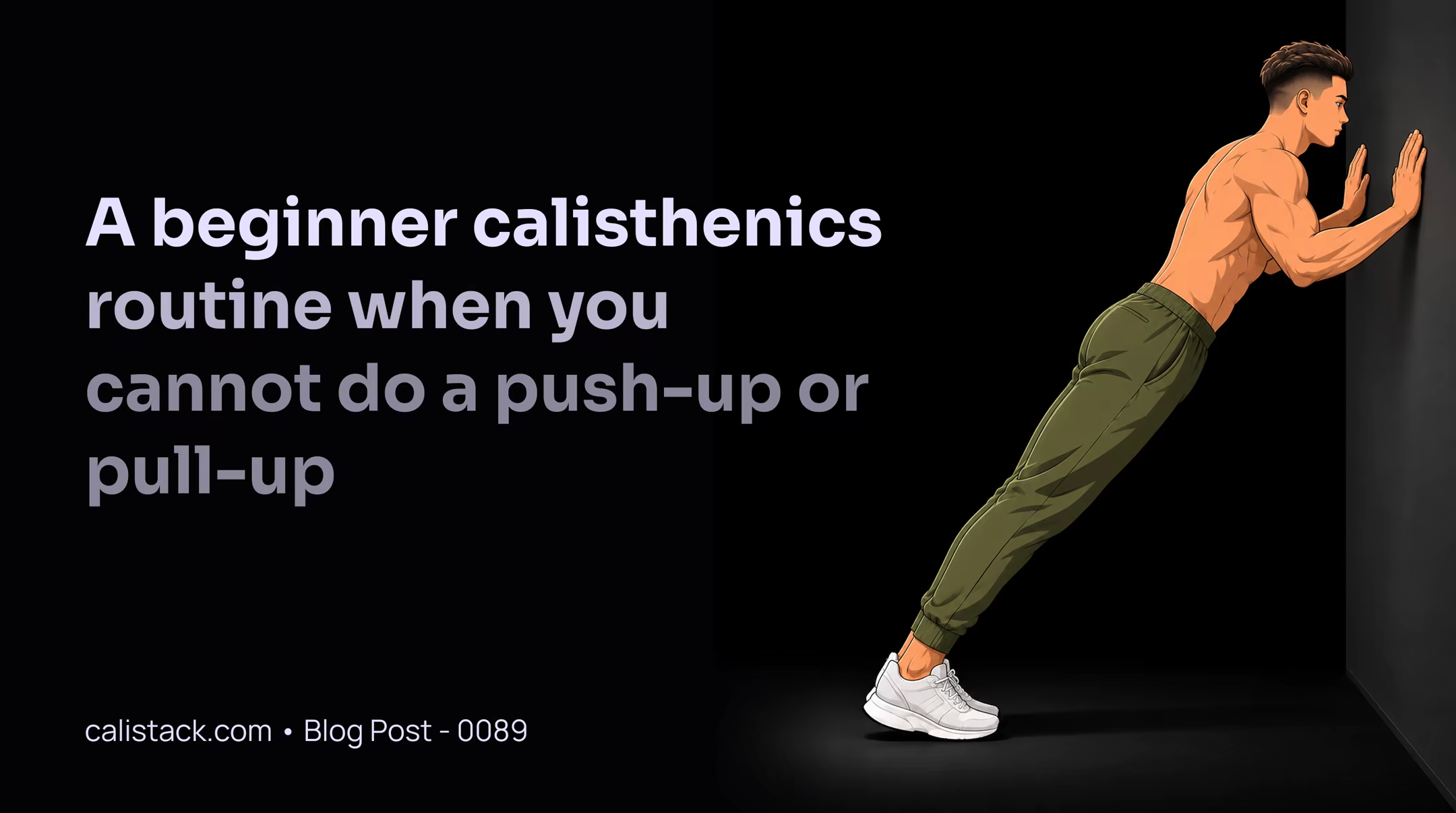
You do not need a floor push-up or a pull-up before you can begin calisthenics. Start with a push-up angle you can control, choose a safe pulling setup if one is available, and pair those movements with a squat and simple trunk work. The routine below is a sample for generally healthy adults, not an individualized plan. If your home has no safe place to row or hang, do the other movements and treat pulling access as a separate problem to solve, rather than pretending extra push-ups train your back.
Choose a starting point, not a test
Before the first session, check the space and the equipment you actually have. A wall push-up needs a clear patch of wall and floor. An incline push-up needs a fixed surface that will not slide, fold, or tip when you lean into it. An inverted row needs equipment designed or installed for that load, such as a properly set low bar or a suitable suspension system used according to its instructions. A loose table, pair of chairs, or improvised door anchor is not a default substitute.
Try a few easy practice repetitions rather than testing your maximum. At the wall, stand close enough that the movement feels light; step farther back only if you can still keep your trunk steady. For a squat, use a comfortable depth and keep your feet planted. For floor exercises, make sure you can get down and up without rushing. If any movement is unfamiliar, a qualified trainer can help you choose a version and check the setup.
- You can lower yourself and return without a sudden drop or a change in body position.
- You can breathe normally and stop with several controlled repetitions still possible.
- The support or bar stays fixed under the intended use; you know how you will enter and exit the movement.
- The range feels manageable. Do not force depth or continue through pain.
Pick one push, one pull, legs, and trunk work
Pushing: make the angle easier
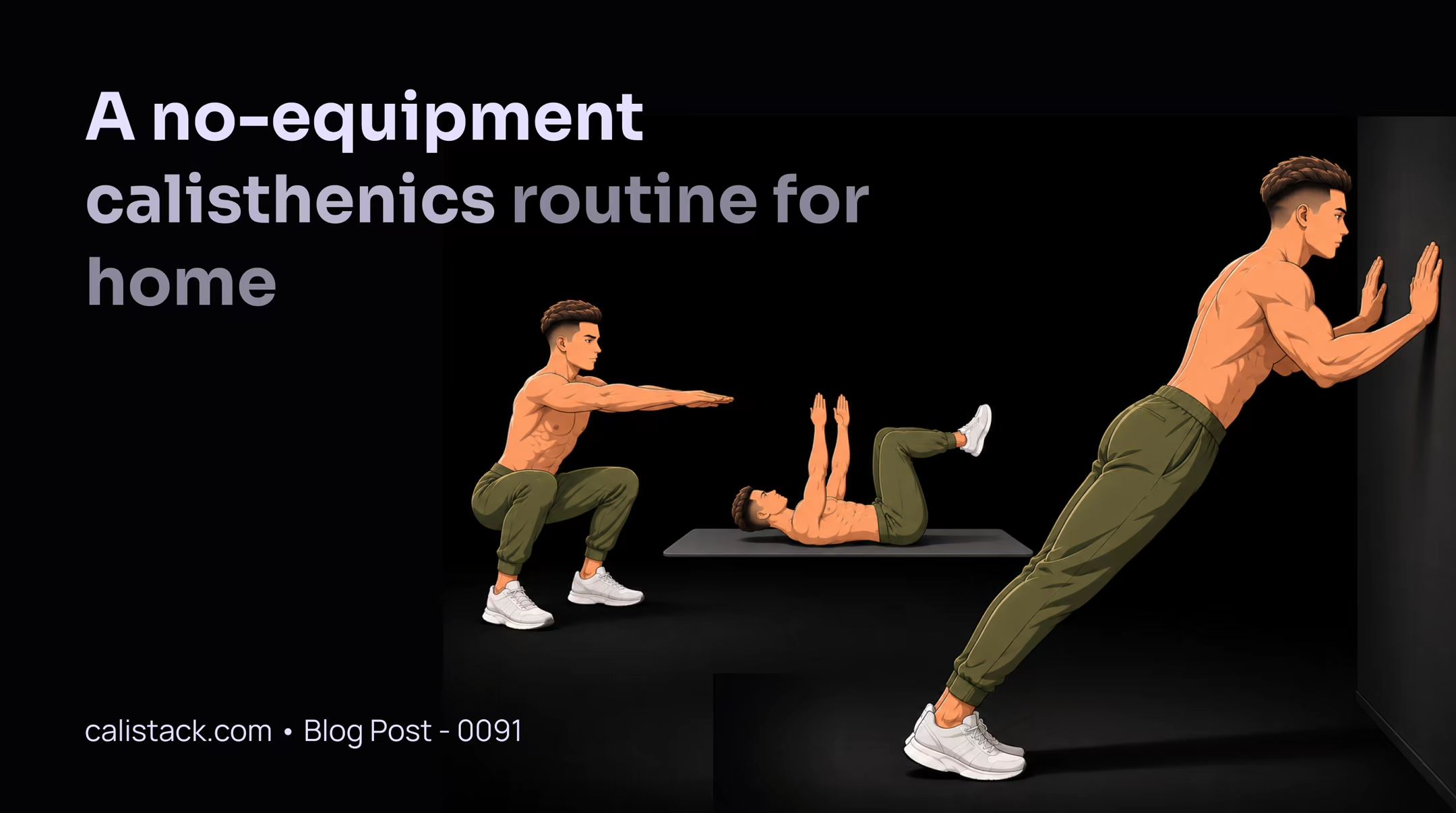
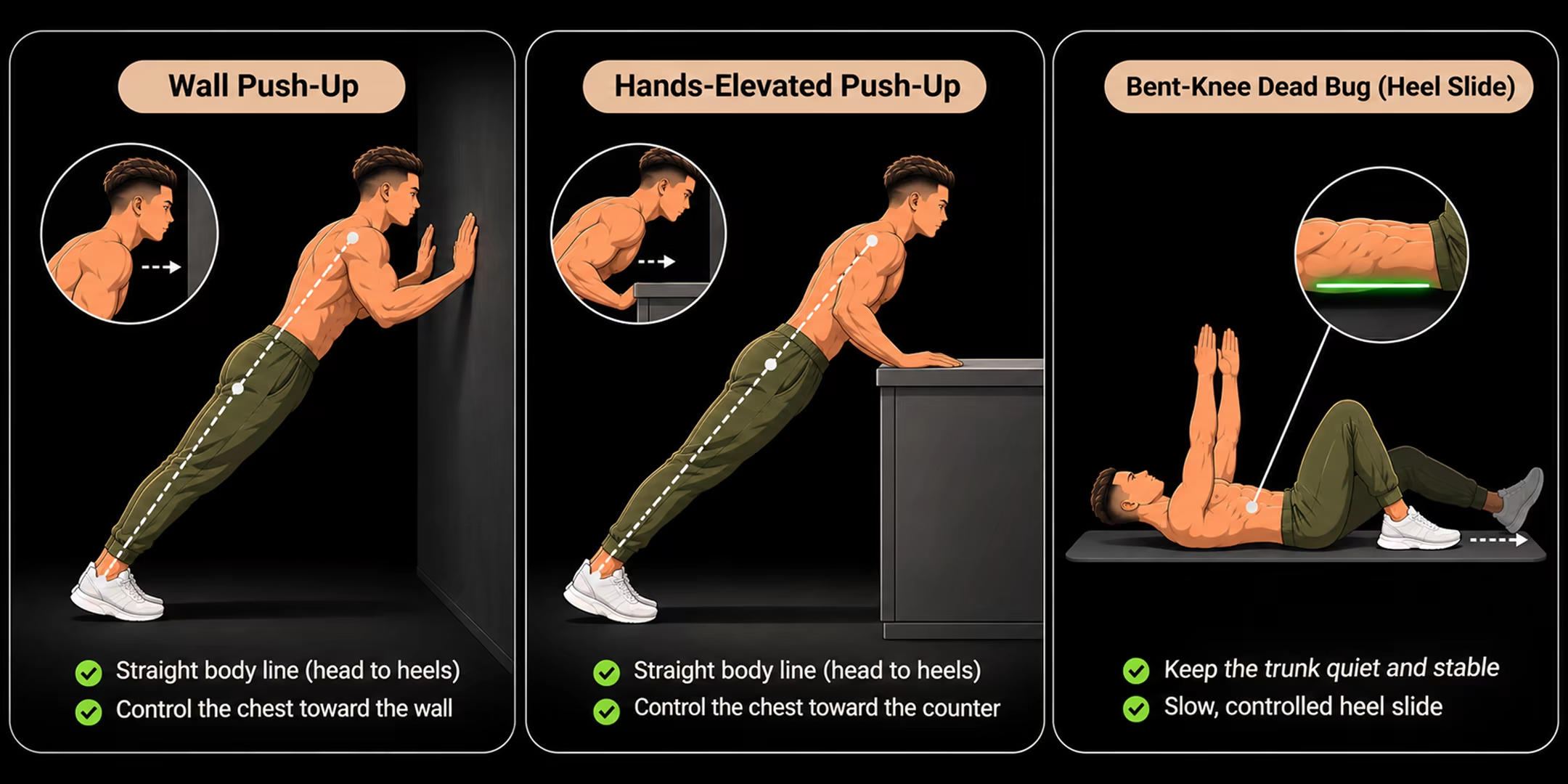
A wall push-up is a useful starting choice when floor push-ups are not available yet. Place your hands around chest height, step back until your arms are straight, and keep your head, trunk, and legs moving as one unit. Bend your elbows and bring your chest toward the wall, then press away. Shorten the range or stand closer if you cannot control the return. A wall is a support for this exercise, not an excuse to lean on a door or a movable panel.
When the wall version feels too easy to practice, an incline push-up changes the angle. Use a fixed counter or exercise rail that is suitable for your bodyweight. Keep your hands under or slightly wider than your shoulders, brace gently, and lower your chest toward the edge without letting your hips sag. A higher hand position usually reduces the demand; a lower position increases it. Change the height only after the current setup is repeatable.
A floor push-up is an option later, not an entry fee. You can also keep an easier version while you build consistency. The exact transition depends on the surface, your body position, and how the movement feels. There is no universal number of wall or incline repetitions that proves someone is ready for the floor.
Pulling: rows and hangs do different jobs
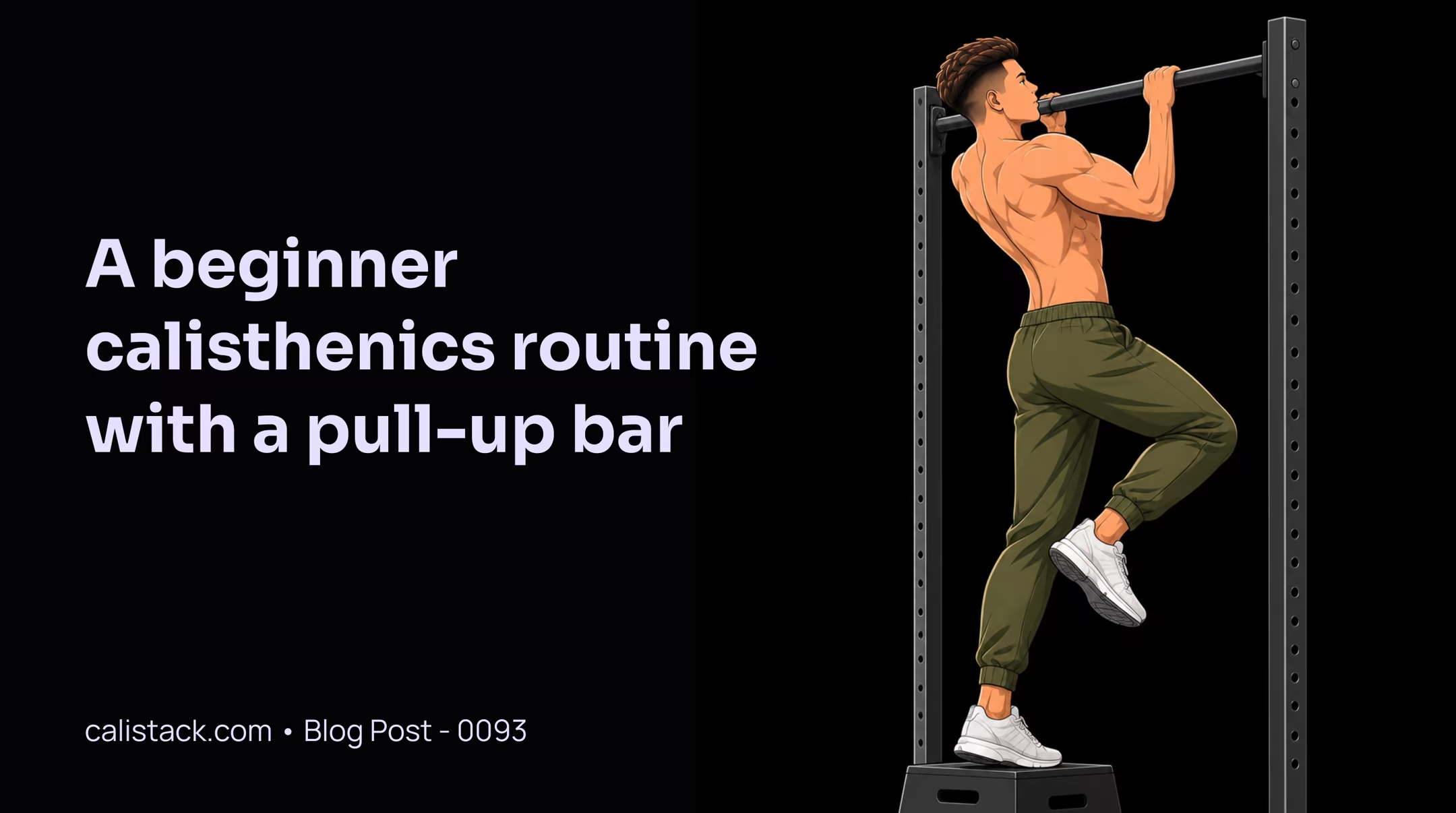
An inverted row is a horizontal pull. With a suitable low bar or installed suspension setup, begin with your body more upright and your feet planted. Keep your body steady, draw your elbows back, and bring your chest toward the support only as far as you can control. The setup determines much of the difficulty: a more upright body is generally easier than a more horizontal one. Do not use furniture as a row station unless its maker has designed it for that purpose.
A dead hang and an active hang are optional bar-based practices, not required steps before a row. In a dead hang, the arms stay long while you hold the bar only if your grip and shoulders tolerate it. In an active hang, keep the elbows straight and gently move the shoulders away from the ears without swinging. These are different tasks from rowing. If you do not have a secure bar or cannot hold it comfortably, skip them.
In the exercise recommendations, Inverted Row is linked with Dead Hang and Active Hang. Those are related movements, not required steps before a row. Choose the row when you have a safe horizontal-pull setup. If you do not, do not replace it with more pressing. Make a plan to use a properly equipped gym, a supervised calisthenics space, or a trainer-approved alternative.
Legs and trunk: keep the first choices simple
For a bodyweight squat, stand with a comfortable stance and lower only as far as you can keep your feet grounded and your torso controlled. A chair placed behind you can be a depth reference only if it is stable and you are not relying on it to catch a fall. You can also squat to a comfortable partial range without a target. The aim of this sample is controlled practice, not a particular depth or a test of flexibility.
A dead bug trains trunk control while you lie on your back. Start with knees bent and feet on the floor. Brace gently, breathe, and slide one heel away before bringing it back. Make the movement smaller if your back arches or your breathing stops. A plank or hollow-body hold is a related option, not an assignment to add all three. For a plank, choose a wall, counter, or floor version that lets you keep a steady shape. A hollow hold is more demanding; use a short bent-knee variation or leave it out if you cannot maintain control.
Dead Bug is also linked with Plank and Hollow Body Hold. Neither is a prerequisite. Choose one trunk exercise that fits the day. You can change it later if it becomes too easy, too difficult, or uncomfortable.
A sample two-day week
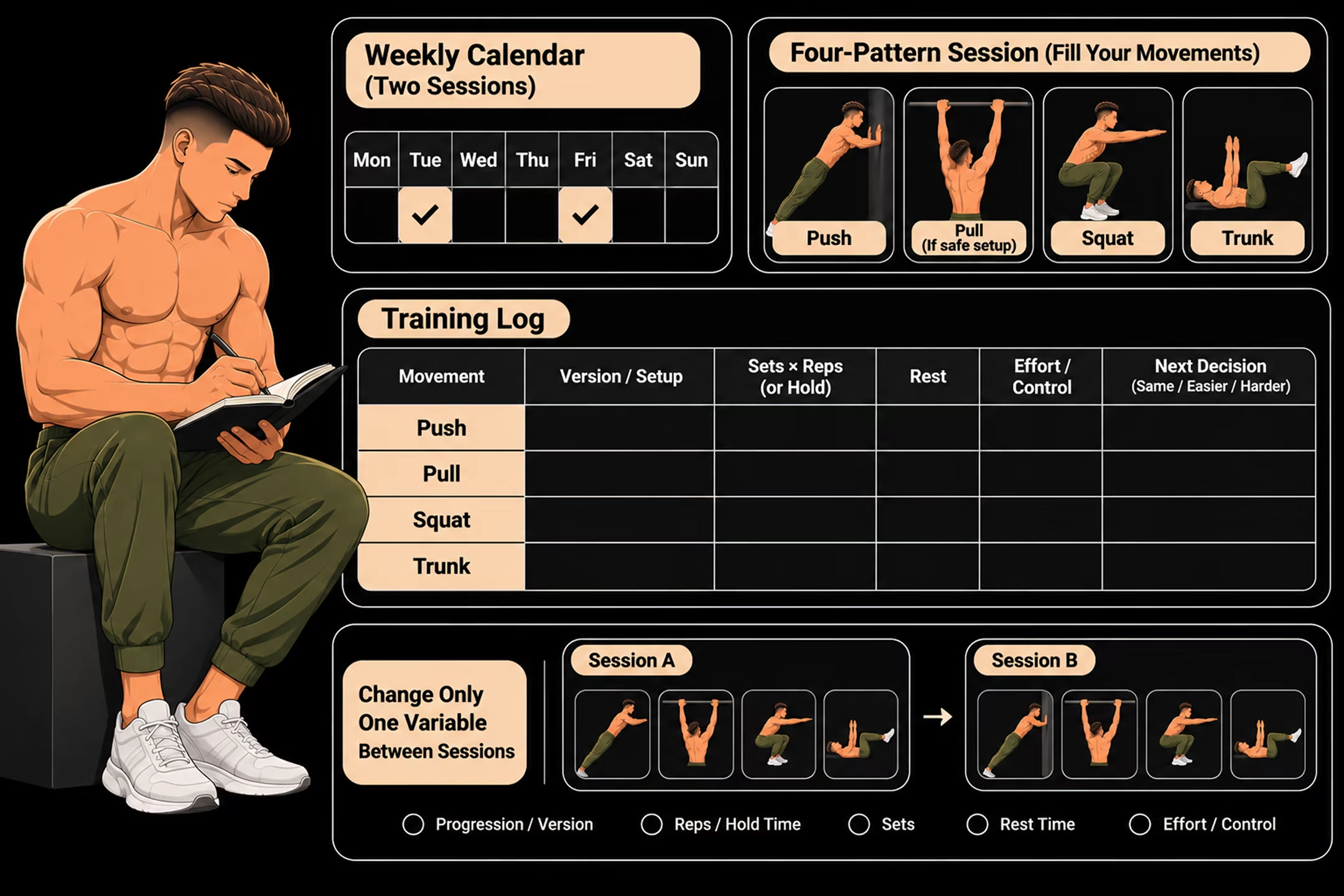
Two nonconsecutive sessions are one manageable way to organize the week. For example, train Tuesday and Saturday, leaving other days for rest or ordinary activity that suits you. The exact days are flexible. If two sessions feel like too much, start with one and reassess; if you already train regularly, this beginner template may be too light. The public-health guideline for adults recommends muscle-strengthening activity on at least two days each week, but that broad target is not a personalized prescription and does not require this exact routine.
| Pattern | Choose one option | Sample starting work |
|---|---|---|
| Push | Wall push-up or fixed incline push-up | 2 sets of 5–10 controlled repetitions |
| Pull | Inverted row on secure equipment; otherwise record that no safe setup is available | 2 sets of 5–8 controlled repetitions when available |
| Legs | Bodyweight squat through a comfortable range | 2 sets of 6–12 repetitions |
| Trunk | Dead bug, plank, or an easier controlled variation | 2 short sets; stop before position changes |
The numbers are examples, not minimums. Use fewer repetitions or one set if you are new to exercise or cannot keep the movement smooth. Rest until you can repeat the next set without rushing; a minute or two is a starting estimate, and more time is fine. Keep the exercises in the same order for a few sessions so you can tell what changed. You do not have to turn the workout into a circuit.
- Do a few minutes of easy movement, then rehearse each exercise with an easier version.
- Complete the selected push, pull if safely available, squat, and one trunk option. Stop any set when control or range changes.
- Write down the version, surface or bar setup, sets, repetitions, rest, and how the movement felt.
- At the next session, repeat the same setup first. Change only one exercise or difficulty variable when you have a reason to do so.
Track the setup, then decide what to change
A repetition count without a setup is hard to compare. For an incline push-up, note the surface and where your feet stood. For an inverted row, record the equipment, bar height, foot position, and body angle. For a squat, note whether you used a target and roughly how deep you went. For a dead bug, record whether your heel stayed on the floor or lifted.
Also note effort in plain language: easy, challenging but controlled, or stopped because the position changed. If you choose to record discomfort, use neutral words and do not use the log to diagnose it. If a movement is painful, stop that movement. Persistent or recurring pain, symptoms after an injury, or uncertainty about whether you should train are reasons to speak with an appropriate health professional.
When a version feels manageable across repeated sessions, make one small change: add a repetition to a set, lower an incline slightly, use a slightly longer controlled range, or choose a modestly harder trunk variation. Then return to the lower end of your range and observe the result. These are coaching examples, not a universal progression rule. If the new version makes you twist, sag, swing, or hold your breath, go back to the previous setup. More work is not always the useful next change.
Common sticking points
If wall push-ups are still hard, stand closer and reduce the range. You can practice a slow press from a comfortable position rather than forcing full depth. If the movement is too easy, step back a little or use a lower fixed incline. Keep the change small enough that the next set remains controlled.
If you have no safe pull station, do not try to solve the problem by pulling on a towel looped over a door or by crawling under furniture. Train the other patterns if they suit you, and look for a supervised or properly equipped place to do pulling work. A routine that lacks pulling is a partial home session, not a complete all-pattern plan.
If you miss a session, resume at the next reasonable opportunity rather than doubling the work. If the routine feels harder than expected after illness, a break, poor sleep, or a demanding week, use easier variations or less volume and reassess. A training plan should fit the person and the week, not force the week to fit the plan.
Beginner calisthenics routine FAQs
Can I start calisthenics if I cannot do one push-up?
Yes. Use a wall push-up or a hands-elevated push-up on a fixed support that is safe for the intended use. Choose an angle where you can lower and press with control. There is no required number of repetitions before you are allowed to begin.
What if I cannot do a pull-up and do not own a bar?
You do not need a pull-up to start. A horizontal row is a different pulling option, but it also needs a secure setup. Do the movements you can perform safely and arrange access to a suitable pulling station instead of using unstable furniture or adding more push-ups.
Are Active Hang and Dead Hang required before Inverted Row?
No. They are related bar-based exercises with different demands. These links are not a compulsory sequence. Skip hangs if you lack a secure bar or cannot hold it comfortably.
Should I do Dead Bug, Plank, and Hollow Body Hold in one workout?
No. They are related trunk options. Start with one that lets you breathe and maintain control. Change the choice when it no longer fits your ability or goal.
How many days per week should I train?
The sample uses two nonconsecutive sessions, but your schedule should reflect your experience, health, recovery, and other activity. Begin with a manageable amount and adjust rather than treating a sample as a medical recommendation or a plan for everyone.
Your next step
Choose one push variation and one squat variation you can repeat safely, then decide whether you have a safe way to train pulling. Record the setup and how each set felt. For a structured way to explore the movements in CaliStack, start with the available exercise options and treat any listed relationship as guidance to review, not an automatic requirement.
Want a clear plan for your next skill?
We built Calistack to show you the exact steps from where you are right now to your first handstand, muscle-up, or lever.