By Calistack Team · Editorial standards: Calistack editorial team
A no-equipment calisthenics routine for home
A no-equipment home routine can train pushing, legs and trunk control with wall push-ups, squats, lunges, bridges and floor exercises. Choose ranges you can repeat comfortably. Without a suitable anchor, this routine does not replace loaded pulling; use a separate session with secure equipment when you have access to it.
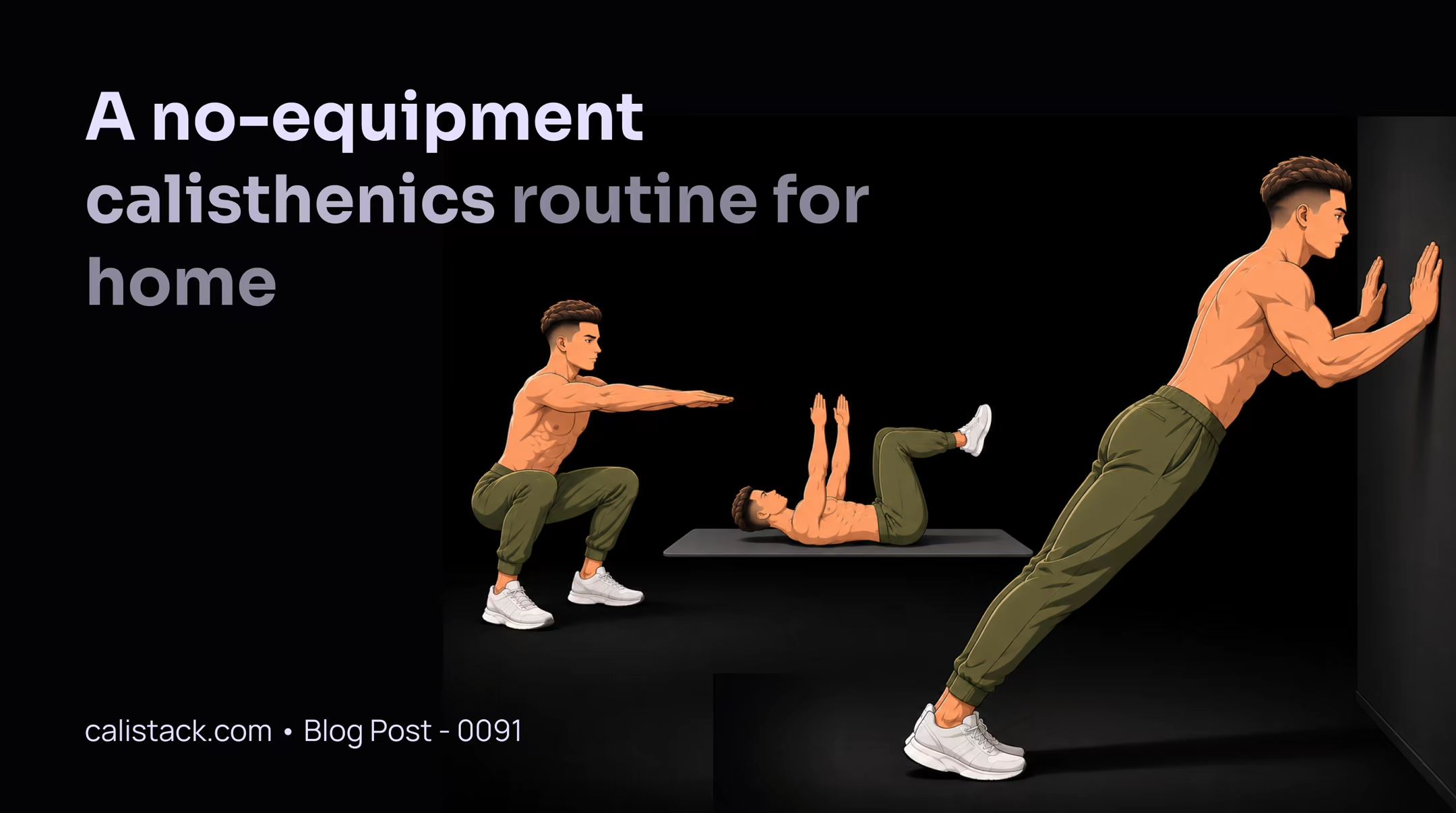
A no-equipment home routine can train pushing, legs, hips, and trunk with bodyweight movements. It cannot honestly promise complete pulling work when you have no secure pulling setup. This plan keeps that limit visible. It uses a wall for the easiest push-up option and the floor for squats, lunges, bridges, and core work; it does not require a bar, bands, weights, or a chair. If you use a counter or step for an easier angle, that is a household support, so check that it is fixed and safe rather than calling it literally equipment-free.
What no equipment means here
The routine below needs floor space and, for wall push-ups, a stable wall. It does not use an unstable chair, an unsecured table, a towel tied to a door, or a doorway bar. Those are not interchangeable with a piece of equipment designed for exercise. If you want to add an incline push-up on a fixed kitchen counter, make sure the surface cannot slide or tip and keep the movement easy enough to control. The main session still works without that option.
A bodyweight routine can change difficulty by changing leverage, range, support, repetition count, or tempo. That does not mean every person will have the same starting point or that one variation is automatically right for everyone. The examples are for generally healthy adults who can move comfortably through the chosen range. If you have a health condition, are returning after injury, or are unsure which movements are suitable, get individual guidance from an appropriate professional.
A six-movement no-gear workout published by SELF includes squats, lunges, glute bridges, a side plank, a hop, and a hands-elevated push-up; the elevated version still calls for a box, bench, or step. Another current full-body routine from the Calisthenics Association includes a row and therefore requires a surface to pull against. Those are examples of how labels such as no equipment can hide small setup requirements. This plan separates the literal floor-and-wall routine from later equipment options.
Choose one version for each pattern
Push: wall, incline, or floor
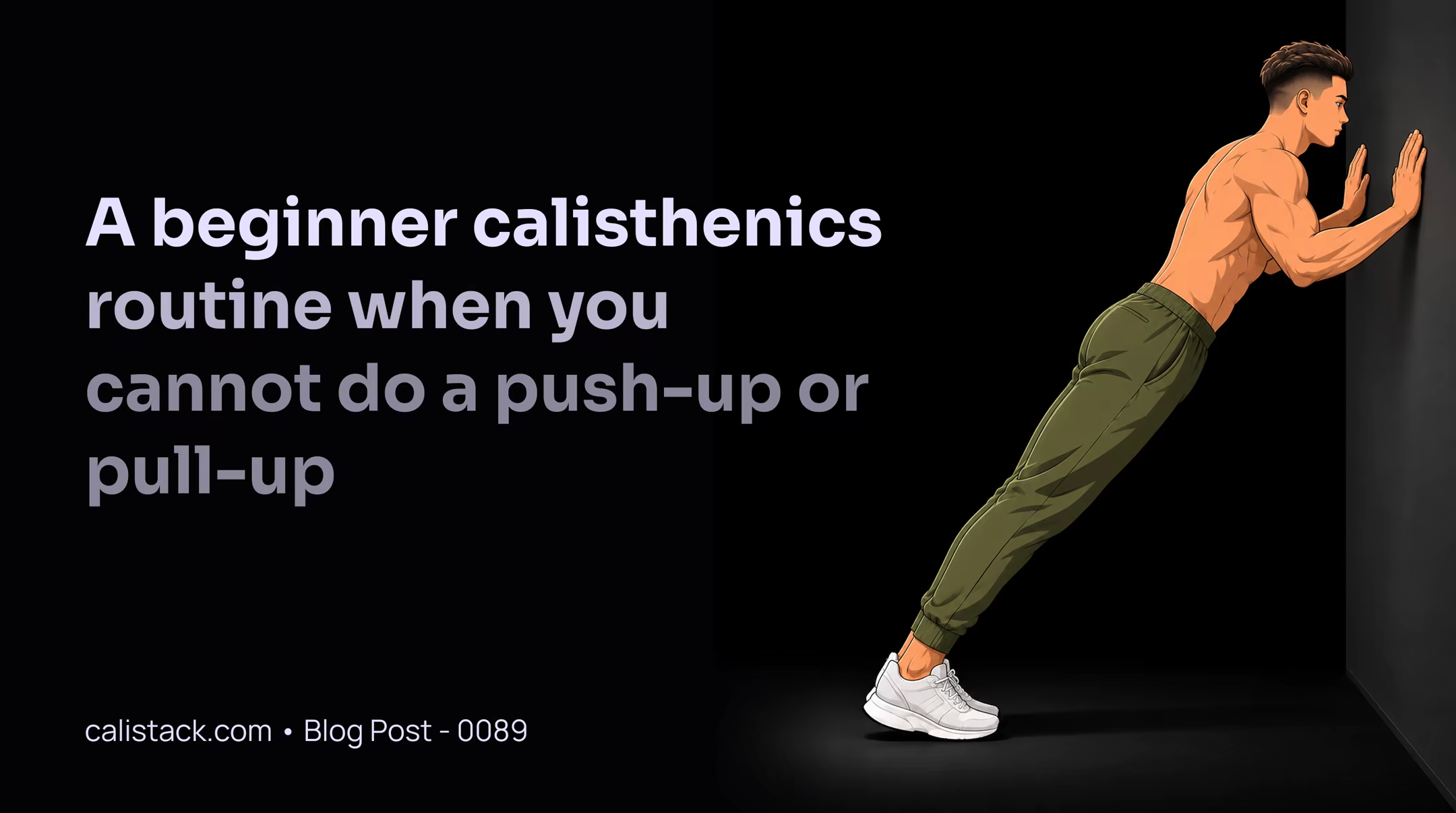
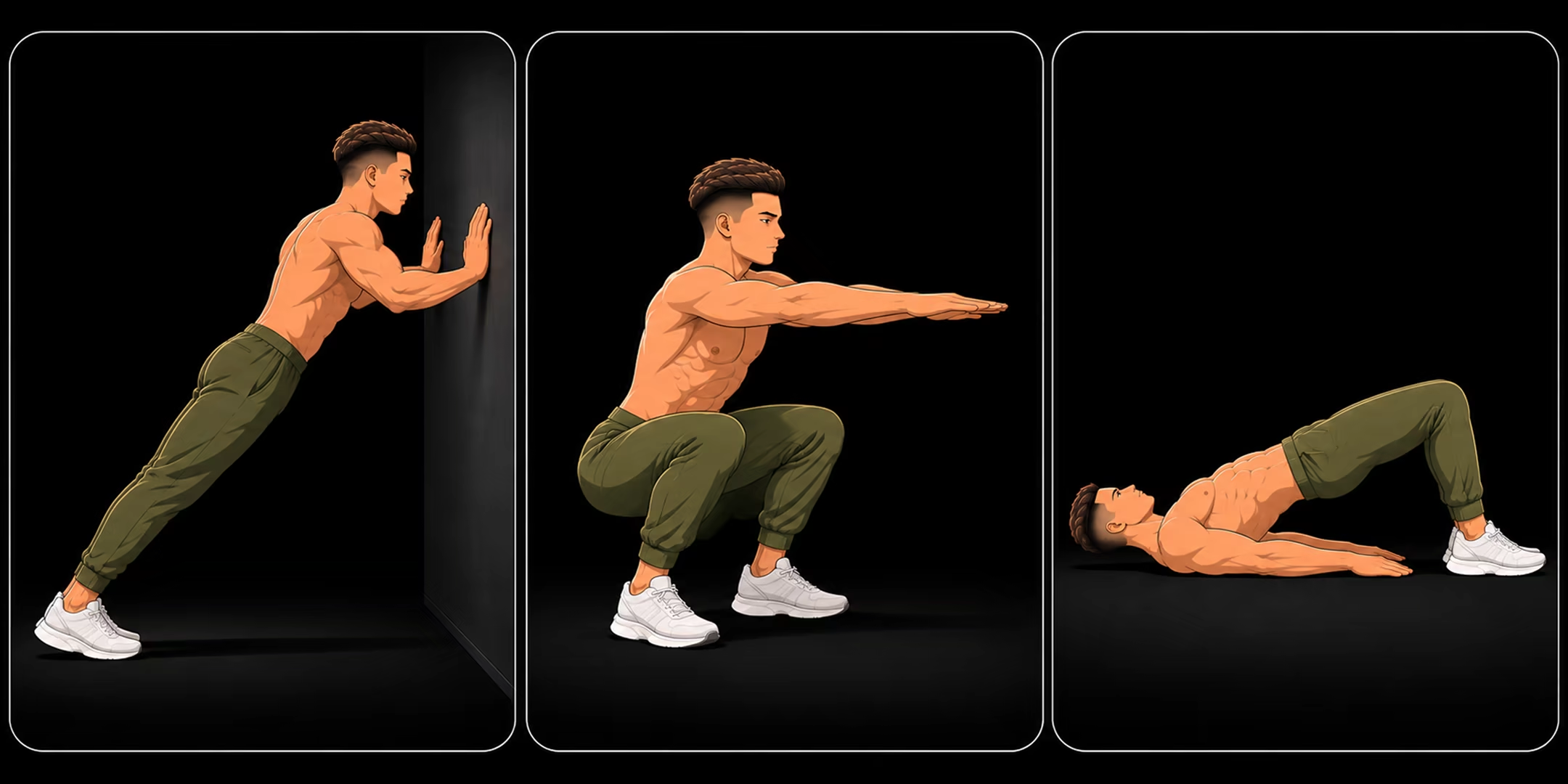
Start with a wall push-up if a floor push-up is not manageable. Put your palms on the wall around chest height and step back only far enough to make the movement a little challenging. Keep your body in a comfortable straight line, bend your elbows, bring your chest toward the wall, and press away. Stand closer or reduce the range if your hips sag or your shoulders shrug toward your ears.
A hands-elevated push-up on a fixed surface reduces the angle less than a wall version and may be a sensible middle option. It is not necessary to use it if you have no trustworthy support. A floor push-up is a harder option only when you can lower and press without losing control. There is no special number of wall push-ups that unlocks the floor version.
The CaliStack exercise list includes Assisted Push-Up as a movement related to Push-Up. The name alone does not tell you how the movement is assisted. Check the current exercise entry and demonstration before choosing it; until the method is clear and the setup is safe, use a wall or fixed incline.
Legs: squat and lunge options
For the bodyweight squat, stand with feet at a comfortable width, sit down and back as far as you can keep your whole foot grounded, then stand smoothly. Use a smaller range if your heels lift or your balance shifts. If a stable chair is available and safe, it can serve as a light touch target, but it is not required. Do not drop onto the seat or use a rolling chair.
Lunges add a one-leg-at-a-time pattern. Step one foot back a comfortable distance, bend both knees only as far as you can control, then return to standing. You can hold a wall lightly for balance if needed. Make the step shorter or use a shallow range to begin. If you wobble, practice a split stance with the feet planted and shift your weight gently before using a deeper lunge.
Hips and trunk: bridge, dead bug, or plank
For Glute Bridges, lie on your back with knees bent and feet on the floor. Press through the feet to lift your hips a comfortable distance, pause briefly if you can keep your ribs and pelvis steady, then lower. Do not arch your lower back to gain extra height. If the bridge feels cramped, adjust your feet slightly or use a smaller lift.
A Dead Bug is a floor-based trunk option. Start with knees bent and feet down. Keep a light brace and breathe as you slide one heel away, then bring it back. Make the reach smaller if the lower back arches. A Plank is another option, not a required addition. You can begin with forearms against a wall or with knees on the floor; choose a position where your body remains steady and breathing continues.
The exercise recommendations link Dead Bug with Plank and Hollow Body Hold. These are related trunk movements, not a requirement to do all three in one session. A Hollow Body Hold can be more demanding than the other options. If you cannot keep a comfortable low-back position or you have to strain to breathe, skip it and use a shorter dead-bug movement or easier plank instead.
A sample home session
Use two nonconsecutive days as a starting example, such as Monday and Thursday. Each session can include one push variation, one squat or lunge, one bridge, and one trunk exercise. A second session can repeat the same movements so you have a fair comparison. If you prefer variety, change only one option at a time and keep notes. General adult guidance recommends muscle-strengthening activity on at least two days a week, but it does not validate this exact selection or mean every person should start with the same amount.
| Order | Movement choice | Example starting work |
|---|---|---|
| 1 | Wall push-up, fixed incline if safe, or floor push-up if controlled | 2 sets of 5–10 repetitions |
| 2 | Bodyweight squat or a shallow supported lunge | 2 sets of 6–12 repetitions; use the easier choice |
| 3 | Glute bridge | 2 sets of 8–12 repetitions |
| 4 | Dead Bug or an easier plank | 2 short sets with steady breathing |
Start near the low end or do one set if you have not trained recently. Stop before you need to rush, hold your breath, or change your body position to finish. Rest until you feel ready to repeat the movement; there is no need to race through the list. A short warm-up of easy walking in place and comfortable joint movement can help you settle into the session, but it does not make a painful exercise safe.
- Clear the floor and check the wall or support you will use.
- Choose the easiest version that still feels like useful practice.
- Do the selected sets with controlled movement and ordinary breathing.
- Record each variation and how the set felt before deciding whether to change it next time.
What this routine leaves out
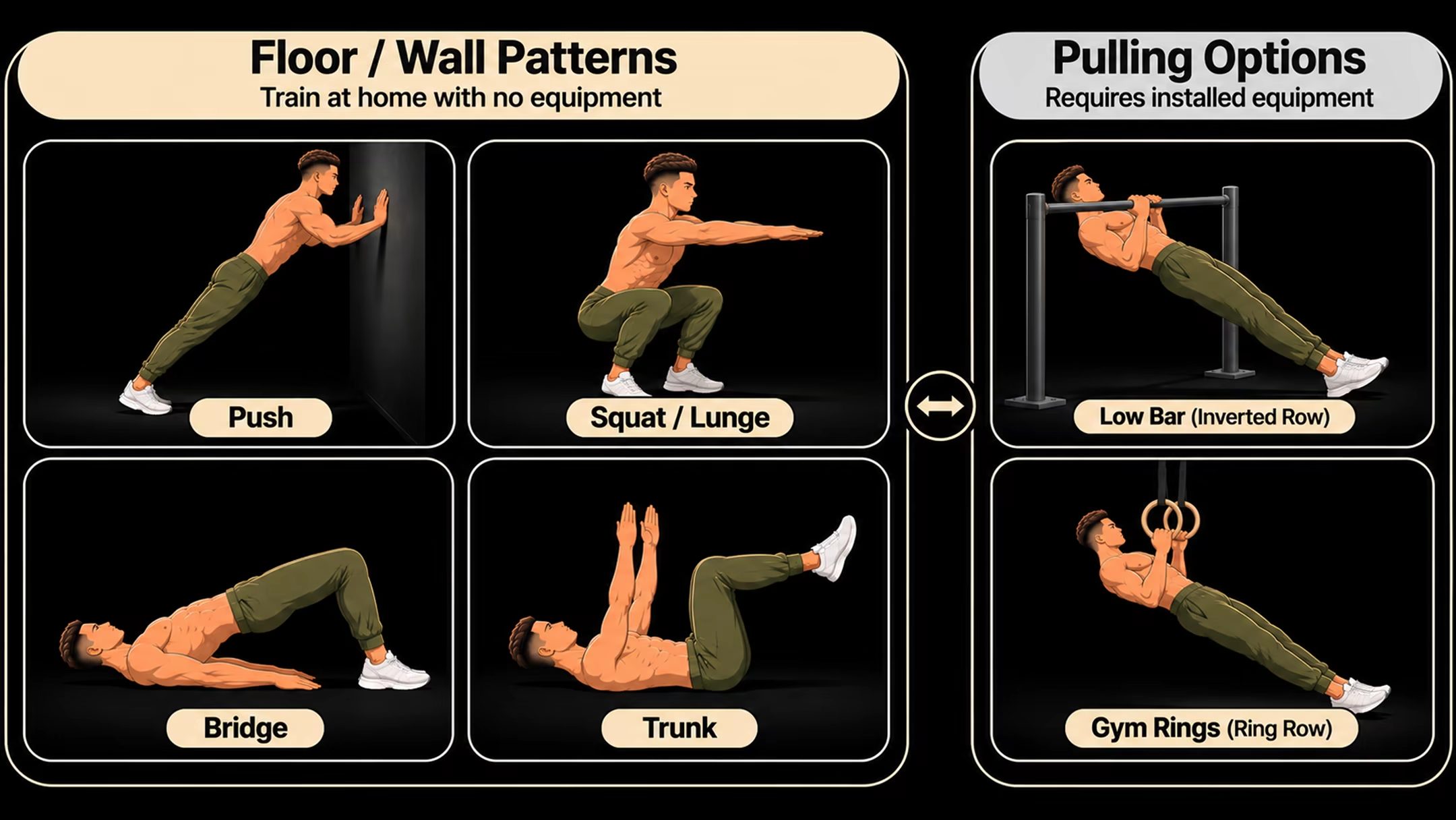
Pulling is the missing category. A wall push-up trains a pushing pattern; it does not become a row because it is done at home. A prone arm lift or floor exercise may train parts of the upper back, but it is not a bodyweight row or a substitute for all pulling demands. The federal adult activity guidance describes strengthening work for all major muscle groups, including the back. This no-equipment sample does not cover that full set of patterns.
If a more complete home routine is your goal, plan access to a secure pull-up bar, installed rings, or a supervised gym or park setup. Follow the manufacturer's installation and use instructions for any bar. Do not load a support that shifts, rotates, or has an unknown rating. If you have no suitable setup today, keep this session honest: train the patterns you can and arrange safe pulling access separately.
You can also ask a qualified trainer for an alternative that fits your room and equipment. The answer depends on what you actually own and whether it is designed to bear force. Avoid internet shortcuts that tell you to pull against a table, door, or towel without checking how the anchor is secured and rated.
How to progress without changing everything
Use the log to compare like with like: same wall distance, same counter height, similar range, and similar rest. If the same version feels controlled over several sessions, change one thing. Add a repetition to one or more sets, lower the incline a little, use a slightly larger comfortable squat range, or slow the lowering phase. Then keep the other movements unchanged while you see how it goes.
If a harder version makes your movement uneven, return to the previous one. If you reach a high repetition count but the exercise has become easy, a different leverage or range may be more useful than doing a very long set. These are coaching examples, not universal rules about how many repetitions you must complete. Calisthenics can be scaled through body position, but the perfect next step is individual.
No-equipment calisthenics FAQs
Can I get a complete full-body workout with no equipment?
You can train several patterns with bodyweight and a wall, but this particular routine does not include a true pulling movement. Do not call it complete for all major muscle groups. Arrange a secure pulling option when that is part of your plan.
Do I need a chair for incline push-ups or squats?
No. Use a wall push-up and a comfortable free squat if you have no suitable support. A chair or counter is optional only when it is stable and appropriate for the exercise; it changes the claim from strictly equipment-free to using a household support.
Is Assisted Push-Up the same as a knee push-up?
That movement definition was not verified. Do not assume a particular version. Wall push-ups and hands-elevated push-ups are clearly described alternatives when the support is fixed and safe.
Should I do both Dead Bug and Plank?
You can choose one trunk exercise for a session. The listed relationship to Plank and Hollow Body Hold does not make them mandatory companions to Dead Bug.
How often should I use the sample?
The sample places sessions on two nonconsecutive days, but the sample frequency and amount are examples. Adjust for experience, recovery, health, and other activity, and seek individual advice when needed.
Your next step
Pick one push-up angle, one leg movement, one bridge, and one trunk option that you can perform with control. Write down your exact setup and repeat it before making a small change. If you want a genuinely balanced home strength plan, solve the pulling-equipment question safely instead of hiding it under a no-equipment label. Explore the home-training exercise options in CaliStack, while treating each movement relationship as a related option rather than a compulsory workout.
Want a clear plan for your next skill?
We built Calistack to show you the exact steps from where you are right now to your first handstand, muscle-up, or lever.