By Calistack Team · Editorial standards: Calistack editorial team
Plank: the core tree's root, and the shape worth holding
A plank is a front support you hold still while breathing, not a timed contest. Keep ribs stacked over your pelvis and end the hold when the hips sag or pike or you stop breathing evenly. Use a knee or incline version if the position changes, and write down the version and why you stopped rather than a personal best.
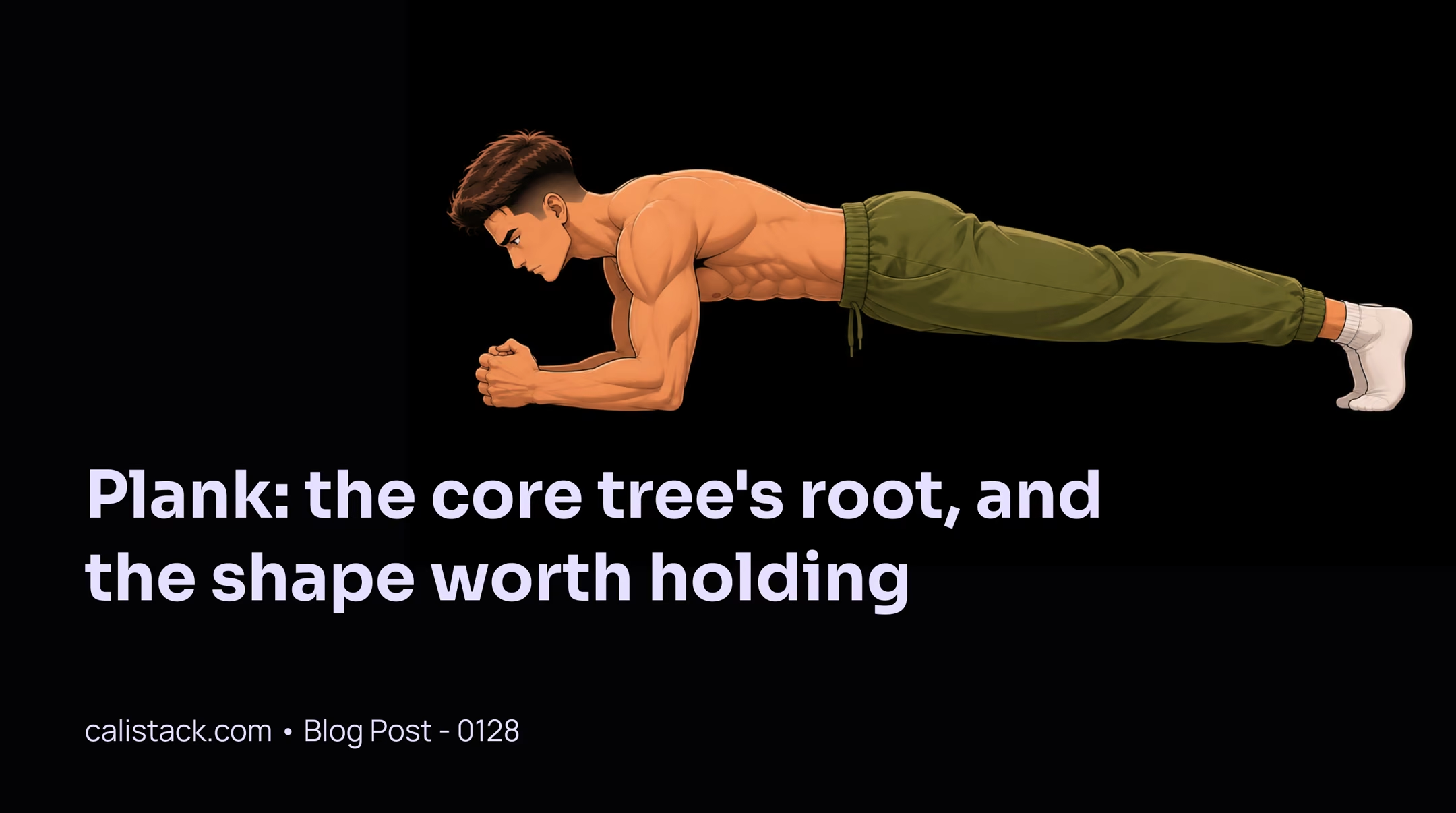
Most people meet the plank as a stopwatch event. The number goes up, the hips drop, and nobody looks at the shape. That is backwards. A plank is a position you hold against gravity while you keep breathing, and the useful question is whether the position survives, not how long you can ignore it. This guide covers what counts, where the movement sits in the CaliStack core tree, how to make it easier without abandoning it, and what is worth writing down.
What counts as a plank
A plank is a front support held still. Your forearms or hands carry part of your weight, your toes or knees carry the rest, and your body stays roughly in one line from ear through shoulder and hip to ankle. The elbows sit under the shoulders in a forearm plank, the ribs stay stacked over the pelvis, and the neck continues the line of the spine rather than craning up. Nothing travels. You are not lowering and lifting; you are refusing to let the middle of the body collapse.
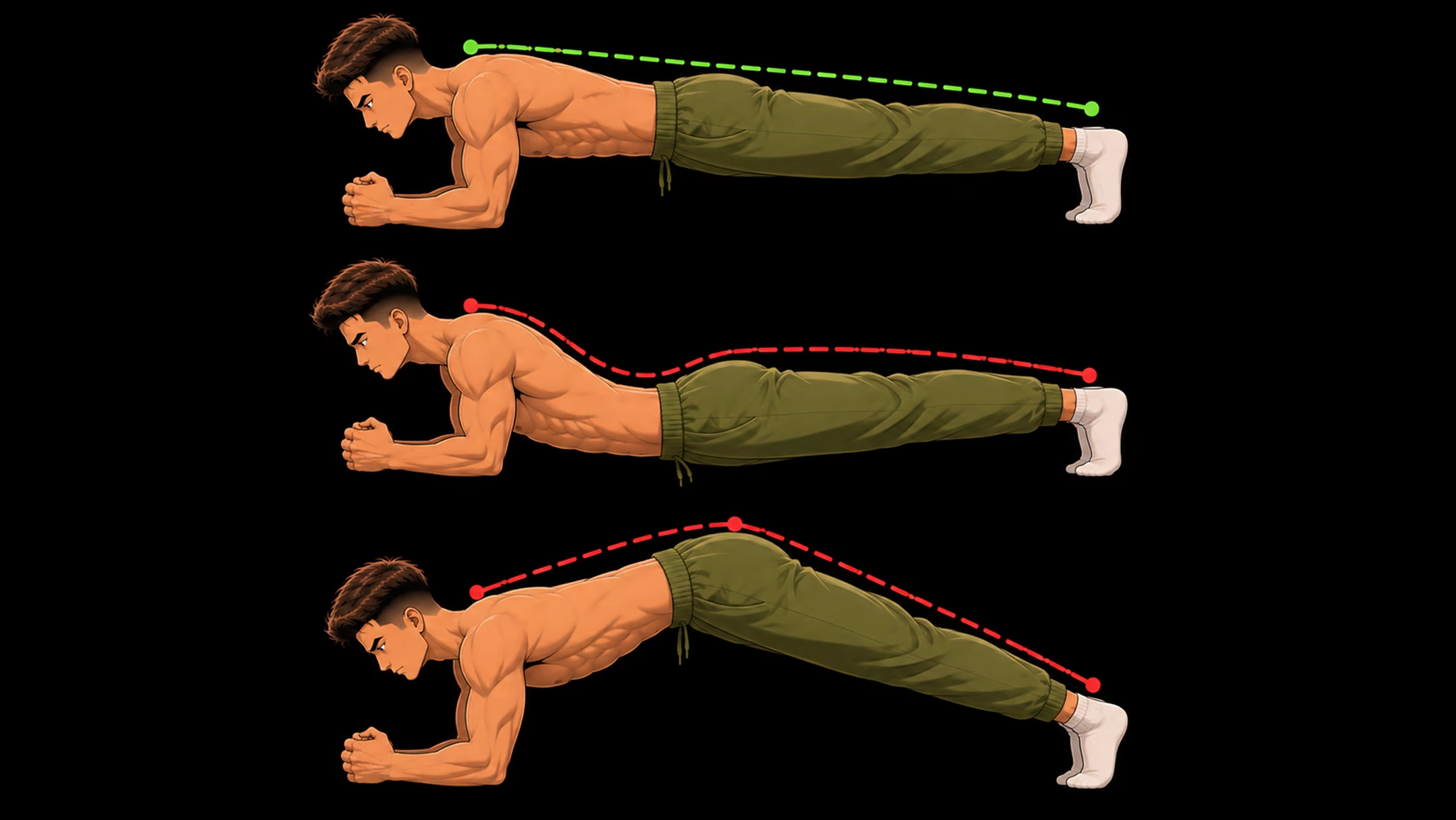
Several things get called a plank without being one. A hold with the hips high is a pike, which shortens the body and takes work away from the trunk. A hold with the lower back dipped is the shape the exercise is meant to resist. A hold where you grip the floor, shrug the shoulders to the ears and stop breathing is an endurance contest in a different position. A hollow body hold and a dead bug are also trunk exercises, but neither is a plank: one is held on your back, and the other moves the limbs while you lie down.
At the root of the core tree
In the CaliStack skill tree, Plank has no parent. It is the root of the core branch, and Hollow Body Hold is its only child. Dead Bug comes next, below Hollow Body Hold, and the branch continues into Mountain Climbers and Leg Raises. Read as a route, that puts a front-support hold before the supine shapes and the dynamic drills. Read as a requirement, it would overstate the case. The tree is a suggested order, not a gate, and the app supplies no sets, hold times or readiness thresholds for any node in it. The published Hollow Body Hold and Dead Bug guides own those movements; this article stays with the plank.
What the record lists for plank
The CaliStack record for Plank lists no additional related movements beyond the main exercise itself. That is not an omission to fill in with guesses. The useful related material is the tree around it: Hollow Body Hold as the child node and Dead Bug as the next step below that. Those are neighbours in a map, not recommendations attached to this record, and they are not compulsory preparation.
Plank, hollow body hold and dead bug compared
| Position | Support | What moves | What it trains |
|---|---|---|---|
| Plank | Forearms or hands, toes or knees | Nothing; one shape is held | Resisting extension of the lower back while breathing |
| Hollow Body Hold | Lying on the back, shoulders and legs lifted | Nothing; a supine shape is held | Keeping ribs and pelvis arranged without arm support |
| Dead Bug | Lying on the back, arms and legs free | One arm and the opposite leg, alternately | Trunk control while the limbs travel |
The plank is the only one of the three where your arms carry part of your weight and your feet are behind you. That single fact changes the demand: the shoulders and wrists join in, the chest has to stay open, and the trunk resists a pull that runs from the feet to the head. A hollow body hold keeps you on your back, where the floor gives you feedback and the arms do no supporting. A dead bug adds movement, but the movement is small and you are still lying down. A long hollow hold does not certify a clean plank, and a quiet dead bug does not either. They are different tasks that share some muscles.
Setting the position, then the range
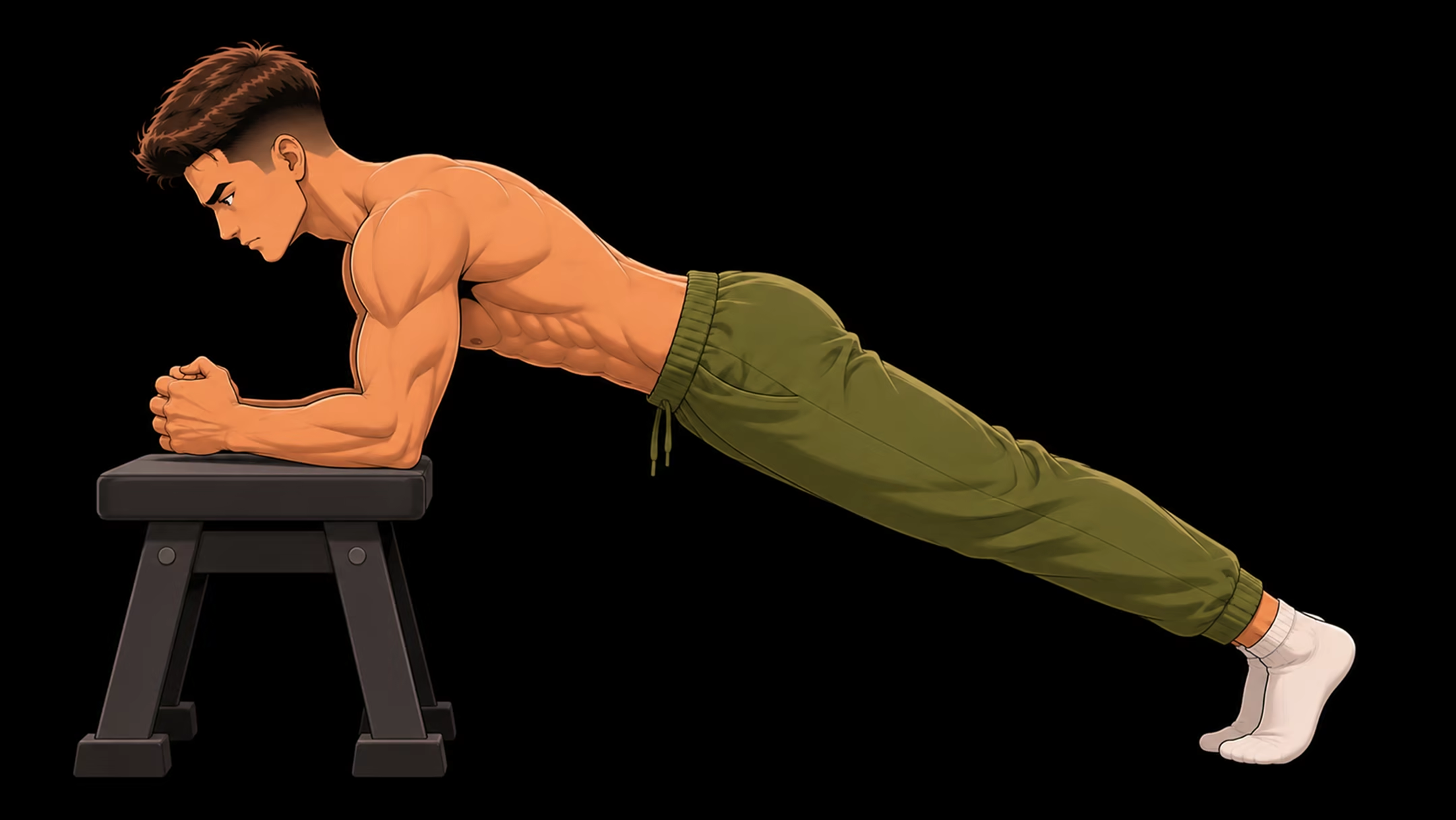
Use a mat or a clear floor, and a bench or box if you want an incline. Check that the surface does not slide. If your wrists complain on flat hands, a forearm plank or a pair of purpose-made handles may suit you better; do not improvise with furniture.
- Place your elbows under your shoulders, forearms flat, or your hands under your shoulders for a high plank.
- Breathe out and let the lower ribs settle toward the hips. Do not force the back flat; find a position you can hold without strain.
- Squeeze the glutes lightly and point the tailbone toward your heels so the pelvis stays level.
- Step the feet back one at a time. Keep the knees down if the hips drop as the legs extend.
- Look at a spot on the floor slightly ahead of your hands, so the neck stays long.
- Breathe in through the nose and out slowly. Say a short sentence out loud to check that you are not holding your breath.
- Lower your knees before the shape changes, not after it has already gone.
The controlled range in a plank is not a distance. It is the band of pelvic positions you can hold without the lower back arching or the hips climbing. For most people that band is narrower than they expect, and it gets narrower as the set goes on. Raising the hands onto a bench reduces the load through the feet and makes the band easier to find. Dropping to the knees shortens the lever and does the same. A knee plank is a plank, not a failed attempt at one, as long as the line from ear to knee stays honest.
A practice example without a target time
One illustration, not a prescription: three to five holds of ten to twenty seconds, with forty-five to sixty seconds of rest between them, twice a week. Choose the version, incline or knees, that lets you keep the shape for the whole hold. These numbers are an example for discussion. No trial has established them as a dose, and the app does not set them. A shorter hold with a level pelvis is more useful than a longer one where the shape has already left.
Research on the plank is mostly test research, and the endpoints are not your training goals. One study of 471 college students timed a forearm plank to technique failure and recorded a mean of about one hundred seconds, with a very wide spread between individuals. That tells you the test is used and that people differ; it does not tell you a target. A smaller study of twelve healthy adults found that unstable plank variations raised measured activity in superficial abdominal and erector spinae muscles, and a study of twenty-one men found that changing the points of support changed shoulder and scapular muscle activity. None of these studies tested whether a longer hold improves a calisthenics skill, and none compared a home practice with a coached one. Treat them as context, not clearance.
Where a plank goes wrong, and what to record
The commonest ending is a slow sag. The ribs drift toward the floor, the lower back arches, and the exercise quietly becomes a different one, with the low back taking a load you meant to avoid. The correction is not to try harder in the same position. End the hold earlier, raise the hands, or drop the knees. A pike is the opposite error: the hips climb, the body shortens, and the hold turns into a rest. If the hips rise as soon as the set begins, the version is too long for the position you can hold.
Two smaller errors are easy to miss. The shoulders can creep ahead of the elbows, which puts the neck and front of the shoulder in a strained position. And the breath can stop, which hides how much effort the hold is costing. Both have the same fix: reset the elbows under the shoulders, let the ribs settle, and say a sentence out loud. If you cannot speak a few words, the hold is already past the point where it is teaching you the shape.
Record the surface, the support, the leg position, the seconds before the first change, and what changed first. An entry such as bench incline, forearms, feet, three holds, hips level for fifteen seconds, ended when the ribs lifted is more useful than a time with no shape attached. Note breathing and how the wrists and shoulders felt the next day. Keep incline, knee and full-floor planks in separate records, because they are different positions and their times are not comparable.
No hold time proves you are ready for the next node. A better signal is that you can find the same shape on several occasions, breathe through it, and repeat it after a rest without hunting for the position. When that is true, change one thing: a slightly longer hold, the hands a little lower, or one leg lifted. Change one variable at a time so the record still means something.
Plank questions
Do I need to hold a plank for a minute?
No. A minute is a common fitness-test duration, not a training standard. End the hold when the hips sag or pike, or when you can no longer breathe evenly.
Is a knee plank a real plank?
Yes. The knees shorten the lever and reduce how much weight the feet carry. Keep the line from ear to knee honest and record it as its own version.
Should my elbows be exactly under my shoulders?
Under the shoulders is the usual reference because it lets you press the forearms down without crowding the neck. If your shoulders or wrists are uncomfortable, try an incline or a high plank instead.
Does the plank train the abs or the shoulders?
Both, along with the rest of the trunk. The shoulders help support you, which is one reason a plank is not simply a hollow body hold performed face down.
Choose one plank version for this week
Pick the version you can hold with a level pelvis and normal breathing, whether that is on a bench, on your knees, or on the floor. Film one short set, note what changed first, and use that note to choose the next session. CaliStack places Plank at the root of the core tree, with Hollow Body Hold below it and Dead Bug below that. Open the three demonstrations and compare them with your clip; the order is a map, not a schedule.
Sources and evidence limits
Source check: . Research context is separate from an individual technique assessment. Sample programs are editorial examples, not validated unlock tests.
Emami and colleagues compared abdominal and lumbar muscle activity during two stabilization exercises. [19]
The comparison of two stabilization tasks does not establish a plank hold time, a regression choice or a skill-transfer benefit.
- [19] Emami F, Pirouzi S and Taghizadeh S. Comparison of Abdominal and Lumbar Muscles Electromyography Activity During Two Types of Stabilization Exercises (2015-04-22).
Publisher article methods and results checked.
Want a clear plan for your next skill?
We built Calistack to show you the exact steps from where you are right now to your first handstand, muscle-up, or lever.