By Calistack Team · Editorial standards: Calistack editorial team · Last updated
The Problem With Learning Calisthenics From Social Media
Social media can introduce useful exercises, but a short clip rarely provides a complete plan for your starting point. Check the equipment, scaling options, and instruction before copying a movement. Keep useful demonstrations, practice a repeatable version, and ask a qualified coach when the setup or technique is unclear.
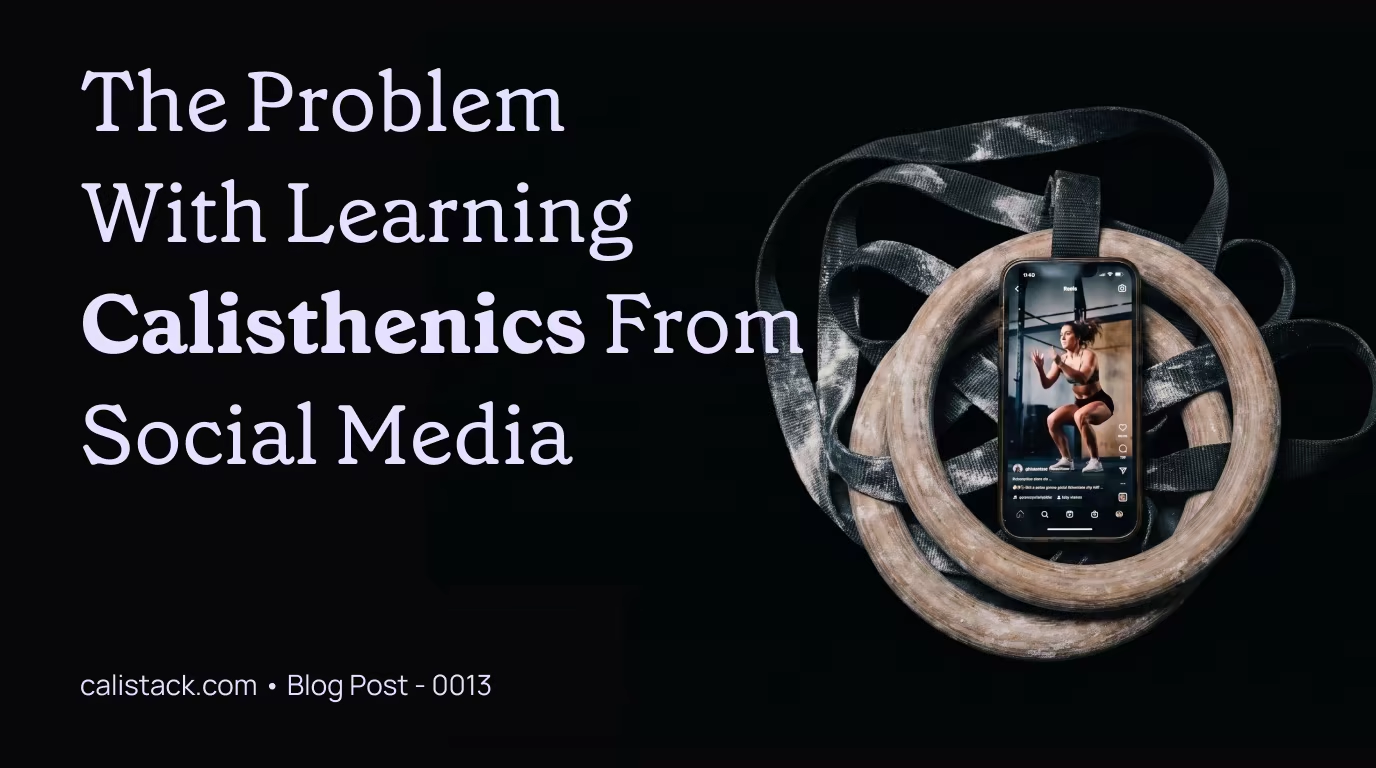
A short video can show an exercise clearly and still leave important questions unanswered. Is the setup secure? Which version matches your ability? How do you get out of the position? Save clips that explain those details, but do not assume that a convincing demonstration is a complete training plan.
Look for the missing context
A clip does not reveal the creator’s whole training history, coaching, or recovery. Do not infer that their learning timeline will also be yours. Before copying a movement, look for a clear setup, an easier option, the intended range, and an explanation of when to stop. For unfamiliar or advanced skills, a qualified coach can provide feedback a prerecorded clip cannot.
Keep recommendations in context
Advice about frequency can sound contradictory because the exercise, effort, experience, and total training differ. Daily easy rehearsal is not the same task as repeated hard attempts. ACSM’s 2026 guidance emphasizes individualization in general resistance training; it does not settle how often every beginner should practice handstands.
Handstand research by Kerwin and Trewartha describes multiple joint contributions to balance. It did not compare online teaching with coaching or establish that one drill prevents injury. Use research to understand the limits of a claim, not to turn a short list of movements into a mandatory ladder.
Turn one useful demonstration into repeatable practice
- Choose one appropriate variation and check the equipment before loading it.
- Use the same setup and comfortable range so you can compare sessions.
- Record the completed work and one technique observation instead of collecting more exercises immediately.
- Review the result before changing one variable; seek coaching when you cannot judge the movement.
Social media can still provide inspiration and useful teaching. You do not need to stop watching it; separate browsing from the decisions you make during practice. Calistack’s progression map is another way to organize those decisions, not evidence that everyone should follow an identical sequence.
Sources and evidence limits
Source check: . Research context is separate from an individual technique assessment. Sample programs are editorial examples, not validated unlock tests.
ACSM’s 2026 guidance emphasizes regular resistance training and individualization. [6]
General healthy-adult guidance does not validate this article’s sample sets, skill order, or readiness tests.
Handstand control involves multiple joint contributions in Kerwin and Trewartha’s analysis. [3]
The study did not compare social media teaching with coaching or measure injury from short videos.
- [6] American College of Sports Medicine. ACSM Publishes Updated Resistance Training Guidelines (2026).
Publisher release excerpt retrieved through search; direct page access was blocked. Not a full review of the Position Stand.
- [3] Kerwin DG and Trewartha G. Strategies for maintaining a handstand in the anterior-posterior direction (2001-07-01).
Abstract retrieved through Europe PMC; not a full-text assessment.
Want a clear plan for your next skill?
We built Calistack to show you the exact steps from where you are right now to your first handstand, muscle-up, or lever.